

Obverse
Description:
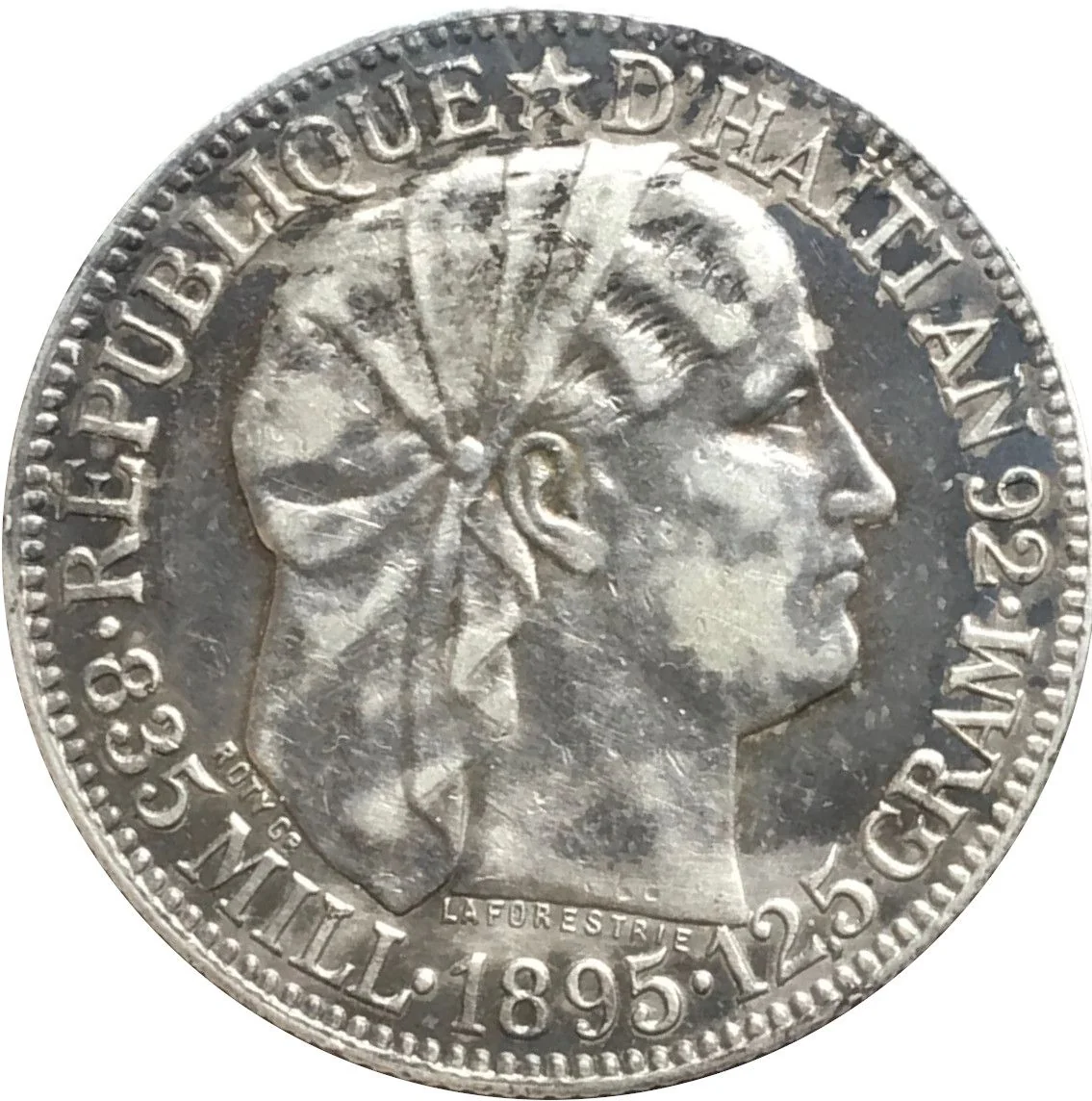
Right-facing bust
Inscription:
.REPUBLIQUE * D'HAÏTI AN 92.
835 MILL.1895.12,5 GRAM.
835 MILL.1895.12,5 GRAM.
Translation:
REPUBLIC * OF HAITI YEAR 92.
835 MILL. 1895. 12.5 GRAM.
835 MILL. 1895. 12.5 GRAM.
Script: Latin
Language: French
Engraver: Louis-Oscar Roty
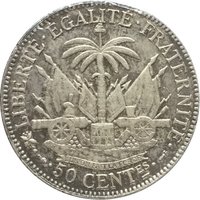
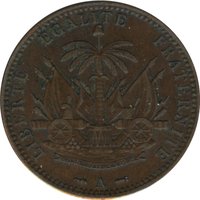
Reverse
Description:
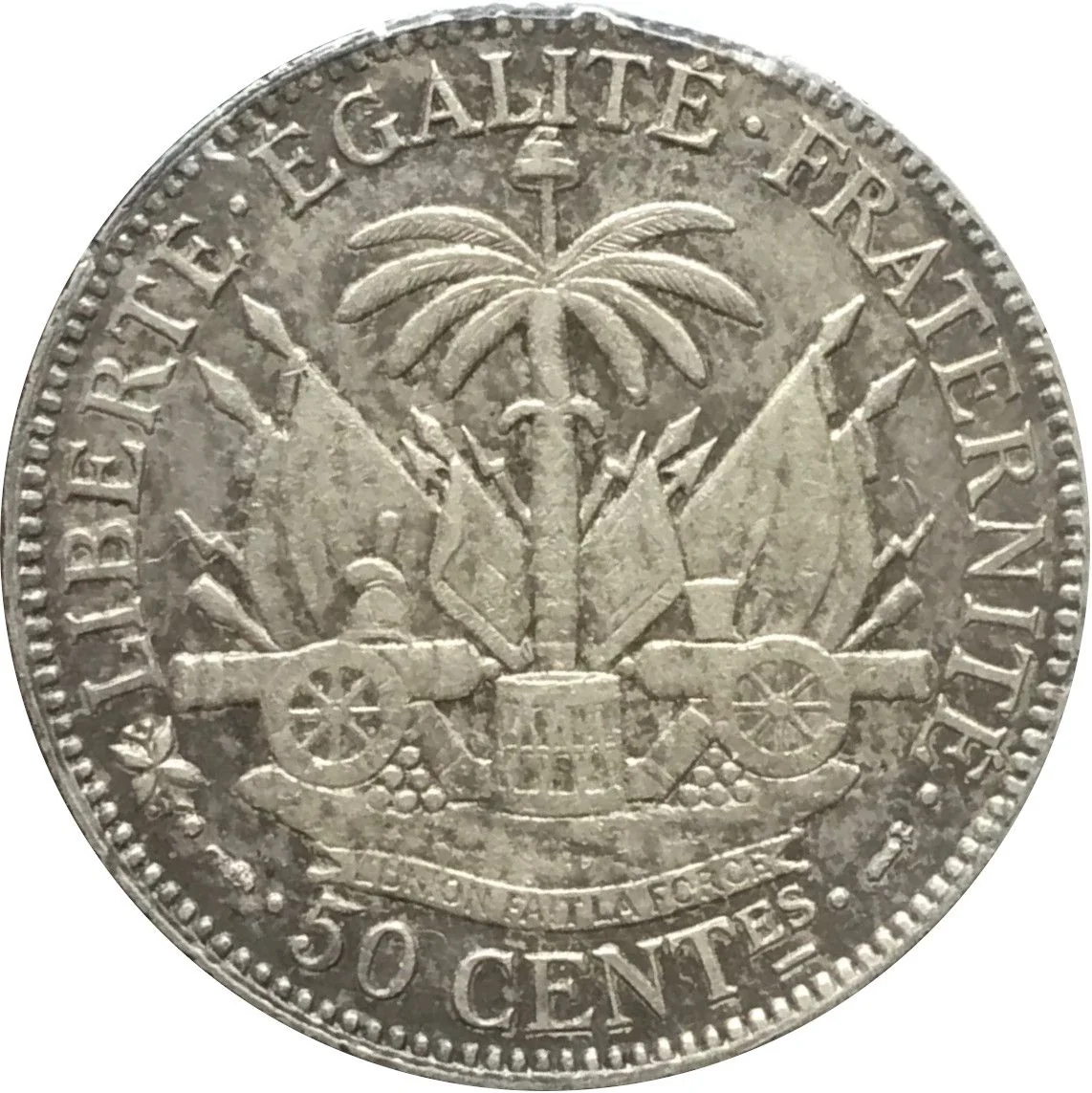
Heraldic emblem
Inscription:
.LIBERTÉ.ÉGALITÉ.FRATERNITÉ.
.50 CENTes.
.50 CENTes.
Translation:
LIBERTY. EQUALITY. FRATERNITY.
50 CENTS.
50 CENTS.
Script: Latin
Language: French
Engraver: Louis-Oscar Roty
Edge
Reeded
Mints
| Name | Mark |
|---|---|
| Monnaie de Paris | — |
Mintings
| Year | Mint Mark | Mintage | Quality | Collection |
|---|---|---|---|---|
| 1882 | — | 440,000 | ||
| 1882 | — | — | Proof | |
| 1883 | — | 400,000 | ||
| 1883 | — | — | Proof | |
| 1887 | — | 250,000 | ||
| 1887 | — | — | Proof | |
| 1890 | — | 100,000 | ||
| 1890 | — | — | Proof | |
| 1895 | — | 900,000 | ||
| 1895 | — | — | Proof |
Historical background
In 1882, Haiti’s currency situation was characterized by profound instability and a complex duality between official and actual value. The official currency was the Haitian gourde, which was pegged to the French franc at a fixed rate of 1 gourde = 5 francs, following the monetary law of 1872. This established a theoretical gold standard, but the reality was starkly different. The government, perpetually strapped for cash due to foreign debt payments and chronic budget deficits, could not back the paper gourdes in circulation with sufficient gold or hard currency reserves. Consequently, the paper gourde traded at a significant and fluctuating discount on the open market, creating a vast gap between the legal parity and its real, depreciated value.
This depreciation was exacerbated by the circulation of a multitude of foreign coins, which were preferred in daily commerce. Particularly dominant was the U.S. gold dollar, alongside British sovereigns, French francs, and Spanish and Mexican pesos. These hard currencies were used for major transactions, international trade, and as a store of value, while the depreciated paper gourde was used for smaller, local exchanges and to pay taxes. This system placed a heavy burden on the rural majority, who were often paid in devalued paper but had to purchase imported goods priced in stable foreign coin, effectively reducing their purchasing power.
The core of the crisis was Haiti's overwhelming foreign debt, much of it owed to French banks. A large portion of the government's revenue was earmarked for servicing this debt, leaving little to support the currency. The situation in 1882 was part of a prolonged period of monetary distress that would lead to further depreciation and, within a few years, the complete abandonment of the gold peg. This unstable currency environment reflected and reinforced Haiti's broader economic fragility and its vulnerable position within the global financial system of the late 19th century.
This depreciation was exacerbated by the circulation of a multitude of foreign coins, which were preferred in daily commerce. Particularly dominant was the U.S. gold dollar, alongside British sovereigns, French francs, and Spanish and Mexican pesos. These hard currencies were used for major transactions, international trade, and as a store of value, while the depreciated paper gourde was used for smaller, local exchanges and to pay taxes. This system placed a heavy burden on the rural majority, who were often paid in devalued paper but had to purchase imported goods priced in stable foreign coin, effectively reducing their purchasing power.
The core of the crisis was Haiti's overwhelming foreign debt, much of it owed to French banks. A large portion of the government's revenue was earmarked for servicing this debt, leaving little to support the currency. The situation in 1882 was part of a prolonged period of monetary distress that would lead to further depreciation and, within a few years, the complete abandonment of the gold peg. This unstable currency environment reflected and reinforced Haiti's broader economic fragility and its vulnerable position within the global financial system of the late 19th century.
🌟 Limited