

50 Cash – Kansu Province
China
Context
Year: 1926
Chinese republican Year: 15
Country: China 
Issuer: Kansu Province
Period:
(1912—1949)
Currency:
(1920—1949)
Demonetized: Yes
Total mintage: 2,564,000
Material
References
Y: #Click to copy to clipboard408
Numista: #276302
Obverse
Description:
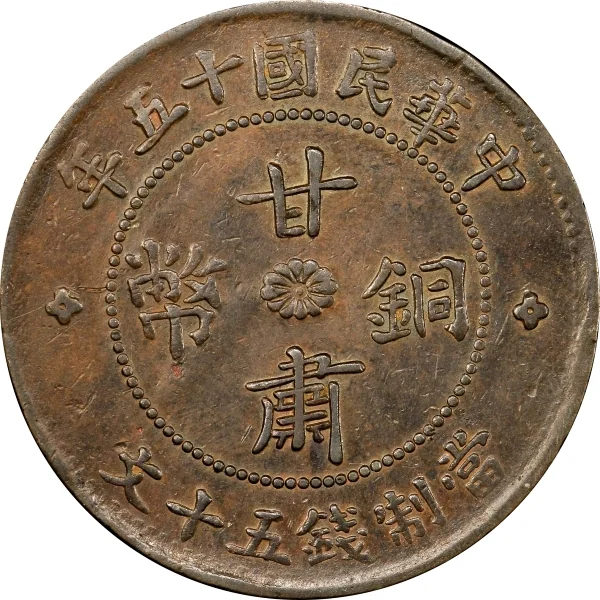
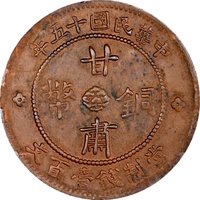
Four Chinese ideograms read vertically, flanking a central flower, all encircled by more text.
Inscription:
年五十國民華中
甘
幣銅
肅
文十五銭制當
甘
幣銅
肅
文十五銭制當
Translation:
FIFTY CASH
REPUBLIC OF CHINA
GANSU
COPPER COIN
FIFTEEN GRAM SYSTEM
REPUBLIC OF CHINA
GANSU
COPPER COIN
FIFTEEN GRAM SYSTEM
Language: Chinese
Reverse
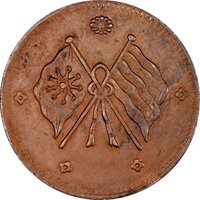
Description:
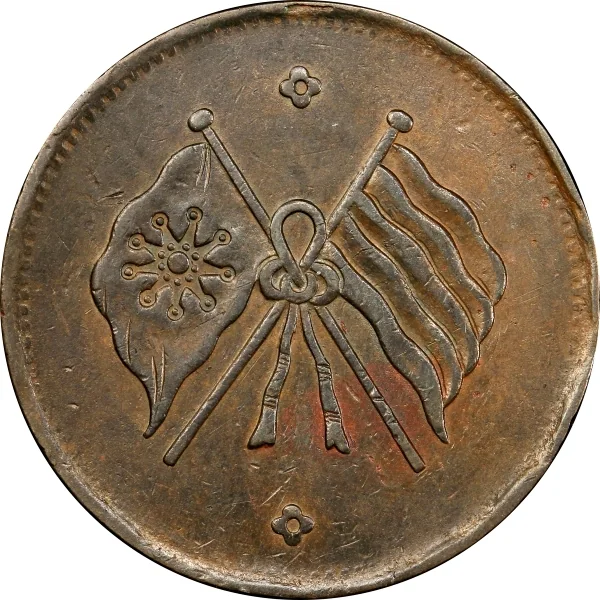
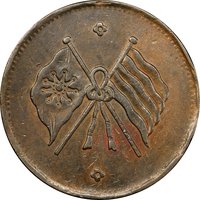
Crossed flags flanked by rosettes.
Edge
Plain
Mintings
| Year | Mint Mark | Mintage | Quality | Collection |
|---|---|---|---|---|
| 1926 | — | 2,564,000 |
Historical background
In 1926, Kansu (modern Gansu) Province was mired in a complex and severe currency crisis, a direct symptom of the wider political fragmentation of the Warlord Era. The province was under the control of local militarists, primarily the Hui Muslim generals of the Ma family clique (Ma Qi and others), who operated with significant autonomy from the nominal central government in Beijing. To finance their armies and administrations, these warlords freely issued their own unbacked paper currency, known as tuchao (local notes). In Kansu, this included notes from various provincial banks, military headquarters, and even commercial establishments coerced into issuing scrip. The result was a chaotic proliferation of currencies of wildly differing values, all subject to rapid depreciation.
The fundamental problem was a complete lack of standardization or convertibility. Notes issued in one district might be worthless or heavily discounted in another, crippling intra-provincial trade. Furthermore, the warlords printed money with abandon to cover deficits, leading to rampant inflation. This hyperinflation devastated the local economy, which was already strained by chronic poverty, periodic famine, and the disruption of traditional trade routes like the Silk Road. Farmers and merchants faced ruin as the value of their cash holdings evaporated, and transactions increasingly reverted to barter or the use of more stable silver sycee (shoe-shaped silver ingots) for significant dealings.
Compounding the chaos was the continued circulation of older monetary forms. While the new tuchao flooded the market, silver coins (like the Mexican "Eagle" dollar or provincial dragon dollars), copper cash coins, and even paper notes from the previous Imperial and early Republican periods still circulated, creating a multi-layered and bewildering monetary environment. The currency situation in 1926 Kansu was, therefore, a state of anarchic pluralism, deliberately fostered by local rulers for short-term gain. It served as a powerful illustration of how warlordism fractured not just China's polity but also its economic foundations, imposing a heavy burden of instability and uncertainty on the population.
The fundamental problem was a complete lack of standardization or convertibility. Notes issued in one district might be worthless or heavily discounted in another, crippling intra-provincial trade. Furthermore, the warlords printed money with abandon to cover deficits, leading to rampant inflation. This hyperinflation devastated the local economy, which was already strained by chronic poverty, periodic famine, and the disruption of traditional trade routes like the Silk Road. Farmers and merchants faced ruin as the value of their cash holdings evaporated, and transactions increasingly reverted to barter or the use of more stable silver sycee (shoe-shaped silver ingots) for significant dealings.
Compounding the chaos was the continued circulation of older monetary forms. While the new tuchao flooded the market, silver coins (like the Mexican "Eagle" dollar or provincial dragon dollars), copper cash coins, and even paper notes from the previous Imperial and early Republican periods still circulated, creating a multi-layered and bewildering monetary environment. The currency situation in 1926 Kansu was, therefore, a state of anarchic pluralism, deliberately fostered by local rulers for short-term gain. It served as a powerful illustration of how warlordism fractured not just China's polity but also its economic foundations, imposing a heavy burden of instability and uncertainty on the population.
✨ Legendary