

1 Jiao – Fukien Province
Circulating commemorative coins
Commemoration: Canton martyrs
China
Context
Year: 1932
Chinese republican Year: 21
Country: China 
Issuer: Fukien Province
Period:
(1912—1949)
Currency:
(1896—1949)
Demonetized: Yes
Material
References
Y: #Click to copy to clipboard390
Numista: #275905
Value
Bullion value: $7.44
Obverse
Description:
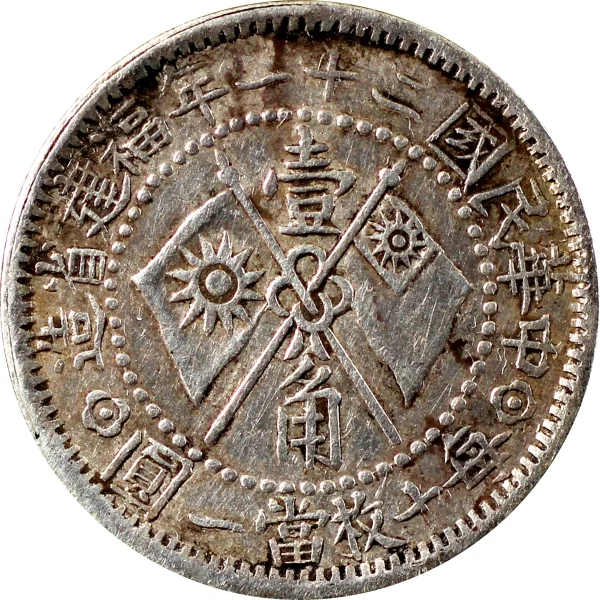
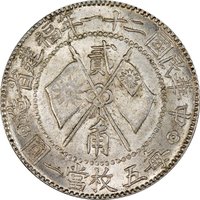
Crossed flags with values above and below, encircled by Chinese characters.
Inscription:
造省建福年一十二國民華中
壹
角
圓一當枚十每
壹
角
圓一當枚十每
Translation:
Made in the 12th year of the Republic of China, Fujian Province
One
Jiao
Each ten pieces equal one yuan
One
Jiao
Each ten pieces equal one yuan
Scripts: Chinese (traditional, regular script)
Language: Chinese
Reverse
Description:
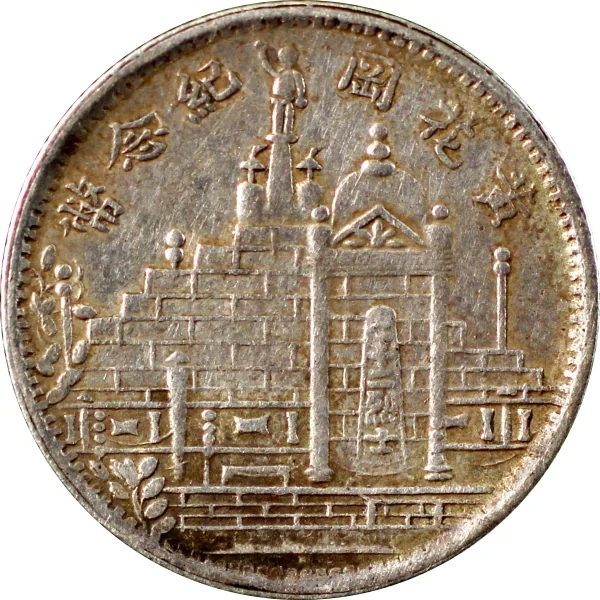
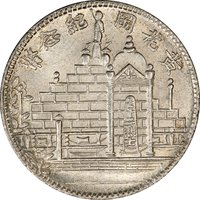
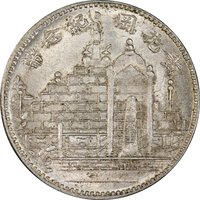
Huanghuagang Mausoleum, topped with a statue and inscribed with Chinese characters on its shrine.
Inscription:
幣念紀岡花黄
七
十
二
烈
士
七
十
二
烈
士
Translation:
In Commemoration of the Huanghuagang Seventy-Two Martyrs
Scripts: Chinese (traditional, regular script)
Language: Chinese
Edge
Reeded.
Mintings
| Year | Mint Mark | Mintage | Quality | Collection |
|---|---|---|---|---|
| 1932 | — | — |
Historical background
In 1932, Fukien (Fujian) Province was caught in a complex and unstable currency situation, typical of China's "warlord era" and the period before the Nationalist government's full monetary consolidation. The province did not have a unified currency. The official currency, the Nationalist government's Fabi (Legal Tender), circulated but competed with a multitude of older, regional issues. These included silver dollars from various Chinese mints, foreign silver coins (notably Mexican "Eagle" dollars), and a flood of banknotes issued by local Fukienese banks, native banks (qianzhuang), and even large merchants. This created a chaotic environment where exchange rates fluctuated locally, and the value and acceptance of any note depended heavily on the reputation of the issuing institution.
The situation was further complicated by the lingering influence of the Fukien People's Government, a short-lived rebel administration established in Fuzhou in November 1933. Although its major currency reforms occurred after 1932, its planning and the political instability it represented in the preceding year disrupted normal financial operations. More directly, the province's extensive coastal trade meant that foreign currencies, particularly the Hong Kong dollar and Japanese yen, were also prevalent in port cities like Xiamen and Fuzhou, used for larger commercial transactions. This external influence underscored the weak control of central monetary authority.
Consequently, the monetary landscape in 1932 Fukien was one of fragmentation and uncertainty. Transactions often required expert knowledge to assess the quality of silver or the credibility of a banknote. This chaos hindered provincial commerce, facilitated smuggling, and reflected the broader political disunity of China. It was a system vulnerable to manipulation by local military authorities and economic shocks, awaiting the forced standardization that would gradually come later in the decade under the Nanjing government's policies.
The situation was further complicated by the lingering influence of the Fukien People's Government, a short-lived rebel administration established in Fuzhou in November 1933. Although its major currency reforms occurred after 1932, its planning and the political instability it represented in the preceding year disrupted normal financial operations. More directly, the province's extensive coastal trade meant that foreign currencies, particularly the Hong Kong dollar and Japanese yen, were also prevalent in port cities like Xiamen and Fuzhou, used for larger commercial transactions. This external influence underscored the weak control of central monetary authority.
Consequently, the monetary landscape in 1932 Fukien was one of fragmentation and uncertainty. Transactions often required expert knowledge to assess the quality of silver or the credibility of a banknote. This chaos hindered provincial commerce, facilitated smuggling, and reflected the broader political disunity of China. It was a system vulnerable to manipulation by local military authorities and economic shocks, awaiting the forced standardization that would gradually come later in the decade under the Nanjing government's policies.
✨ Legendary