

5 fen – Suiyuan Province
Add to wishlist
China
Context
Year: 1949
Chinese republican Year:: 38
Country: China
Issuer: Suiyuan Province
Period:
(1928—1949)
Currency:
(since 1949)
Demonetized: Yes
Material
References
KM: #
Numista: #275274
Obverse
Description:
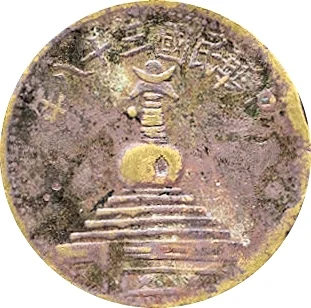
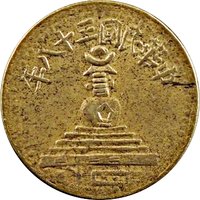
White tower with Chinese characters above.
Inscription:
年八十三國民華中
Translation:
Eighty-three years of the Republic of China
Language: Chinese
Reverse
Description:
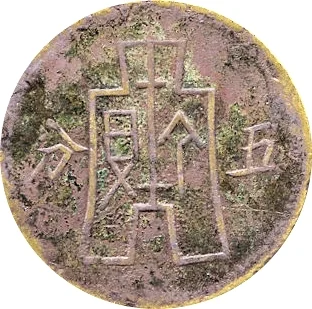
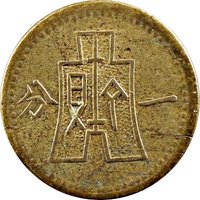
Ancient Chinese spade coin with one character per side.
Inscription:
分一
貝齊
貝齊
Translation:
Qi of Bei, One Fen.
Language: Classical Chinese
Edge
Categories
| Building> Tower |
| Currency> Coin depiction |
Mintings
| Year | Mint Mark | Mintage | Quality | Collection |
|---|---|---|---|---|
| 1949 | — | — |
Historical background
In early 1949, Suiyuan Province found itself in a state of monetary chaos and hyperinflation, a direct legacy of the protracted Chinese Civil War. The region was nominally under the control of the Nationalist (Kuomintang) government, whose national currency, the Gold Yuan, had catastrophically collapsed. Issued in 1948 to replace the defunct Fabi, the Gold Yuan depreciated at a staggering rate, rendering it nearly worthless by the spring of 1949. This created a vacuum where daily commerce seized up, salaries became meaningless, and the provincial economy reverted to barter or reliance on more stable foreign currencies and precious metals.
The situation was further complicated by Suiyuan's unique political-military status. Following the Communist victory in the Pingjin Campaign, the Nationalist forces in Suiyuan, led by General Dong Qiwu, were isolated. While negotiating a peaceful settlement with the People's Liberation Army, the province existed in a tense limbo. During this interim period, local authorities and merchants resorted to issuing various forms of makeshift scrip and promissory notes to facilitate basic transactions. Simultaneously, the silver Yuan dollar and physical goods like grain and cloth became de facto currencies, as the populace utterly rejected the discredited Nationalist paper money.
This monetary anarchy was decisively resolved with the "Peaceful Liberation" of Suiyuan in September 1949. Following the formal incorporation of the province into the People's Republic of China, the new central government moved swiftly to impose financial order. The People's Bank of China began circulating the new national currency, the Renminbi (or "People's Currency"), and initiated a process of unifying the monetary system. By the end of the year, the old Gold Yuan, local scrip, and various commodity currencies were being replaced, integrating Suiyuan's economy into the nascent socialist financial structure and ending the province's period of severe currency crisis.
The situation was further complicated by Suiyuan's unique political-military status. Following the Communist victory in the Pingjin Campaign, the Nationalist forces in Suiyuan, led by General Dong Qiwu, were isolated. While negotiating a peaceful settlement with the People's Liberation Army, the province existed in a tense limbo. During this interim period, local authorities and merchants resorted to issuing various forms of makeshift scrip and promissory notes to facilitate basic transactions. Simultaneously, the silver Yuan dollar and physical goods like grain and cloth became de facto currencies, as the populace utterly rejected the discredited Nationalist paper money.
This monetary anarchy was decisively resolved with the "Peaceful Liberation" of Suiyuan in September 1949. Following the formal incorporation of the province into the People's Republic of China, the new central government moved swiftly to impose financial order. The People's Bank of China began circulating the new national currency, the Renminbi (or "People's Currency"), and initiated a process of unifying the monetary system. By the end of the year, the old Gold Yuan, local scrip, and various commodity currencies were being replaced, integrating Suiyuan's economy into the nascent socialist financial structure and ending the province's period of severe currency crisis.
✨ Legendary