

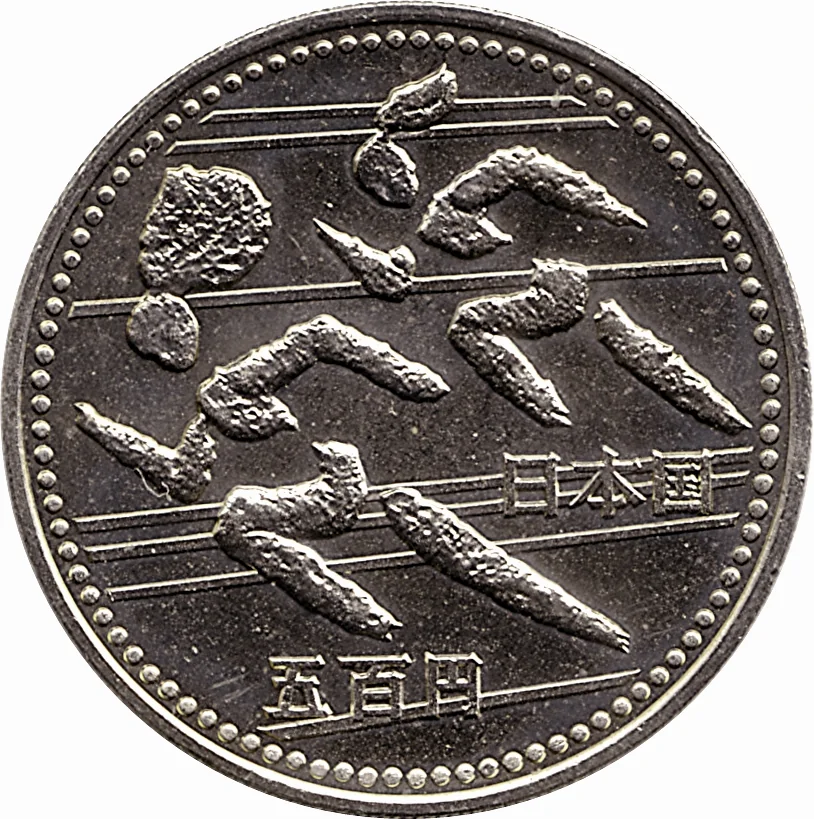
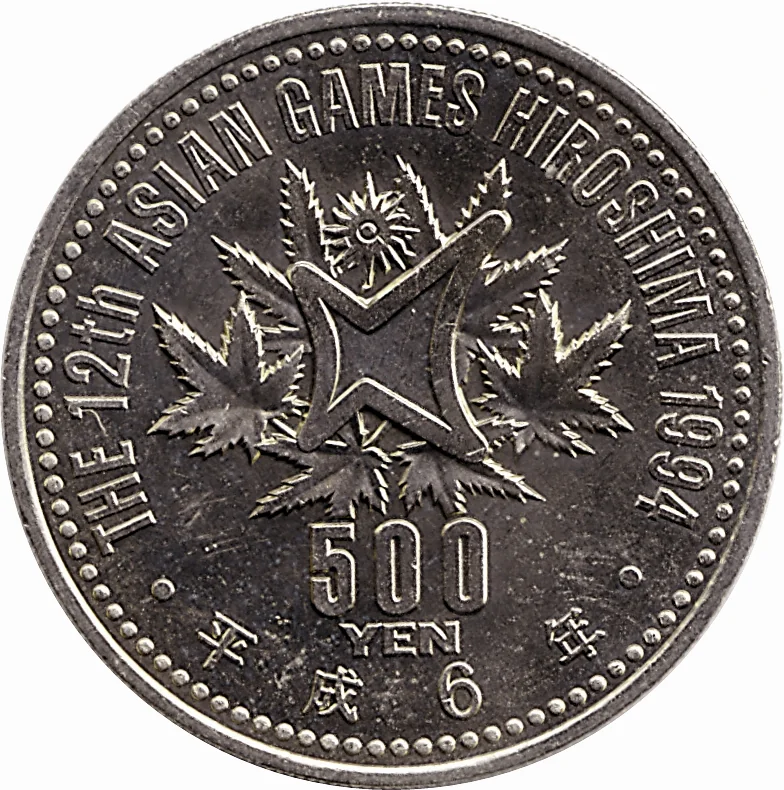
500 Yen – Japan
Circulating commemorative coins
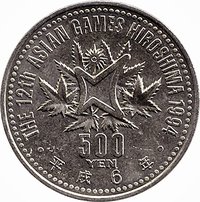
Commemoration: 1994 Asian Games, Hiroshima
Japan
Context
Year: 1994
Japanese - Heisei era Year: 6
Issuer: Japan 
Ruler: Heisei
Currency:
(since 1871)
Total mintage: 10,000,000
Material
References
Y: #Click to copy to clipboard111
Numista: #10964
Value
Exchange value: 500 JPY = $3.20
Inflation-adjusted value: 570.45 JPY
Obverse
Reverse
Edge
Reeded
Categories
| Sport> Asian Games |
| Sport> Athletics |
Mintings
| Year | Mint Mark | Mintage | Quality | Collection |
|---|---|---|---|---|
| 1994 | — | 9,900,000 | ||
| 1994 | — | 100,000 | Proof |
Historical background
In 1994, Japan was in the midst of a prolonged economic stagnation following the collapse of its asset price bubble in the early 1990s, a period that would later be termed the "Lost Decade." The currency situation was characterized by a significantly strong yen, known as "endaka." This strength was driven not by robust domestic economic health, but by Japan's persistent trade surpluses and the country's status as the world's largest creditor nation, which created constant overseas demand for yen. Furthermore, the yen appreciated sharply against the US dollar in the preceding years, peaking at an unprecedented 79 yen to the dollar in April 1995, a trend already firmly in motion by 1994.
Domestically, the strong yen presented a severe challenge to Japan's export-driven economy. Major industries like automobiles and electronics saw their overseas profits erode when converted back to yen, threatening corporate competitiveness and employment. In response, the Bank of Japan (BOJ) maintained an extremely accommodative monetary policy, having already cut the official discount rate to a historic low of 1.0% in 1993. The government and the BOJ were thus caught in a difficult position: needing low interest rates to stimulate the faltering domestic economy, yet seeing those low rates contribute to the yen's strength by making yen-denominated assets less attractive.
Internationally, 1994 was a year of significant policy divergence, particularly with the United States. The U.S. Federal Reserve began a series of aggressive interest rate hikes in February 1994 to preempt inflation, widening the interest rate differential with Japan. This dynamic typically would weaken the yen, but the currency's strength persisted due to structural factors, leading to periods of intense and costly intervention by the Japanese Ministry of Finance to sell yen and buy dollars. Consequently, 1994 set the stage for the extreme volatility that would follow, culminating in the yen's dramatic peak in 1995 and subsequent coordinated G7 intervention to stabilize the currency markets.
Domestically, the strong yen presented a severe challenge to Japan's export-driven economy. Major industries like automobiles and electronics saw their overseas profits erode when converted back to yen, threatening corporate competitiveness and employment. In response, the Bank of Japan (BOJ) maintained an extremely accommodative monetary policy, having already cut the official discount rate to a historic low of 1.0% in 1993. The government and the BOJ were thus caught in a difficult position: needing low interest rates to stimulate the faltering domestic economy, yet seeing those low rates contribute to the yen's strength by making yen-denominated assets less attractive.
Internationally, 1994 was a year of significant policy divergence, particularly with the United States. The U.S. Federal Reserve began a series of aggressive interest rate hikes in February 1994 to preempt inflation, widening the interest rate differential with Japan. This dynamic typically would weaken the yen, but the currency's strength persisted due to structural factors, leading to periods of intense and costly intervention by the Japanese Ministry of Finance to sell yen and buy dollars. Consequently, 1994 set the stage for the extreme volatility that would follow, culminating in the yen's dramatic peak in 1995 and subsequent coordinated G7 intervention to stabilize the currency markets.
🌟 Limited