

500 Yen (Retrocession of Okinawa) – Japan
Circulating commemorative coins
Commemoration: 20th Anniversary of the Retrocession of Okinawa
Japan
Context
Year: 1992
Japanese - Heisei era Year: 4
Issuer: Japan 
Ruler: Heisei
Currency:
(since 1871)
Total mintage: 20,000,000
Material
References
Y: #Click to copy to clipboard106
Numista: #10963
Value
Exchange value: 500 JPY = $3.20
Inflation-adjusted value: 587.63 JPY
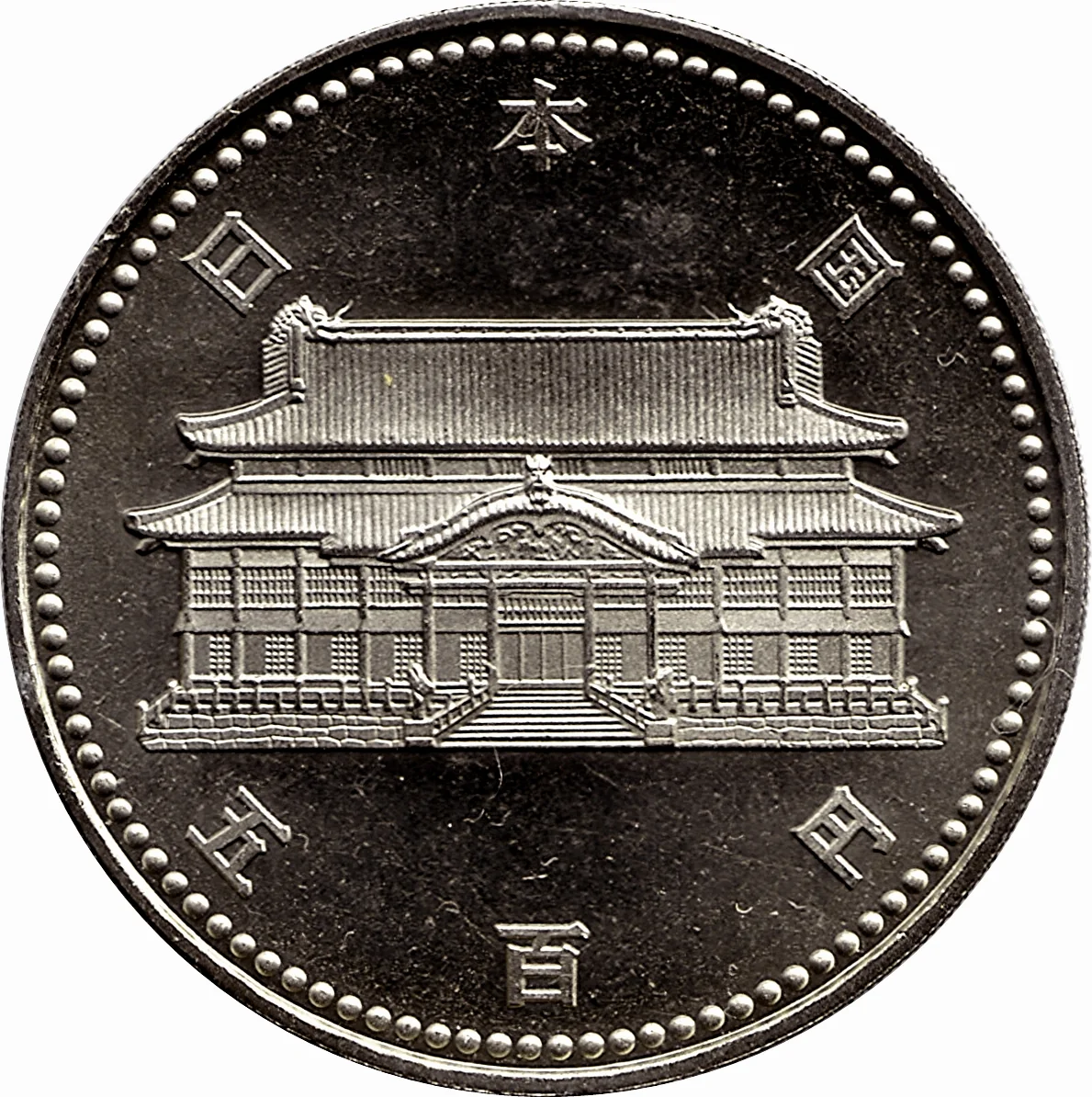
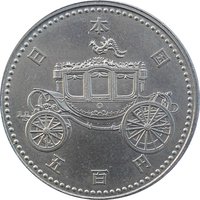
Obverse
Description:
Authority above, value below.
Inscription:
日 本 国
五 百 円
五 百 円
Translation:
Japan
500 Yen
500 Yen
Language: Japanese
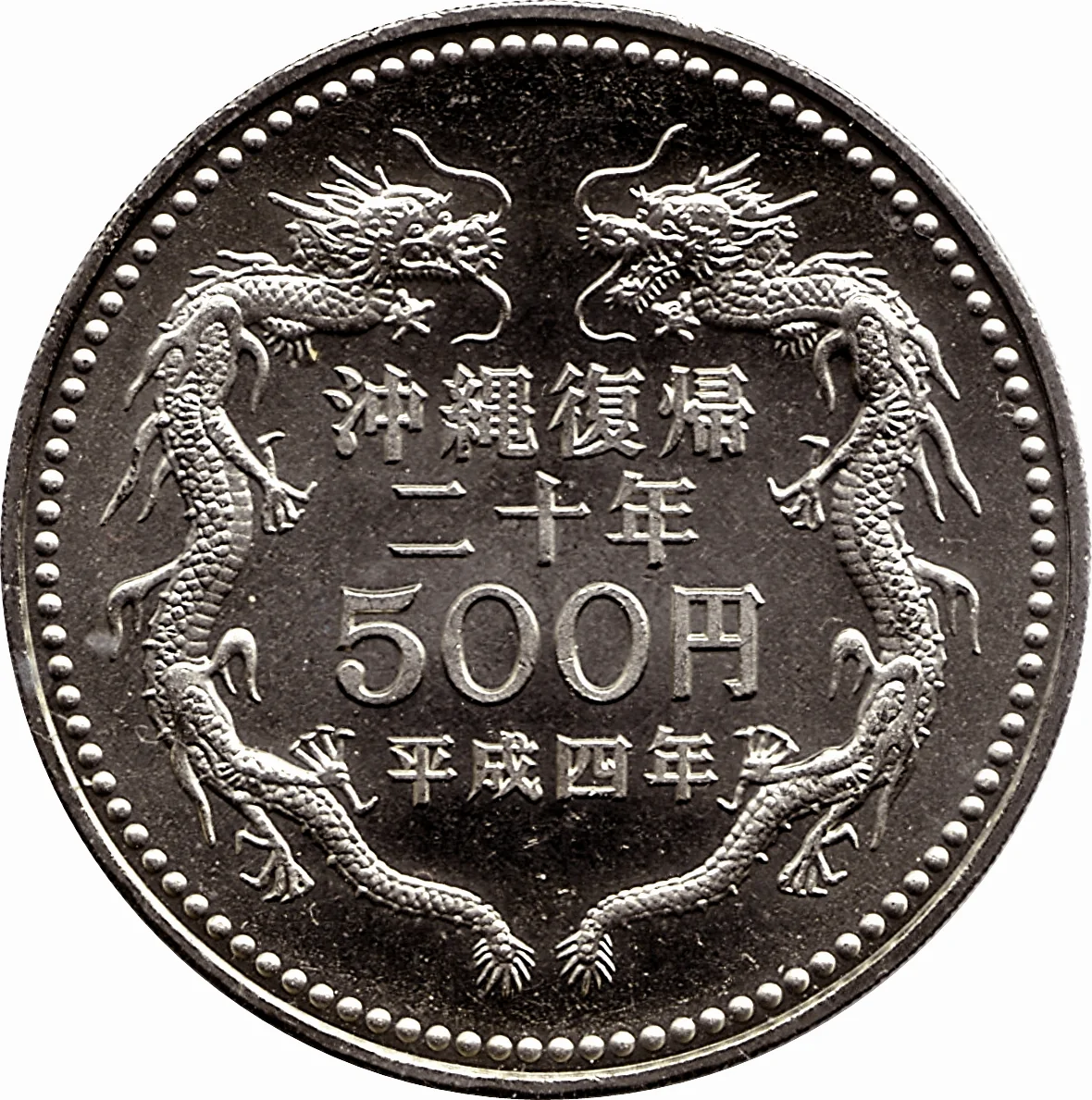
Reverse
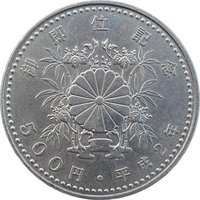
Description:
Two dragons flanking text, value, and date.
Inscription:
沖縄復帰
二十年
500 円
平成四年
二十年
500 円
平成四年
Translation:
Return of Okinawa to Japan
Twentieth Year
500 Yen
Heisei 4
Twentieth Year
500 Yen
Heisei 4
Language: Japanese
Categories
| Mythology> Fantastic animal |
| Building> Castle or fortification |
Mintings
| Year | Mint Mark | Mintage | Quality | Collection |
|---|---|---|---|---|
| 1992 | — | 19,950,000 | ||
| 1992 | — | 50,000 | Proof |
Historical background
In 1992, Japan found itself mired in the early stages of the "Lost Decade," a period of profound economic stagnation triggered by the collapse of its massive asset price bubble. The currency situation was directly shaped by this crisis. Following the 1985 Plaza Accord, which had sharply appreciated the yen to address US trade deficits, the Bank of Japan (BOJ) had slashed interest rates to historic lows to cushion the domestic economy. This easy money policy had fueled rampant speculation in real estate and stocks. By 1992, with asset prices collapsing and banks saddled with non-performing loans, the priority was financial stability and stimulating growth, not currency strength.
Consequently, the yen entered a period of managed weakness against the US dollar throughout much of the year. From a high near ¥125 to the dollar in early 1990, the yen had depreciated to around ¥130-135 by mid-1992. This depreciation was tacitly accepted, and at times encouraged, by Japanese authorities as a tool to support struggling exporters by making their goods cheaper overseas. The BOJ maintained an ultra-low interest rate policy, cutting the official discount rate to 3.25% in July, which widened the interest rate differential with the United States and further pressured the yen downward.
However, this dynamic was not absolute. The yen remained susceptible to sharp swings based on external factors, particularly US trade policy and market interventions. American officials still viewed Japan's large trade surplus as a problem, leading to persistent "yen appreciation pressure" through diplomatic channels. Thus, the currency situation in 1992 was one of controlled depreciation within a volatile range, caught between the domestic imperative to fight a deflationary bust and international pressures to correct trade imbalances, setting the stage for the prolonged economic malaise to come.
Consequently, the yen entered a period of managed weakness against the US dollar throughout much of the year. From a high near ¥125 to the dollar in early 1990, the yen had depreciated to around ¥130-135 by mid-1992. This depreciation was tacitly accepted, and at times encouraged, by Japanese authorities as a tool to support struggling exporters by making their goods cheaper overseas. The BOJ maintained an ultra-low interest rate policy, cutting the official discount rate to 3.25% in July, which widened the interest rate differential with the United States and further pressured the yen downward.
However, this dynamic was not absolute. The yen remained susceptible to sharp swings based on external factors, particularly US trade policy and market interventions. American officials still viewed Japan's large trade surplus as a problem, leading to persistent "yen appreciation pressure" through diplomatic channels. Thus, the currency situation in 1992 was one of controlled depreciation within a volatile range, caught between the domestic imperative to fight a deflationary bust and international pressures to correct trade imbalances, setting the stage for the prolonged economic malaise to come.
🌟 Uncommon