

500 yen – Japan
Add to wishlist
Circulating commemorative coins
Commemoration: Opening of the Seto Bridge
Japan
Context
Year: 1988
Japanese - Shōwa era Year:: 63
Issuer: Japan
Ruler: Shōwa
Currency:
(since 1871)
Total mintage: 20,000,000
Material
References
Y: #
Numista: #10961
Value
Exchange value: 500 JPY
Inflation-adjusted value: 643.96 JPY
Obverse
Description:
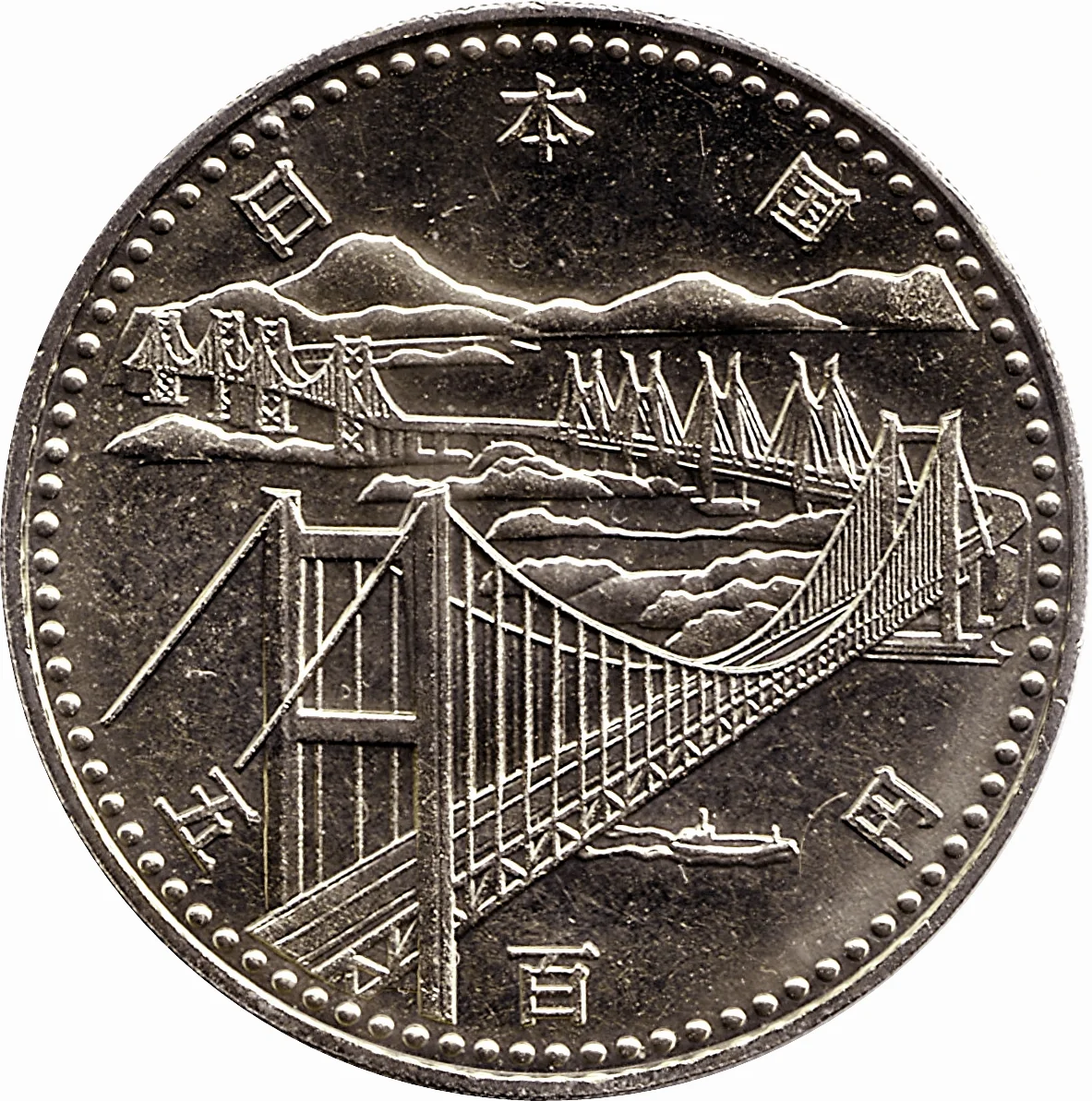
Seto Bridge: authority above, value below.
Inscription:
日 本 国
五 百 円
五 百 円
Translation:
Japan
Five Hundred Yen
Five Hundred Yen
Language: Japanese
Reverse
Description:
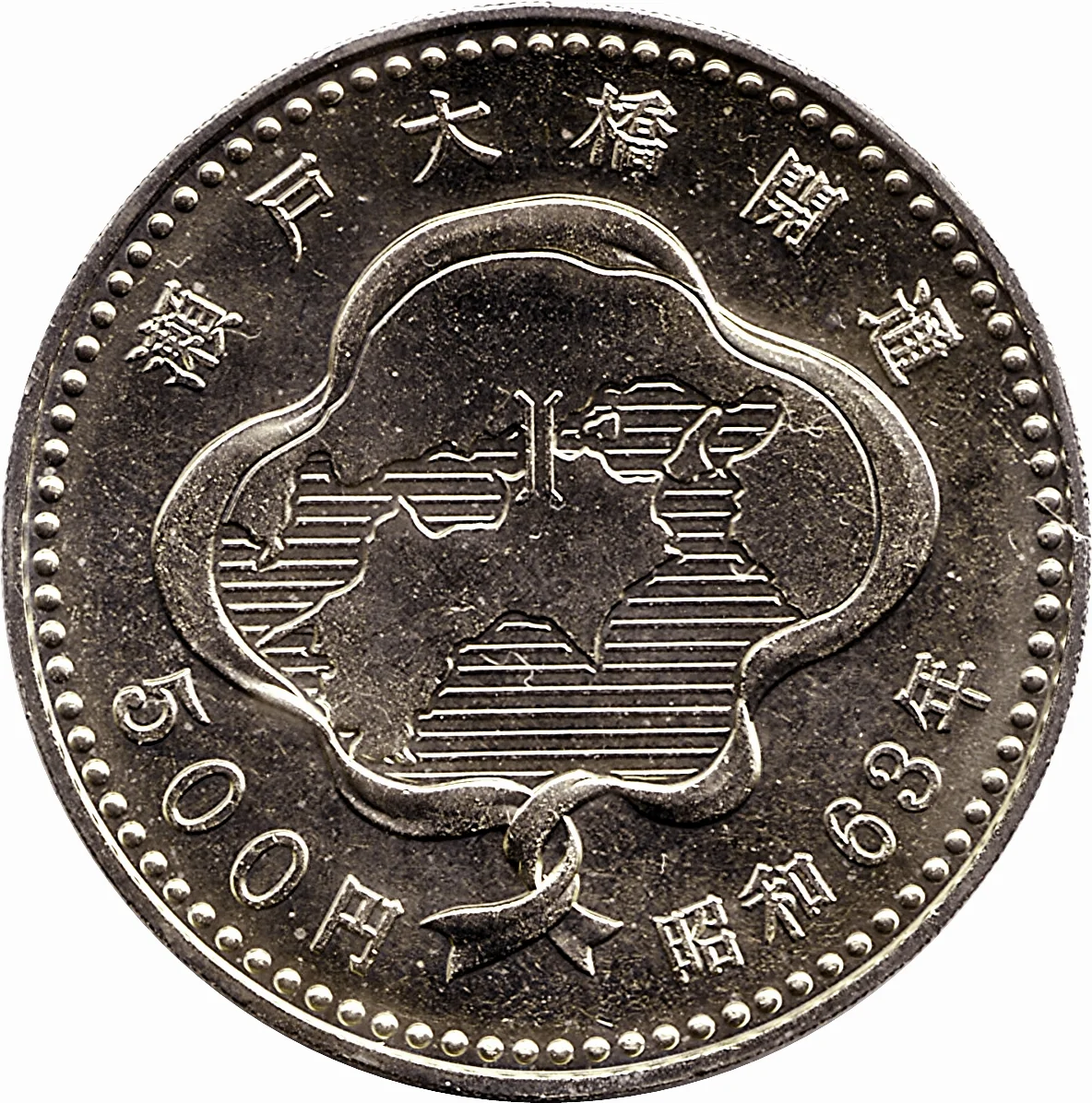
Honshu in a ribbon, legends encircling.
Inscription:
瀬 戸 大 橋 開 通
500円 昭和63年
500円 昭和63年
Translation:
Seto Ohashi Opening
500 Yen, Showa 63
500 Yen, Showa 63
Language: Japanese
Edge
Reeded with text
Legend:
SETO BRIDGE '88 ◆ 88, ƎפpIɹq O┴ƎS ◆
Translation:
SETO BRIDGE '88 ◆ 88, BRIDGE SETO ◆
Language: English
Mintings
| Year | Mint Mark | Mintage | Quality | Collection |
|---|---|---|---|---|
| 1988 | — | 20,000,000 |
Historical background
In 1988, Japan's currency situation was dominated by the dramatic appreciation of the yen following the Plaza Accord of 1985. The agreement, designed to correct global trade imbalances, saw major economies intervene to weaken the US dollar. This led to the yen's value soaring from around 240 yen to the dollar in 1985 to approximately 128 yen by the end of 1988. This sharp endaka (high yen) presented a dual challenge: it severely squeezed the profitability of Japan's export-driven industries like automobiles and electronics, while simultaneously increasing the purchasing power of Japanese corporations and individuals abroad.
Domestically, the strong yen contributed to the speculative excesses of the "bubble economy." To counteract the deflationary pressure of the high yen and a recession in 1986, the Bank of Japan implemented an extended period of extremely low interest rates. This cheap money, combined with corporate profits from earlier exports, flooded into domestic asset markets, inflating massive bubbles in real estate and stock prices. The currency's strength also fueled a wave of overseas investment and acquisitions, as Japanese entities found foreign assets and companies suddenly more affordable, leading to high-profile purchases of iconic foreign properties.
By 1988, policymakers faced a complex dilemma. The yen's strength was a testament to Japan's economic might but threatened its industrial core. The government and the Bank of Japan were attempting a delicate balancing act: managing the yen's volatility through occasional intervention while cautiously tightening monetary policy to address the domestic asset bubble, without triggering a further yen appreciation that would harm exports. The currency situation was thus a central and precarious element of the late-1980s bubble, embedding vulnerabilities that would culminate in its collapse in the early 1990s.
Domestically, the strong yen contributed to the speculative excesses of the "bubble economy." To counteract the deflationary pressure of the high yen and a recession in 1986, the Bank of Japan implemented an extended period of extremely low interest rates. This cheap money, combined with corporate profits from earlier exports, flooded into domestic asset markets, inflating massive bubbles in real estate and stock prices. The currency's strength also fueled a wave of overseas investment and acquisitions, as Japanese entities found foreign assets and companies suddenly more affordable, leading to high-profile purchases of iconic foreign properties.
By 1988, policymakers faced a complex dilemma. The yen's strength was a testament to Japan's economic might but threatened its industrial core. The government and the Bank of Japan were attempting a delicate balancing act: managing the yen's volatility through occasional intervention while cautiously tightening monetary policy to address the domestic asset bubble, without triggering a further yen appreciation that would harm exports. The currency situation was thus a central and precarious element of the late-1980s bubble, embedding vulnerabilities that would culminate in its collapse in the early 1990s.
🌟 Uncommon