

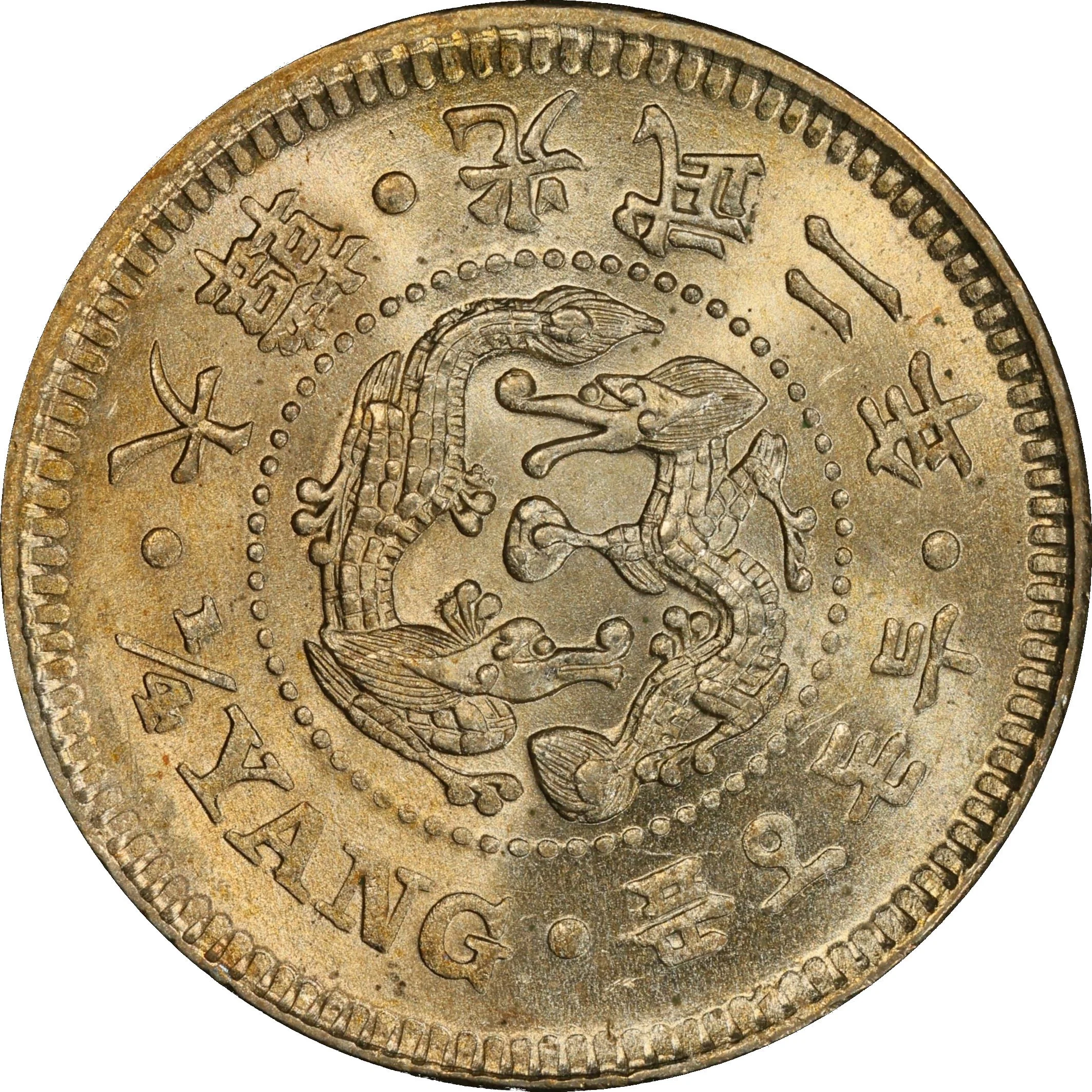
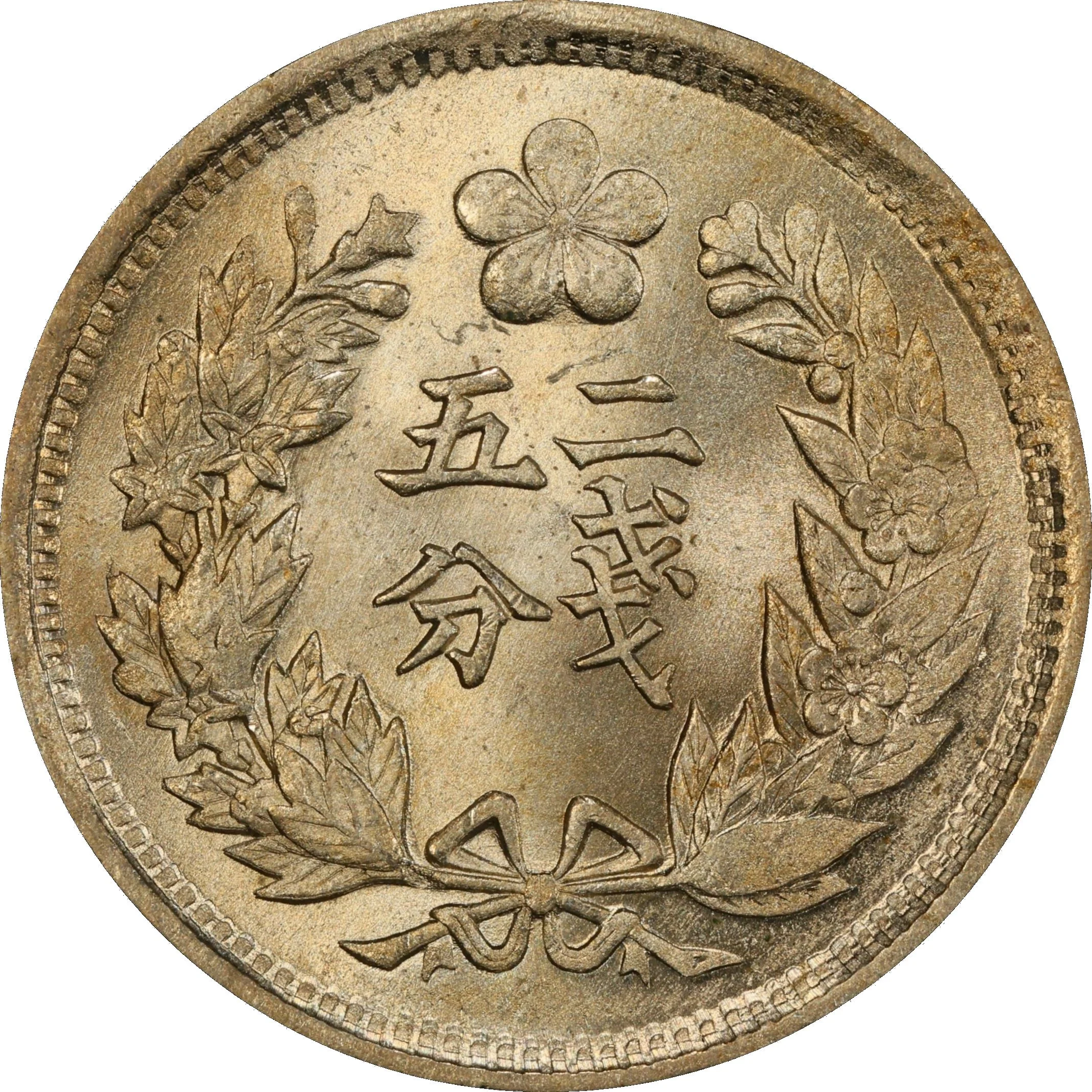
2 chon 5 fun – Korean Empire
Add to wishlist
Context
Years: 1897–1901
Country: Korea
Issuer: Korean Empire
Currency:
(1897—1902)
Subdivision: 2 chon 5 fun = ¼ Yang
Demonetization: 31 December 1909
Material
Diameter: 20.7 mm
Weight: 4.8 g
Thickness: 2 mm
Shape: Round
Composition: Copper-nickel
Technique: Milled
References
KM: #
Numista: #24480
Obverse
Reverse
Description:
Denomination encircled by Rose of Sharon (left) and plum (right), with the Plum Blossom (Imperial Seal) above.
Inscription:
五二
分戔
分戔
Translation:
Fifty-two
Cents
Cents
Language: Classical Chinese
Edge
Plain
Categories
| Mythology> Fantastic animal |
| Plants> Flower |
| Symbols> Coat of Arms |
| Symbol> Wreath |
Mintings
| Year | Mint Mark | Mintage | Quality | Collection |
|---|---|---|---|---|
| 1897 | — | — | ||
| 1898 | — | — | ||
| 1899 | — | — | ||
| 1900 | — | — | ||
| 1901 | — | — |
Historical background
The Korean Empire, proclaimed in 1897, inherited a complex and unstable monetary system from the preceding Joseon dynasty. The economy operated on a bimetallic system of copper yeopjeon (cash coins) and silver yang (taels), but the circulation was chaotic. A severe debasement of copper coinage in the late 19th century, intended to address royal fiscal shortfalls, had triggered rampant inflation and a loss of public trust. Furthermore, foreign currencies, particularly the Mexican silver dollar (and its Japanese Yen equivalent), circulated widely in open ports, undermining national monetary sovereignty and creating a dual economy where domestic coins were increasingly shunned for foreign silver.
Emperor Gojong's government recognized that a modern, unified currency was essential for asserting independence and stabilizing the economy. In 1901, with technical assistance from German mints, the Empire introduced a new decimalized currency system based on the won (divided into 100 jeon). Gold, silver, and copper coins bearing the imperial insignia were minted, representing Korea's first machine-struck, round coinage. This reform was a bold symbolic step toward modernization and financial sovereignty, aiming to displace the older mixed system and curb the influence of foreign coinage.
However, the currency reform faced immense challenges and ultimately proved unsuccessful. The Empire's precarious financial state, exacerbated by foreign indemnities like the one imposed after the Gabo Reform turmoil, limited the amount of new coinage that could be minted, preventing full circulation. More critically, the growing Japanese political and economic influence following the 1905 Eulsa Treaty made monetary independence impossible. By 1910, with Japan's formal annexation of Korea, the Korean Empire's currency was swiftly replaced by the Japanese banking and monetary system, ending this brief chapter of attempted financial self-determination.
Emperor Gojong's government recognized that a modern, unified currency was essential for asserting independence and stabilizing the economy. In 1901, with technical assistance from German mints, the Empire introduced a new decimalized currency system based on the won (divided into 100 jeon). Gold, silver, and copper coins bearing the imperial insignia were minted, representing Korea's first machine-struck, round coinage. This reform was a bold symbolic step toward modernization and financial sovereignty, aiming to displace the older mixed system and curb the influence of foreign coinage.
However, the currency reform faced immense challenges and ultimately proved unsuccessful. The Empire's precarious financial state, exacerbated by foreign indemnities like the one imposed after the Gabo Reform turmoil, limited the amount of new coinage that could be minted, preventing full circulation. More critically, the growing Japanese political and economic influence following the 1905 Eulsa Treaty made monetary independence impossible. By 1910, with Japan's formal annexation of Korea, the Korean Empire's currency was swiftly replaced by the Japanese banking and monetary system, ending this brief chapter of attempted financial self-determination.
🌱 Fairly Common