

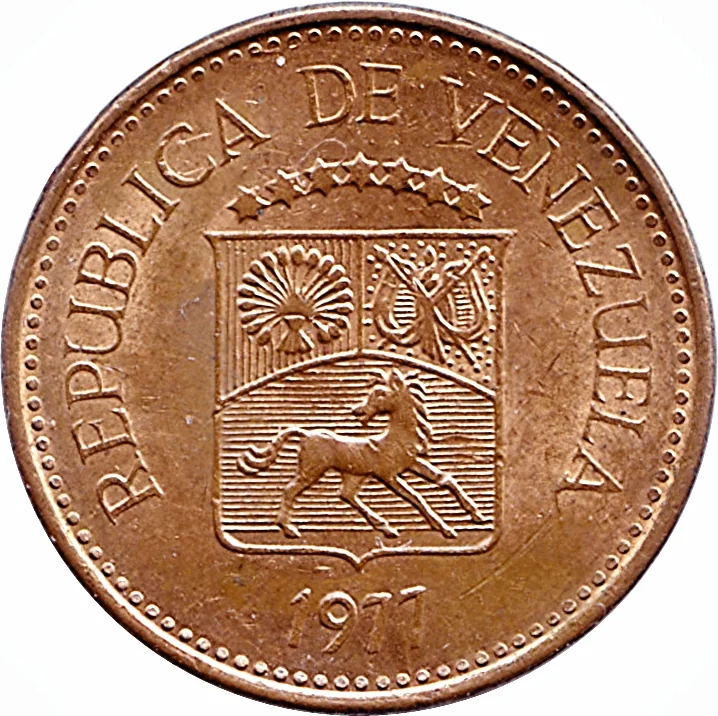
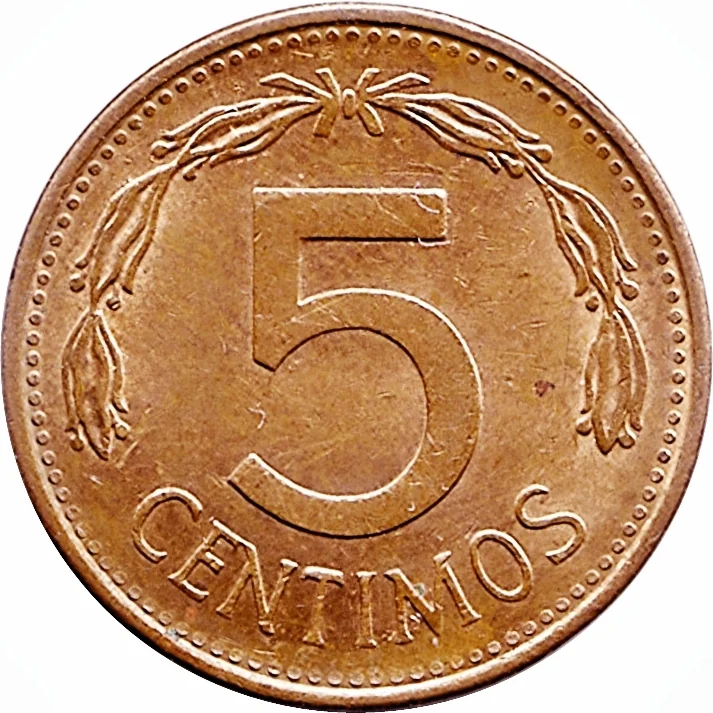
5 Centimos – Venezuela
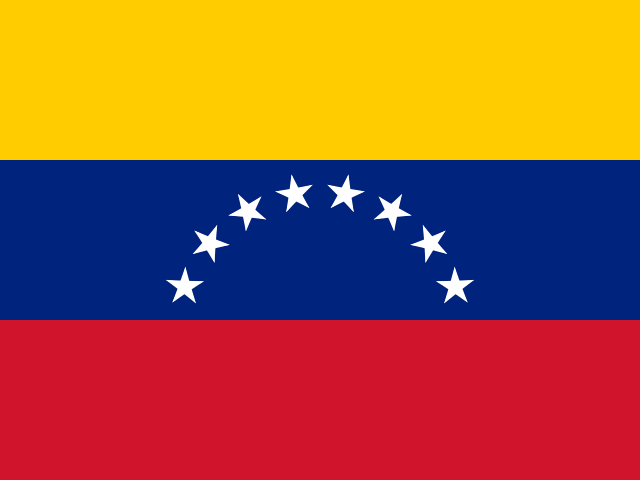
Venezuela
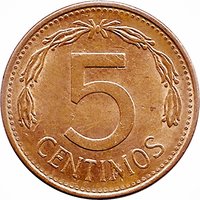
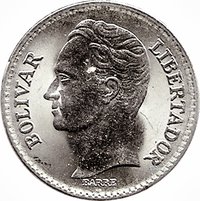
Obverse
Reverse
Edge
Plain
Mints
| Name | Mark |
|---|---|
| Royal Mint | — |
| VDM Metals / Vereinigte Deutsche Metallwerke | — |
Mintings
| Year | Mint Mark | Mintage | Quality | Collection |
|---|---|---|---|---|
| 1974 | — | 200,000,000 | ||
| 1976 | — | 200,000,000 | ||
| 1977 | — | 600,000,000 |
Historical background
In 1974, Venezuela's currency situation was one of remarkable strength and stability, underpinned by an unprecedented oil boom. Following the 1973 oil embargo and subsequent price shocks, global oil prices quadrupled. As a major OPEC member and the world's second-largest oil exporter at the time, Venezuela experienced a massive influx of petrodollars. This surge in revenue filled state coffers, bolstered foreign reserves, and created a large balance of payments surplus. The Venezuelan bolívar, pegged to the U.S. dollar at a fixed rate of 4.25 bolívares since 1964, was considered a hard currency, even stronger than the dollar in some regional black markets.
This economic windfall fostered a sense of boundless prosperity, encapsulated in the phrase "Saudi Venezuela." The government, led by President Carlos Andrés Pérez, embarked on ambitious spending programs through its "La Gran Venezuela" plan, nationalizing the iron industry in 1974 and the oil industry the following year. The strong bolívar made imports cheap, fueling a consumer boom and rapid industrialization through state-led investments. The currency's stability and the nation's creditworthiness allowed Venezuela to borrow heavily on international markets, with lenders viewing its vast oil reserves as unshakeable collateral.
However, this enviable position in 1974 sowed the seeds of future vulnerability. The economy became overwhelmingly dependent on oil revenues, and the fixed exchange rate masked growing inefficiencies. The spending boom, without corresponding investments in productive non-oil sectors, led to inflation and increased public debt. The strong bolívar made non-oil exports uncompetitive, further eroding economic diversification. While the currency itself faced no immediate pressure in 1974, the fiscal policies and structural imbalances of that boom year created profound dependencies, setting the stage for the severe currency crises that would plague Venezuela decades later.
This economic windfall fostered a sense of boundless prosperity, encapsulated in the phrase "Saudi Venezuela." The government, led by President Carlos Andrés Pérez, embarked on ambitious spending programs through its "La Gran Venezuela" plan, nationalizing the iron industry in 1974 and the oil industry the following year. The strong bolívar made imports cheap, fueling a consumer boom and rapid industrialization through state-led investments. The currency's stability and the nation's creditworthiness allowed Venezuela to borrow heavily on international markets, with lenders viewing its vast oil reserves as unshakeable collateral.
However, this enviable position in 1974 sowed the seeds of future vulnerability. The economy became overwhelmingly dependent on oil revenues, and the fixed exchange rate masked growing inefficiencies. The spending boom, without corresponding investments in productive non-oil sectors, led to inflation and increased public debt. The strong bolívar made non-oil exports uncompetitive, further eroding economic diversification. While the currency itself faced no immediate pressure in 1974, the fiscal policies and structural imbalances of that boom year created profound dependencies, setting the stage for the severe currency crises that would plague Venezuela decades later.
🌱 Very Common