

2 Jiao – Yunnan Province
China
Context
Year: 1949
Chinese republican Year: 38
Country: China 
Issuer: Yunnan Province
Period:
(1912—1949)
Currency:
(1908—1949)
Demonetized: Yes
Material
References
Y: #Click to copy to clipboard493
Numista: #22635
Value
Bullion value: $15.75
Obverse
Description:
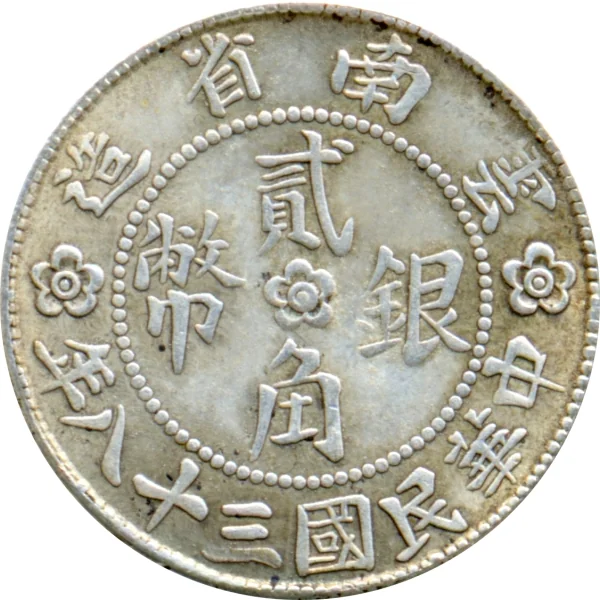
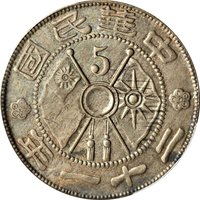
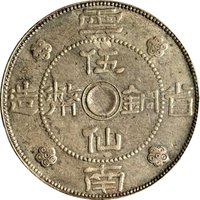
Four Chinese characters read vertically, centered around a flower, surrounded by more characters.
Inscription:
造省南雲
貳
幣 銀
角
年八十三國民華中
貳
幣 銀
角
年八十三國民華中
Translation:
Made in Yunnan Province
Two
Silver Coin
Jiao
Year 83 of the Republic of China
Two
Silver Coin
Jiao
Year 83 of the Republic of China
Language: Chinese
Reverse
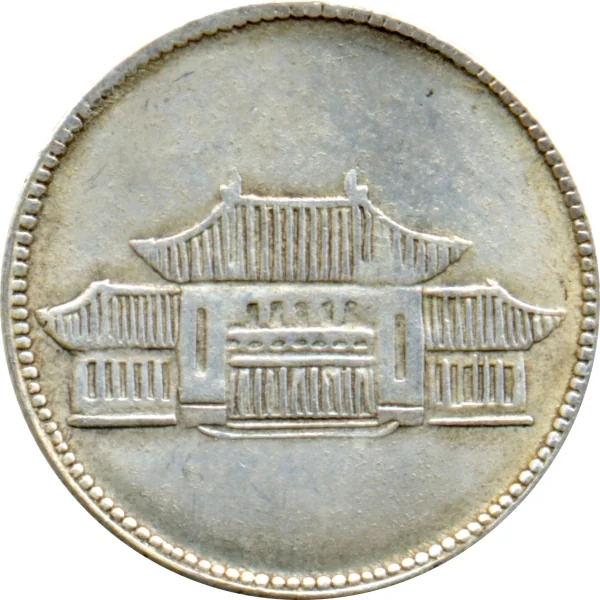
Description:
Provincial capitol.
Edge
Reeded.
Mintings
| Year | Mint Mark | Mintage | Quality | Collection |
|---|---|---|---|---|
| 1949 | — | — |
Historical background
In 1949, Yunnan Province found itself in a state of severe monetary chaos, a direct consequence of the collapsing Nationalist (Kuomintang or KMT) regime and the advancing Communist forces. As the Chinese Civil War reached its climax, the national currency, the Gold Yuan, introduced in 1948 in a failed attempt to curb hyperinflation, had become virtually worthless. In Yunnan, this was compounded by the circulation of older Fabì notes and local military scrip, leading to a multi-currency environment where bartering for goods like opium, silver dollars (yuan), and even salt became more reliable than paper money.
The provincial authority, under Chairman Lu Han, attempted to assert control by issuing a local currency known as the Yunnan Silver Dollar Certificate (云南省银元兑换券). Backed by the promise of redemption for silver coins, it was an effort to create a stable medium of exchange and fund local administration and military expenses. However, public trust in any government-issued paper was extremely low due to the recent memory of the Gold Yuan's collapse. Consequently, the certificates circulated with limited acceptance, primarily in Kunming and a few other urban centers, while the rural economy increasingly reverted to silver, barter, and commodity-based transactions.
This fragmented monetary situation persisted until the People's Liberation Army entered Yunnan in late 1949 and early 1950. The new Communist government moved swiftly to impose financial order as part of its consolidation of power. It demonetized all previous currencies, including the Yunnan certificates, and began the process of replacing them with the unified national currency issued by the People's Bank of China, thereby ending Yunnan's period of autonomous currency circulation and integrating it fully into the new socialist economic system.
The provincial authority, under Chairman Lu Han, attempted to assert control by issuing a local currency known as the Yunnan Silver Dollar Certificate (云南省银元兑换券). Backed by the promise of redemption for silver coins, it was an effort to create a stable medium of exchange and fund local administration and military expenses. However, public trust in any government-issued paper was extremely low due to the recent memory of the Gold Yuan's collapse. Consequently, the certificates circulated with limited acceptance, primarily in Kunming and a few other urban centers, while the rural economy increasingly reverted to silver, barter, and commodity-based transactions.
This fragmented monetary situation persisted until the People's Liberation Army entered Yunnan in late 1949 and early 1950. The new Communist government moved swiftly to impose financial order as part of its consolidation of power. It demonetized all previous currencies, including the Yunnan certificates, and began the process of replacing them with the unified national currency issued by the People's Bank of China, thereby ending Yunnan's period of autonomous currency circulation and integrating it fully into the new socialist economic system.
⭐ Rare