

5 Chiao – Meng Chiang
China
Context
Year: 1938
Chinese republican Year: 27
Country: China 
Issuer: Meng Chiang
Currency:
(1938—1944)
Demonetized: Yes
Material
Diameter: 25.1 mm
Weight: 5.5 g
Shape: Round
Composition: Copper-nickel
Technique: Milled
Alignment: Medal alignment
flip
References
Y: #Click to copy to clipboard521
Numista: #22540
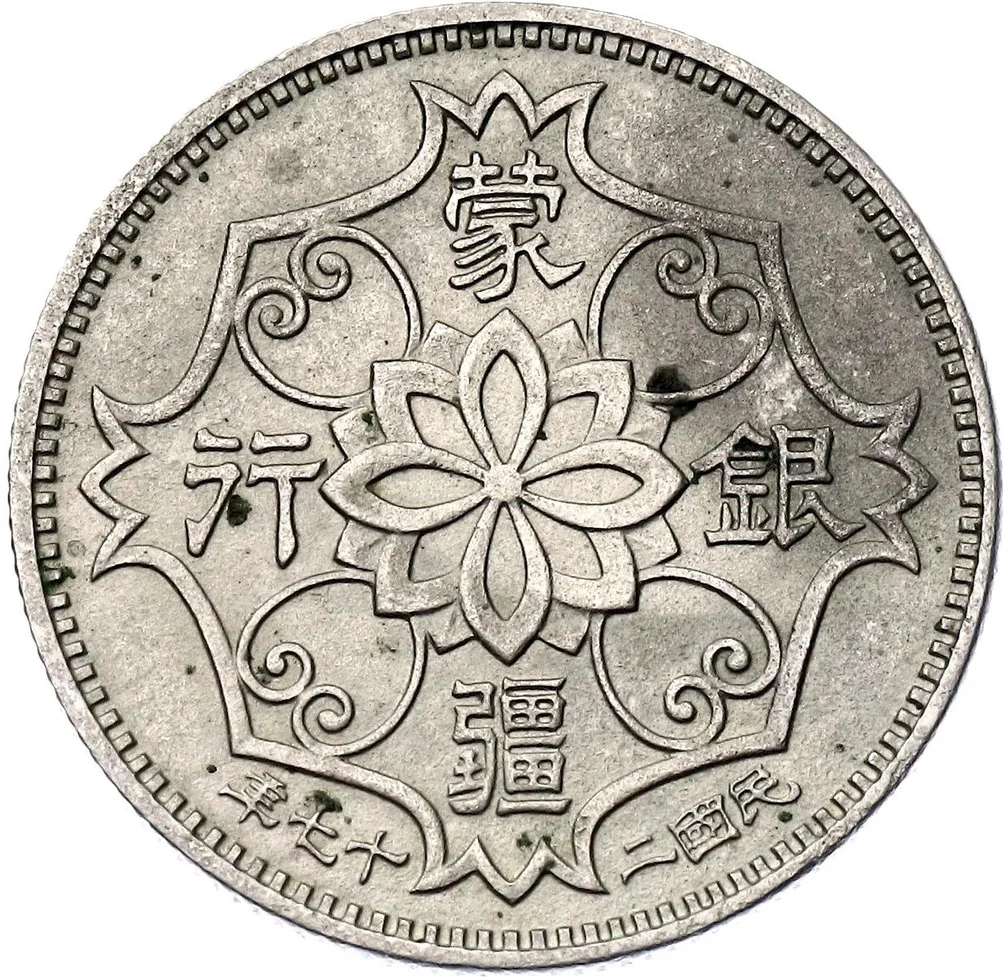
Obverse
Description:
Floral icon
Inscription:
蒙
行 銀
疆
年七十二國民
行 銀
疆
年七十二國民
Translation:
Seventy-second year of the Republic,
Xinjiang Province Bank,
One Yuan.
Xinjiang Province Bank,
One Yuan.
Script: Chinese
Language: Classical Chinese
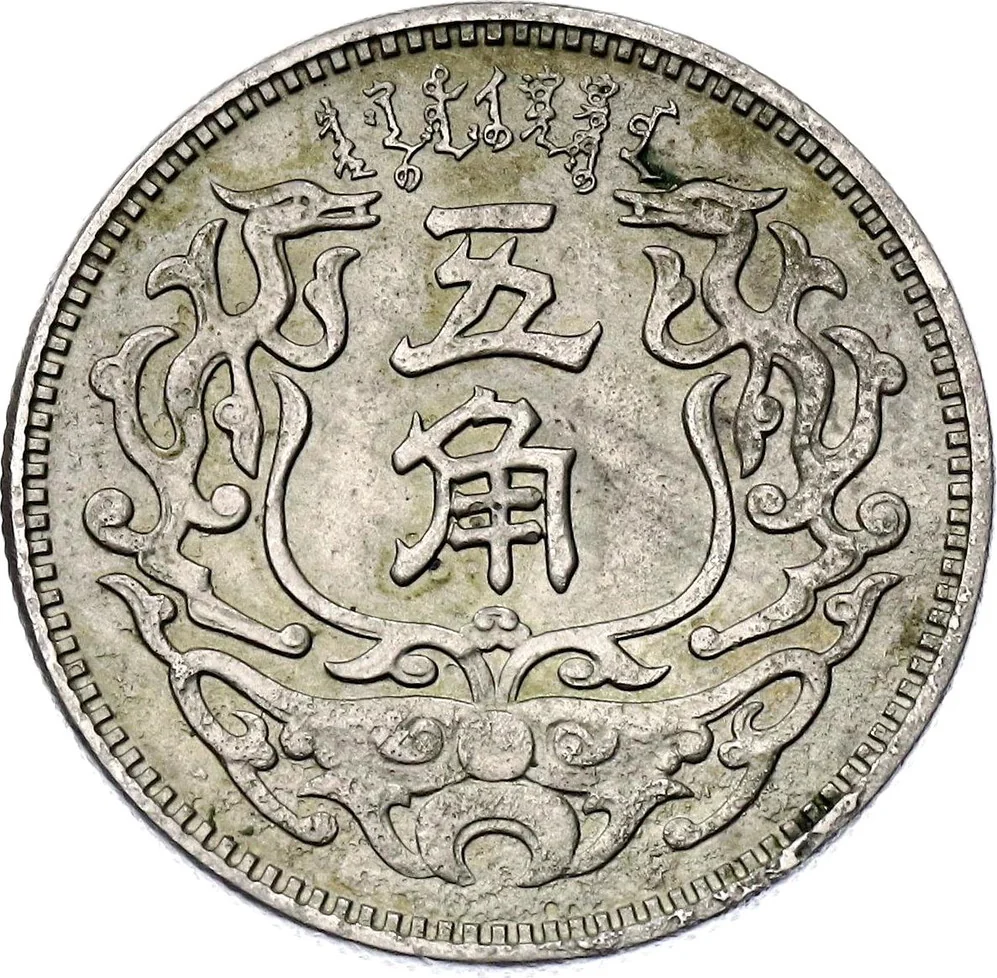
Reverse
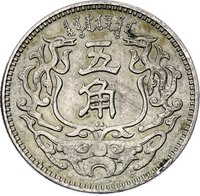
Description:
Value between stylized phoenixes under Mongolian script.
Inscription:
ᠴᠢᠩᠭᠢᠰ ᠬᠠᠭᠠᠨ ᠤ ᠳᠣᠯᠣᠭᠠᠨ ᠵᠠᠭᠤ ᠭᠤᠴᠢᠨ ᠭᠤᠷᠪᠠᠳᠤᠭᠠᠷ ᠣᠨ
五
角
五
角
Translation:
CHINGGIS KHAAN of the DOLO'AN ZA'U GÜCHIN GURBADUGAR ON
Five
Jiao
Five
Jiao
Scripts: Chinese, Mongolian / Manchu
Languages: Classical Chinese, Mongolian
Edge
Reeded
Categories
| Animal> Bird |
| Mythology> Fantastic animal |
Mintings
| Year | Mint Mark | Mintage | Quality | Collection |
|---|---|---|---|---|
| 1938 | — | — |
Historical background
Between 1937 and 1945, the Japanese military established the puppet state of Meng Chiang (Mengjiang) in parts of Inner Mongolia to exploit resources and secure the northern flank of its occupation. By 1938, the currency situation was chaotic and deliberately engineered to serve Japanese economic and strategic aims. The region became a battlefield for competing currencies: the Japanese Military Yen, notes from the puppet Federal Reserve Bank of China (based in Beijing), and various local and provincial notes all circulated alongside traditional silver dollars. This multiplicity created confusion, undermined public trust, and facilitated the systematic extraction of local wealth.
The primary Japanese objective was to displace the Chinese Nationalist fabi (legal tender) and sever the region's economic ties with unoccupied China. To this end, Japanese authorities aggressively promoted their sponsored currencies, often requiring taxes and commercial transactions to be conducted in them. However, these notes were inherently unstable, being fiat currencies backed by military decree rather than substantial reserves. Their value was artificially pegged to the Japanese yen, but inflation was a persistent problem as over-issuance began almost immediately to fund occupation costs.
Consequently, the year 1938 in Meng Chiang was characterized by a coercive and unstable monetary transition. For the local Mongolian and Han Chinese populations, this currency warfare translated into economic hardship, uncertainty in daily transactions, and a loss of savings through stealth devaluation. The chaotic currency landscape effectively functioned as a tool of colonial control, destabilizing the existing economy and integrating the region into Japan's wartime "Yen Bloc," prioritizing the financial needs of the occupation over the welfare of the inhabitants.
The primary Japanese objective was to displace the Chinese Nationalist fabi (legal tender) and sever the region's economic ties with unoccupied China. To this end, Japanese authorities aggressively promoted their sponsored currencies, often requiring taxes and commercial transactions to be conducted in them. However, these notes were inherently unstable, being fiat currencies backed by military decree rather than substantial reserves. Their value was artificially pegged to the Japanese yen, but inflation was a persistent problem as over-issuance began almost immediately to fund occupation costs.
Consequently, the year 1938 in Meng Chiang was characterized by a coercive and unstable monetary transition. For the local Mongolian and Han Chinese populations, this currency warfare translated into economic hardship, uncertainty in daily transactions, and a loss of savings through stealth devaluation. The chaotic currency landscape effectively functioned as a tool of colonial control, destabilizing the existing economy and integrating the region into Japan's wartime "Yen Bloc," prioritizing the financial needs of the occupation over the welfare of the inhabitants.
🌟 Uncommon