

500 Yen – Japan
Japan
Context
Material
Diameter: 26.5 mm
Weight: 7 g
Thickness: 1.81 mm
Shape: Round
Magnetic: No
Techniques: Latent image, Milled
Alignment: Medal alignment
flip
References
Y: #Click to copy to clipboard125
Numista: #2122
Value
Exchange value: 500 JPY = $3.20
Inflation-adjusted value: 555.14 JPY
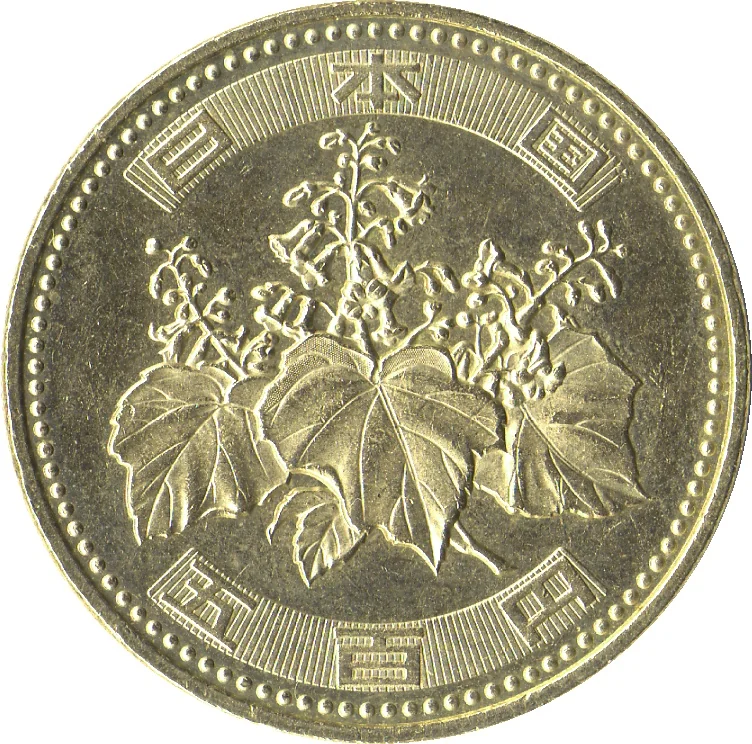
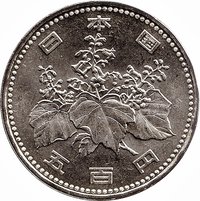
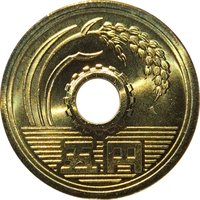
Obverse
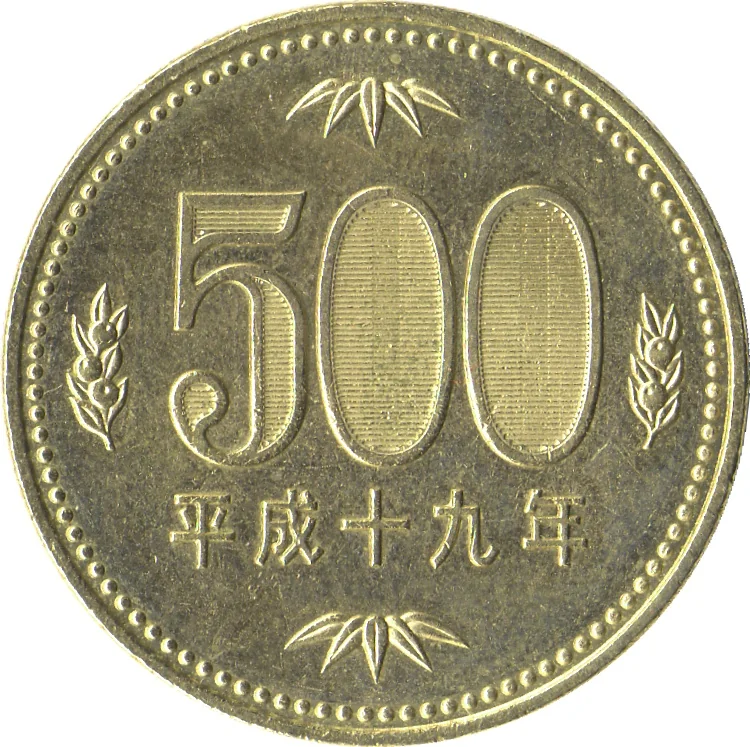
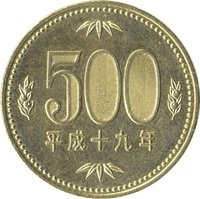
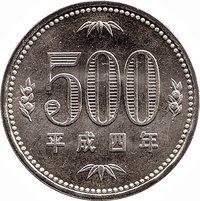
Reverse
Edge
Slanted reeding right
Mints
| Name | Mark |
|---|---|
| Japan Mint | — |
Mintings
| Year | Mint Mark | Mintage | Quality | Collection |
|---|---|---|---|---|
| 2000 | — | 595,743,000 | ||
| 2000 | — | 226,000 | Proof | |
| 2001 | — | 607,803,000 | ||
| 2001 | — | 238,000 | Proof | |
| 2002 | — | 504,419,000 | ||
| 2002 | — | 242,000 | Proof | |
| 2003 | — | 438,130,000 | ||
| 2003 | — | 275,000 | Proof | |
| 2004 | — | 356,623,000 | ||
| 2004 | — | 283,000 | Proof | |
| 2005 | — | 334,762,000 | ||
| 2005 | — | 258,000 | Proof | |
| 2006 | — | 381,346,000 | ||
| 2006 | — | 247,000 | Proof | |
| 2007 | — | 401,701,200 | ||
| 2007 | — | 201,800 | Proof | |
| 2008 | — | 432,811,000 | ||
| 2008 | — | 168,200 | Proof | |
| 2009 | — | 343,003,000 | ||
| 2009 | — | 132,000 | Proof | |
| 2010 | — | 407,000,000 | ||
| 2010 | — | 130,187 | Proof | |
| 2011 | — | 108,000 | Proof | |
| 2011 | — | 302,000,000 | ||
| 2012 | — | 260,000,000 | ||
| 2012 | — | 103,000 | Proof | |
| 2013 | — | 137,892,000 | ||
| 2013 | — | 102,000 | Proof | |
| 2014 | — | 167,013,000 | ||
| 2014 | — | — | Proof | |
| 2015 | — | 143,004,000 | ||
| 2015 | — | — | Proof | |
| 2016 | — | 221,064,000 | ||
| 2016 | — | — | Proof | |
| 2017 | — | 426,327,000 | ||
| 2017 | — | — | Proof | |
| 2018 | — | 286,192,000 | ||
| 2018 | — | — | Proof | |
| 2019 | — | 126,164,000 | ||
| 2019 | — | — | Proof |
Historical background
In the year 2000, Japan's currency situation was characterized by a period of deliberate and significant yen weakness, driven by a prolonged domestic economic crisis. The country was still grappling with the aftermath of the collapsed asset bubble of the early 1990s, entrenched in what became known as the "Lost Decade." This era was defined by deflation, stagnant growth, and a fragile banking sector burdened by non-performing loans. In this context, a weaker yen was seen by policymakers as a crucial tool to stimulate the economy by boosting exports, making Japanese goods like cars and electronics more competitive abroad and helping to counter deflationary pressures by raising import prices.
Monetary policy was squarely aimed at achieving this devaluation. The Bank of Japan (BOJ) had already pioneered the use of the Zero Interest Rate Policy (ZIRP) in 1999, and by 2000, it maintained rates near zero. This created a wide interest rate differential with other major economies, particularly the United States, which was in a tightening cycle. The yield gap made holding yen assets less attractive, encouraging capital outflows and selling of the yen. While there was a brief, unsuccessful attempt to raise rates in August 2000—quickly reversed as the economy faltered—the overall stance remained aggressively accommodative. Authorities were also suspected of conducting covert currency interventions to sell yen and buy dollars, further pressuring the currency's value.
Consequently, the yen traded at historically weak levels against the US dollar throughout much of the year, averaging around ¥108 to the dollar and even breaching the ¥110 mark at times—a level not seen since the mid-1990s. This weak-yen policy was a double-edged sword: it provided vital support to major exporters like Toyota and Sony, but also drew criticism from trading partners and did little to address the deep-rooted structural problems in Japan's domestic economy and financial system. Thus, the currency situation in 2000 was less a sign of strength and more a reflection of a desperate, ongoing battle against deflation and economic stagnation.
Monetary policy was squarely aimed at achieving this devaluation. The Bank of Japan (BOJ) had already pioneered the use of the Zero Interest Rate Policy (ZIRP) in 1999, and by 2000, it maintained rates near zero. This created a wide interest rate differential with other major economies, particularly the United States, which was in a tightening cycle. The yield gap made holding yen assets less attractive, encouraging capital outflows and selling of the yen. While there was a brief, unsuccessful attempt to raise rates in August 2000—quickly reversed as the economy faltered—the overall stance remained aggressively accommodative. Authorities were also suspected of conducting covert currency interventions to sell yen and buy dollars, further pressuring the currency's value.
Consequently, the yen traded at historically weak levels against the US dollar throughout much of the year, averaging around ¥108 to the dollar and even breaching the ¥110 mark at times—a level not seen since the mid-1990s. This weak-yen policy was a double-edged sword: it provided vital support to major exporters like Toyota and Sony, but also drew criticism from trading partners and did little to address the deep-rooted structural problems in Japan's domestic economy and financial system. Thus, the currency situation in 2000 was less a sign of strength and more a reflection of a desperate, ongoing battle against deflation and economic stagnation.
🌱 Very Common