

50 Yuan (Taiwan currency) – Taiwan
Non-circulating coins
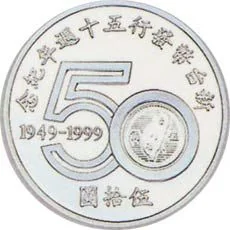
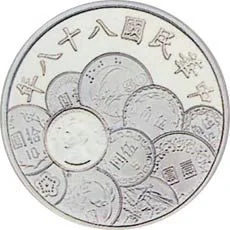
Commemoration: 50 Years Taiwan Yuan (Dollar)
China
Context
Year: 1999
Chinese republican Year: 88
Country: China 
Issuer: Taiwan 
Period:
(since 1949)
Currency:
(since 1949)
Total mintage: 130,000
Material
Diameter: 33 mm
Weight: 15.57 g
Silver weight: 14.40 g
Shape: Round
Composition: 92.5% Silver
Standard: Silver half ounce
Magnetic: No
Technique: Milled
References
Y: #Click to copy to clipboard559
Numista: #106203
Value
Exchange value: 50 TWD
Bullion value: $40.12
Inflation-adjusted value: 80.51 TWD
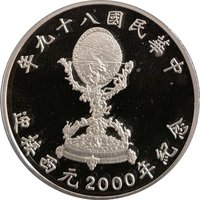
Obverse
Description:
Coin collection.
Script: Chinese
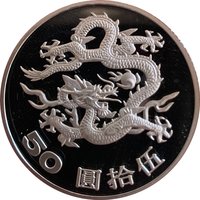
Reverse
Description:
Coin type, design, and year.
Script: Chinese
Edge
Mintings
| Year | Mint Mark | Mintage | Quality | Collection |
|---|---|---|---|---|
| 1999 | — | 130,000 |
Historical background
In 1999, Taiwan's currency, the New Taiwan Dollar (NTD or TWD), operated within a managed float regime overseen by the Central Bank of the Republic of China (Taiwan). The primary macroeconomic context was one of cautious stability following the seismic shock of the 1997 Asian Financial Crisis. While Taiwan had weathered that storm better than many regional neighbors due to its strong foreign exchange reserves and relatively robust financial system, authorities remained vigilant against speculative capital flows and exchange rate volatility. The central bank's policy focused on maintaining relative stability to support export competitiveness—a cornerstone of the island's economy—while managing inflationary pressures.
The year was marked by a significant political event that indirectly influenced financial confidence: the July 9 announcement by President Lee Teng-hui of the "special state-to-state theory," which dramatically heightened cross-strait tensions with mainland China. This political uncertainty led to capital outflows and downward pressure on the NTD, prompting the central bank to intervene in the foreign exchange market to defend the currency's value. Despite these pressures, the NTD's depreciation was relatively contained, ending the year at around 31.4 to the US dollar, a modest decline from approximately 32.2 at the start of the year, reflecting the central bank's successful management of the situation.
Economically, 1999 was a year of solid recovery and growth for Taiwan, with GDP expanding by over 5.7%, bolstering the currency's fundamental backing. The central bank's actions were characterized by a preference for gradual adjustment and discrete intervention rather than drastic policy shifts, aiming to provide a predictable environment for trade and investment. This approach underscored Taiwan's broader financial strategy in the late 1990s: leveraging its substantial reserves (exceeding US$100 billion) to insulate its currency and economy from external shocks while navigating the unique political risks of the region.
The year was marked by a significant political event that indirectly influenced financial confidence: the July 9 announcement by President Lee Teng-hui of the "special state-to-state theory," which dramatically heightened cross-strait tensions with mainland China. This political uncertainty led to capital outflows and downward pressure on the NTD, prompting the central bank to intervene in the foreign exchange market to defend the currency's value. Despite these pressures, the NTD's depreciation was relatively contained, ending the year at around 31.4 to the US dollar, a modest decline from approximately 32.2 at the start of the year, reflecting the central bank's successful management of the situation.
Economically, 1999 was a year of solid recovery and growth for Taiwan, with GDP expanding by over 5.7%, bolstering the currency's fundamental backing. The central bank's actions were characterized by a preference for gradual adjustment and discrete intervention rather than drastic policy shifts, aiming to provide a predictable environment for trade and investment. This approach underscored Taiwan's broader financial strategy in the late 1990s: leveraging its substantial reserves (exceeding US$100 billion) to insulate its currency and economy from external shocks while navigating the unique political risks of the region.

✨ Legendary