

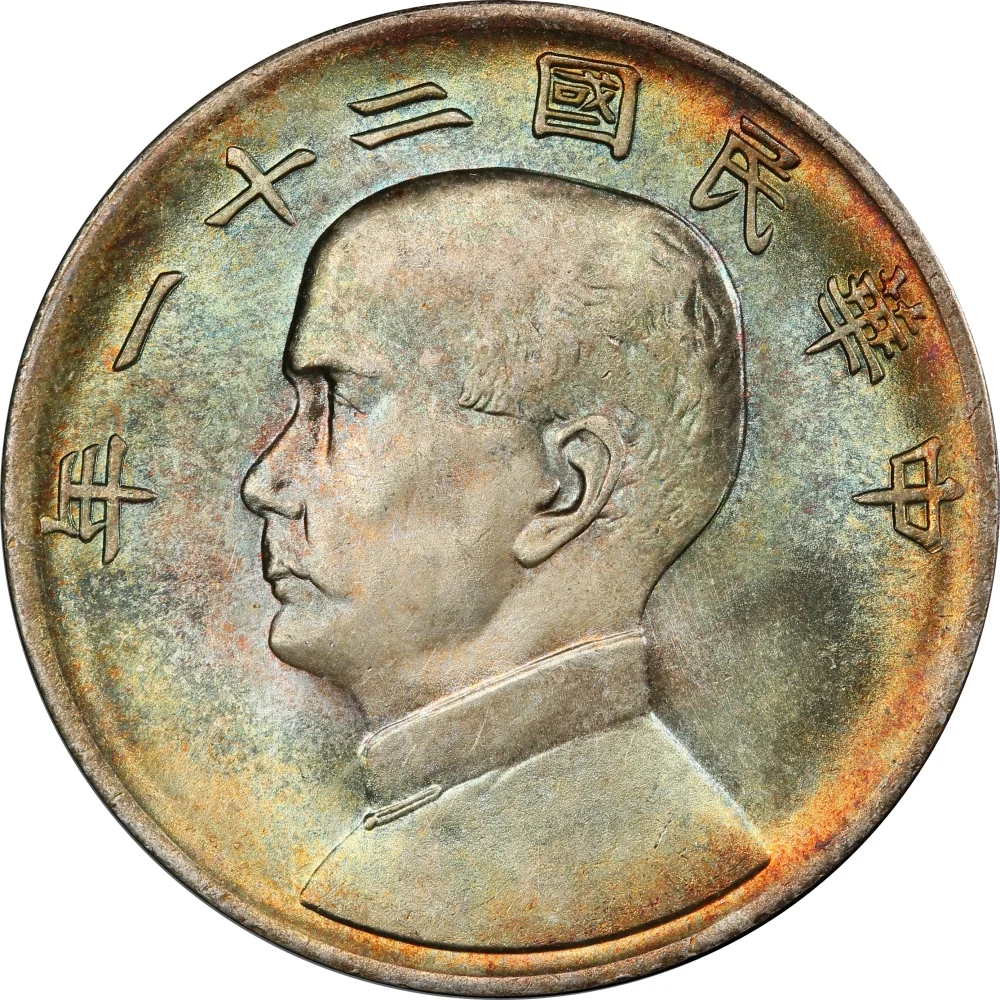
1 Dollar – Republic of China
China
Context
Year: 1932
Chinese republican Year: 21
Country: China 
Issuer: Republic of China
Period:
(1912—1949)
Currency:
(1912—1948)
Demonetized: Yes
Total mintage: 2,260,000
Material
References
Y: #Click to copy to clipboard344
Numista: #17825
Value
Bullion value: $67.10
Obverse
Reverse
Description:
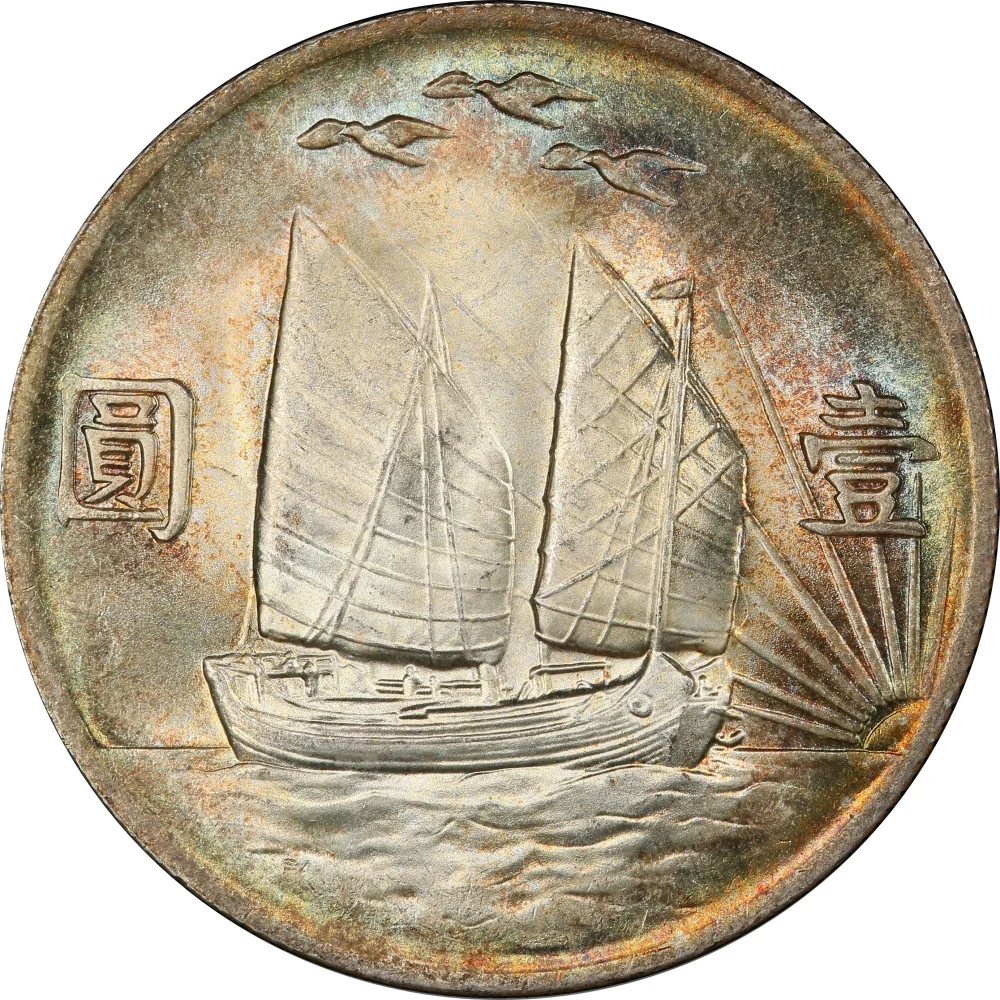
Two-masted junk sailing right, three birds overhead, rising sun behind, and one Chinese ideogram on each side.
Inscription:
圓壹
Translation:
One Yuan
Script: Chinese
Language: Classical Chinese
Edge
Categories
| Animal> Bird |
| Person> Politician |
| Transportation> Watercraft |
Mintings
| Year | Mint Mark | Mintage | Quality | Collection |
|---|---|---|---|---|
| 1932 | — | 2,260,000 |
Historical background
In 1932, the currency situation in the Republic of China was characterized by extreme fragmentation and instability, a direct legacy of the warlord era and compounded by the global Great Depression. The central government in Nanjing, under the Kuomintang, exercised limited monetary control. While it had introduced the national fabi (legal tender) currency in 1935, in 1932 this reform was still in the future. The primary unit, the silver yuan, existed alongside a chaotic multitude of provincial banknotes, local scrip, and silver sycee (shoe-shaped ingots), all circulating at fluctuating values. This system was inherently vulnerable, as China remained on a silver standard while most of the world used the gold standard, making its economy subject to volatile international silver prices.
The year was particularly critical due to the "Shanghai Incident" of January-March, a major military conflict between Chinese and Japanese forces in the city. The fighting devastated China's financial heartland, causing massive capital flight, bank runs, and a severe liquidity crisis. To meet military expenses and stabilize the local economy, the Shanghai banking consortium was forced to issue "Security Payment Certificates," a form of emergency scrip. This event starkly exposed the weakness of the central financial authority and highlighted the urgent need for a unified, government-controlled currency system that could withstand both internal division and external shock.
Furthermore, the global depression created a paradoxical crisis. As Western nations abandoned the gold standard and devalued their currencies, the price of silver—and thus the value of China's silver-backed money—initially rose. This led to a devastating deflationary spiral within China, as the yuan appreciated, making Chinese exports more expensive and deepening an economic downturn. By 1932, this deflation was crippling farmers and merchants, creating widespread social unrest. These combined pressures—military, political, and economic—set the stage for the radical monetary reforms that would follow in 1935, when China would finally abandon the silver standard.
The year was particularly critical due to the "Shanghai Incident" of January-March, a major military conflict between Chinese and Japanese forces in the city. The fighting devastated China's financial heartland, causing massive capital flight, bank runs, and a severe liquidity crisis. To meet military expenses and stabilize the local economy, the Shanghai banking consortium was forced to issue "Security Payment Certificates," a form of emergency scrip. This event starkly exposed the weakness of the central financial authority and highlighted the urgent need for a unified, government-controlled currency system that could withstand both internal division and external shock.
Furthermore, the global depression created a paradoxical crisis. As Western nations abandoned the gold standard and devalued their currencies, the price of silver—and thus the value of China's silver-backed money—initially rose. This led to a devastating deflationary spiral within China, as the yuan appreciated, making Chinese exports more expensive and deepening an economic downturn. By 1932, this deflation was crippling farmers and merchants, creating widespread social unrest. These combined pressures—military, political, and economic—set the stage for the radical monetary reforms that would follow in 1935, when China would finally abandon the silver standard.
⭐ Rare