

1 Jiao – Republic of China
China
Context
Year: 1926
Chinese republican Year: 15
Country: China 
Issuer: Republic of China
Period:
(1912—1949)
Currency:
(1912—1948)
Demonetized: Yes
Material
References
Y: #Click to copy to clipboard334
Numista: #17824
Value
Bullion value: $7.72
Obverse
Description:
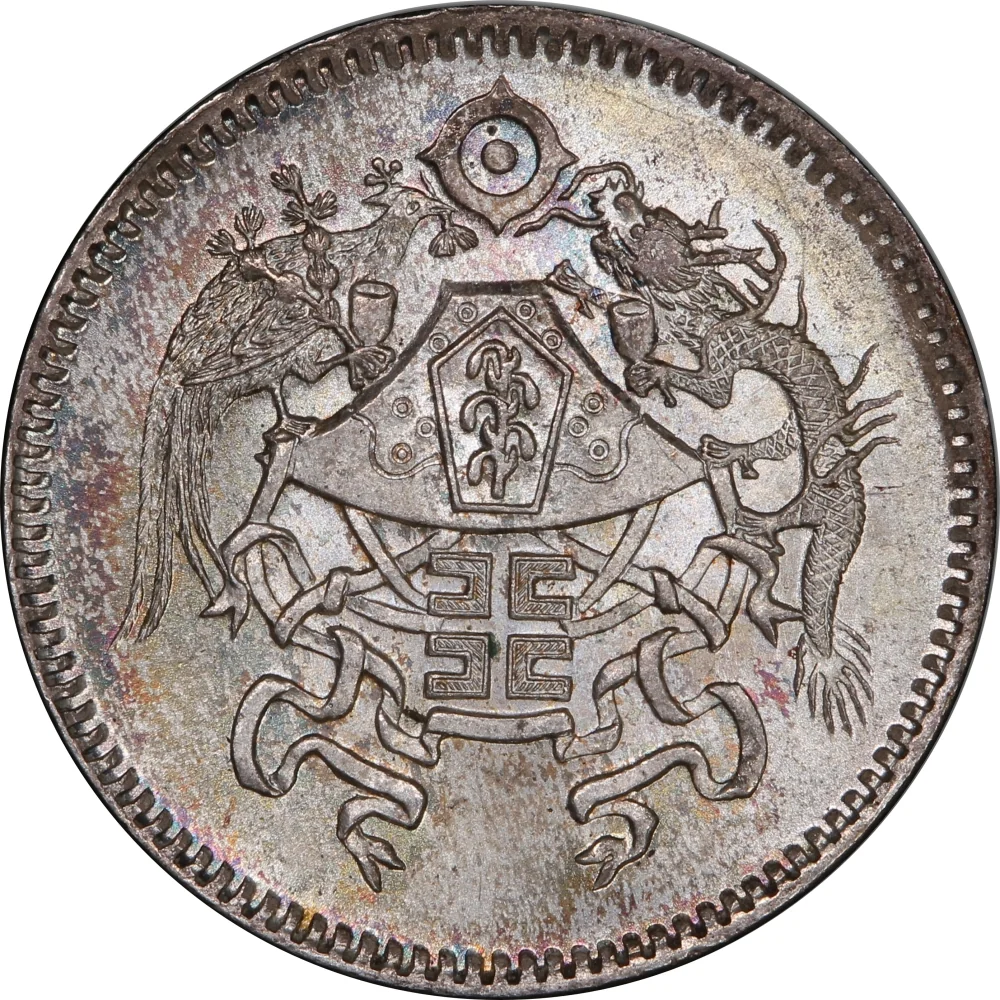
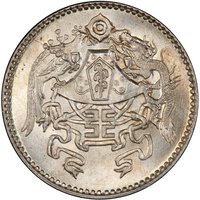
China's 1913-1928 national emblem featured a dragon and phoenix holding cups over an axe.
Reverse
Description:
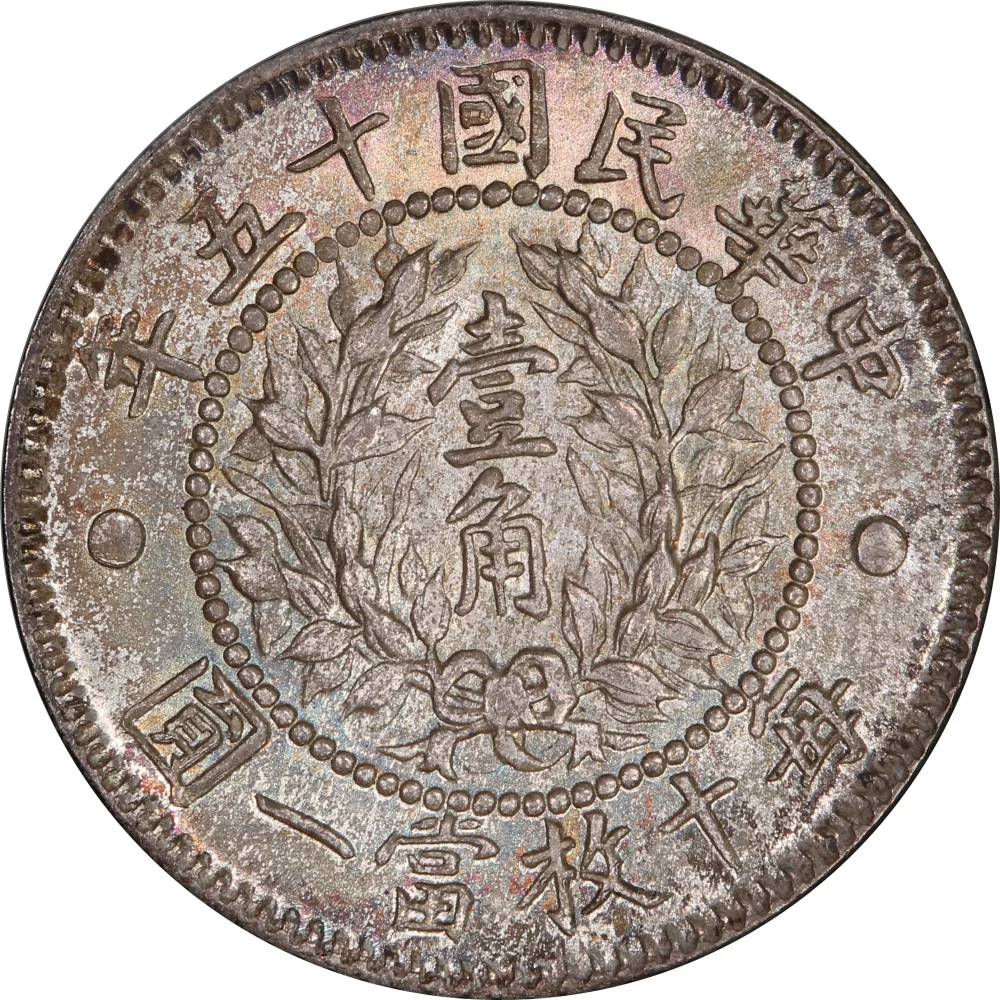
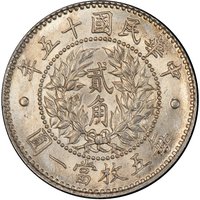
Two Chinese characters encircled by a wreath, surrounded by additional designs.
Inscription:
年五十國民華中
壹
角
圓一當枚十每
壹
角
圓一當枚十每
Translation:
ONE
JIAO
ONE YUAN EQUALS TEN PIECES, FIFTIETH YEAR OF THE REPUBLIC OF CHINA.
JIAO
ONE YUAN EQUALS TEN PIECES, FIFTIETH YEAR OF THE REPUBLIC OF CHINA.
Language: Chinese
Edge
Reeded.
Categories
| Mythology> Fantastic animal |
| Symbols> Coat of Arms |
| Symbol> Wreath |
Mintings
| Year | Mint Mark | Mintage | Quality | Collection |
|---|---|---|---|---|
| 1926 | — | — |
Historical background
In 1926, the Republic of China was mired in a severe and chaotic multi-currency crisis, a direct reflection of the country's political fragmentation. The central Beiyang Government in Beijing, its authority crumbling, continued to issue its own unbacked paper currency, the "fabì" (legal tender). However, this currency was subject to rampant depreciation and hyperinflation due to incessant military spending and a complete lack of fiscal discipline. Its credibility was so low that it circulated only in areas under direct northern warlord control, and its value could change dramatically from city to city.
Simultaneously, the nation was flooded with a bewildering variety of other mediums of exchange. Numerous regional warlords, controlling vast territories, printed their own unsecured banknotes to fund their armies, which became worthless once their regime fell. Furthermore, foreign banks, such as the British Hongkong and Shanghai Banking Corporation (HSBC) and the Japanese Yokohama Specie Bank, issued their own banknotes in treaty ports, which often held more trust than Chinese government notes. Perhaps most critically, silver—in the form of traditional sycee (shoe-shaped ingots), foreign-minted silver dollars (like the Mexican "Eagle" dollar), and the new Chinese "Yuan Shikai" dollars—remained the preferred and stable store of value for the public and for significant transactions, creating a dual monetary system.
This monetary disintegration had devastating economic consequences. Trade between regions became extremely difficult due to exchange rate complexities and the risk of holding worthless paper. The peasantry suffered enormously as taxes were often demanded in silver while their income was in local depreciating paper. This environment of financial anarchy provided a potent rallying point for the opposing Nationalist (Kuomintang) government in Canton, which criticized the Beiyang regime's incompetence. As the Northern Expedition began in 1926, one of the Guomindang's key promises was to unify the nation's currency, a goal that would eventually lead to the 1933 currency reform and the introduction of the fabi managed by the new Central Bank of China.
Simultaneously, the nation was flooded with a bewildering variety of other mediums of exchange. Numerous regional warlords, controlling vast territories, printed their own unsecured banknotes to fund their armies, which became worthless once their regime fell. Furthermore, foreign banks, such as the British Hongkong and Shanghai Banking Corporation (HSBC) and the Japanese Yokohama Specie Bank, issued their own banknotes in treaty ports, which often held more trust than Chinese government notes. Perhaps most critically, silver—in the form of traditional sycee (shoe-shaped ingots), foreign-minted silver dollars (like the Mexican "Eagle" dollar), and the new Chinese "Yuan Shikai" dollars—remained the preferred and stable store of value for the public and for significant transactions, creating a dual monetary system.
This monetary disintegration had devastating economic consequences. Trade between regions became extremely difficult due to exchange rate complexities and the risk of holding worthless paper. The peasantry suffered enormously as taxes were often demanded in silver while their income was in local depreciating paper. This environment of financial anarchy provided a potent rallying point for the opposing Nationalist (Kuomintang) government in Canton, which criticized the Beiyang regime's incompetence. As the Northern Expedition began in 1926, one of the Guomindang's key promises was to unify the nation's currency, a goal that would eventually lead to the 1933 currency reform and the introduction of the fabi managed by the new Central Bank of China.
⭐ Rare