

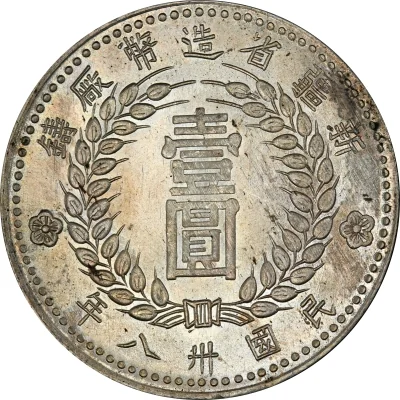
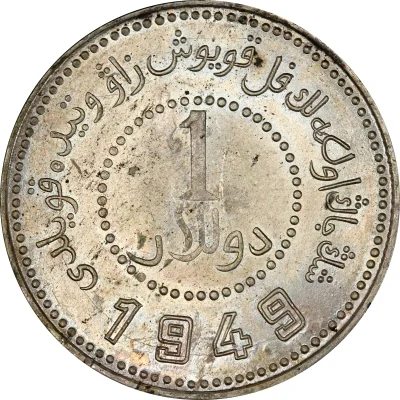
1 yuan – Sinkiang Province
Add to wishlist
China
Context
Year: 1949
Chinese republican Year:: 38
Country: China
Issuer: Sinkiang Province
Period:
(1912—1949)
Currency:
(1939—1949)
Demonetized: Yes
Material
References
Y: #
Numista: #17682
Value
Bullion value: $64.64
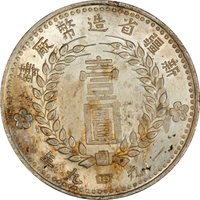
Obverse
Description:
Two Chinese characters in a wreath, encircled by more characters.
Inscription:
鑄廠幣造省疆新
壹
圓
年八卅國民
壹
圓
年八卅國民
Translation:
Minted by the New Frontier Province Mint
One
Dollar
38th Year of the Republic
One
Dollar
38th Year of the Republic
Language: Chinese
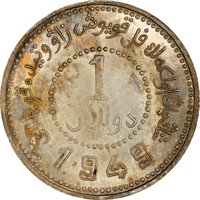
Reverse
Description:
Arabic legend above, value and year below.
Inscription:
شىڭ جاڭ ئۆلكۆلۆك ڥۇل قۇيۇش زاۋۇتىدە قۇيۇلدى
1
دولار
1949
1
دولار
1949
Translation:
Silver coin minted at the Xingjiang Provincial Mint.
1
Dollar
1949
1
Dollar
1949
Language: Uyghur
Edge
Mints
| Name | Mark |
|---|---|
| Sinkiang Pouring Factory Mint | — |
Mintings
| Year | Mint Mark | Mintage | Quality | Collection |
|---|---|---|---|---|
| 1949 | — | — |
Historical background
In 1949, the currency situation in Sinkiang (Xinjiang) Province was one of extreme fragmentation and hyperinflation, reflecting the broader political and military chaos of the final phase of the Chinese Civil War. The region was under the nominal control of the Nationalist (Kuomintang) government, but its authority was weak and contested. The primary circulating currency was the Xinjiang Provincial Bank Note (新疆省银行券), often called "Xinjiang Yuan." However, this currency had been issued in vast, unbacked quantities to fund military expenditures and government deficits, leading to a catastrophic loss of value. By 1949, denominations had skyrocketed into the hundreds of millions, and the currency was essentially worthless, severely disrupting daily commerce and the local economy.
Alongside the devalued provincial notes, a complex mosaic of other mediums of exchange persisted. In the northern Ili region, the Three Districts Revolution (backed by the Soviet Union) issued its own stable currency, the Ili Note (伊犁票), which circulated independently and maintained greater credibility. Furthermore, given Xinjiang's position on the Silk Road and its historical trade patterns, physical silver coins (particularly Yuan Shikai silver dollars), Soviet rubles, and even barter were commonly used, especially in border areas and rural markets. This monetary plurality underscored the fractured political control and the population's loss of faith in the centralizing paper currency of the collapsing Nanjing government.
The situation resolved abruptly with the peaceful liberation of Xinjiang by the People's Liberation Army in September 1949. The new Communist authorities moved swiftly to impose monetary order as part of consolidating control. In December 1949, the People's Bank of China announced the replacement of all local currencies, including the worthless Xinjiang Yuan and the Ili Note, with the national Renminbi (RMB). This currency reform, completed by 1951, was a critical first step in integrating Xinjiang's economy into the new People's Republic of China, ending the hyperinflationary period and establishing a unified monetary system under central authority.
Alongside the devalued provincial notes, a complex mosaic of other mediums of exchange persisted. In the northern Ili region, the Three Districts Revolution (backed by the Soviet Union) issued its own stable currency, the Ili Note (伊犁票), which circulated independently and maintained greater credibility. Furthermore, given Xinjiang's position on the Silk Road and its historical trade patterns, physical silver coins (particularly Yuan Shikai silver dollars), Soviet rubles, and even barter were commonly used, especially in border areas and rural markets. This monetary plurality underscored the fractured political control and the population's loss of faith in the centralizing paper currency of the collapsing Nanjing government.
The situation resolved abruptly with the peaceful liberation of Xinjiang by the People's Liberation Army in September 1949. The new Communist authorities moved swiftly to impose monetary order as part of consolidating control. In December 1949, the People's Bank of China announced the replacement of all local currencies, including the worthless Xinjiang Yuan and the Ili Note, with the national Renminbi (RMB). This currency reform, completed by 1951, was a critical first step in integrating Xinjiang's economy into the new People's Republic of China, ending the hyperinflationary period and establishing a unified monetary system under central authority.
💎 Extremely Rare