

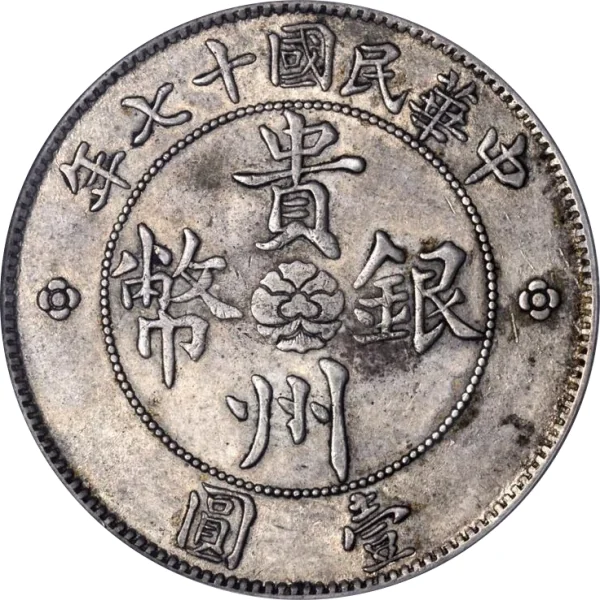
1 Yuan – Kweichow Province
Circulating commemorative coins
Commemoration: First Road of Kweichow
China
Context
Year: 1928
Chinese republican Year: 17
Country: China 
Issuer: Kweichow Province
Period:
(1912—1949)
Currency:
(1888—1949)
Demonetized: Yes
Material
References
Y: #Click to copy to clipboard428
Numista: #16012
Value
Bullion value: $72.98
Obverse
Reverse
Description:
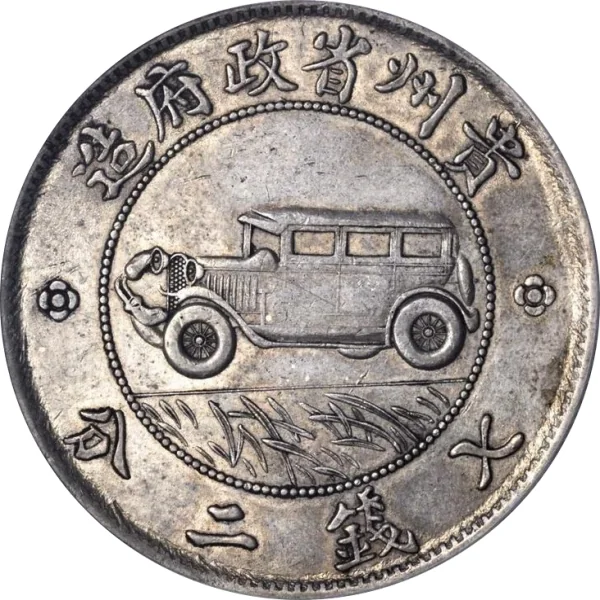
The governor's car departs from a lawn, surrounded by Chinese characters.
Inscription:
造府政省州贵
分二錢七
分二錢七
Translation:
Established by the Government Administration Bureau of the Province.
Twenty-seven Fen.
Twenty-seven Fen.
Script: Chinese
Language: Classical Chinese
Edge
Reeded.
Categories
| Transportation> Car |
Mintings
| Year | Mint Mark | Mintage | Quality | Collection |
|---|---|---|---|---|
| 1928 | — | — |
Historical background
In 1928, Kweichow (Guizhou) Province was immersed in the complex and chaotic monetary legacy of the Warlord Era. Following the collapse of the Qing dynasty, national currency systems had fragmented, and regional militarists financed their regimes by issuing unbacked paper notes and debasing coinage. In Kweichow, this was exemplified by the circulation of the "Kweichow Provincial Bank" notes and various military scrip issued by local commanders like Zhou Xicheng and Wang Jialie. These currencies were not trusted, suffered from severe inflation, and their value could change drastically depending on which warlord's forces controlled a given market town, crippling intra-provincial trade.
The situation was further complicated by the influx of external currencies. Silver dollars, particularly the "Yuan Shikai" and "Sun Yat-sen" dollars from coastal mints, along with Mexican silver dollars, circulated as hard currency for significant transactions. Meanwhile, the Chinese Nationalist government under Chiang Kai-shek, having nominally reunified China in 1928, was attempting to assert its financial authority with its new central bank notes. However, in remote, mountainous Kweichow, Nanjing's paper currency held little practical sway against the entrenched local military scrip and the enduring public preference for silver.
Consequently, the province operated under a dysfunctional multi-currency system. The local economy was strained by the lack of a reliable medium of exchange, with peasants and merchants bearing the risk of sudden devaluation. This monetary anarchy reflected Kweichow's political isolation and economic underdevelopment, posing a significant obstacle to any attempts at provincial integration or modernization. The currency chaos of 1928 thus stood as a stark symbol of the broader challenge the new Nationalist government faced in extending real administrative and economic control into the southwestern hinterlands.
The situation was further complicated by the influx of external currencies. Silver dollars, particularly the "Yuan Shikai" and "Sun Yat-sen" dollars from coastal mints, along with Mexican silver dollars, circulated as hard currency for significant transactions. Meanwhile, the Chinese Nationalist government under Chiang Kai-shek, having nominally reunified China in 1928, was attempting to assert its financial authority with its new central bank notes. However, in remote, mountainous Kweichow, Nanjing's paper currency held little practical sway against the entrenched local military scrip and the enduring public preference for silver.
Consequently, the province operated under a dysfunctional multi-currency system. The local economy was strained by the lack of a reliable medium of exchange, with peasants and merchants bearing the risk of sudden devaluation. This monetary anarchy reflected Kweichow's political isolation and economic underdevelopment, posing a significant obstacle to any attempts at provincial integration or modernization. The currency chaos of 1928 thus stood as a stark symbol of the broader challenge the new Nationalist government faced in extending real administrative and economic control into the southwestern hinterlands.
⭐ Rare