

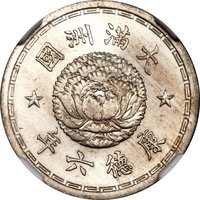
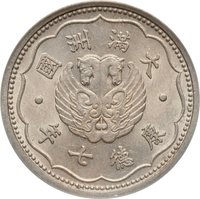
Obverse
Description:
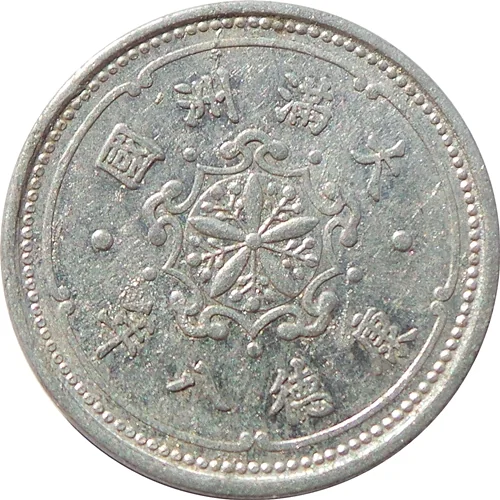
Imperial Seal of Manchoukuo encircled by inscription.
Inscription:
• 國洲滿大 •
年八德康
年八德康
Translation:
The great state is full of virtue;
The year is prosperous and virtuous.
The year is prosperous and virtuous.
Script: Chinese
Language: Classical Chinese
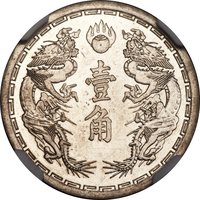
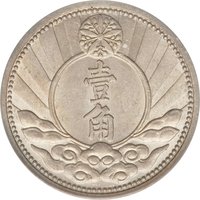
Reverse
Edge
Plain
Mintings
| Year | Mint Mark | Mintage | Quality | Collection |
|---|---|---|---|---|
| 1939 | — | — | ||
| 1940 | — | — | ||
| 1941 | — | — | ||
| 1942 | — | — | ||
| 1943 | — | — |
Historical background
In 1939, the currency situation in Manchukuo was characterized by the firm consolidation of Japanese financial control through the Manchukuo Central Bank, established in 1932 as the puppet state's sole note-issuing authority. The primary currency was the Manchukuo yuan, which was pegged at parity to the Japanese yen and formed part of the "Yen Bloc," ensuring its stability against the yen but making it wholly dependent on Japanese monetary policy. This linkage facilitated the extraction of Manchuria's resources for Japan's war economy and cemented the region's integration into the imperial economic sphere, while deliberately isolating it from the volatile Chinese nationalist currency markets.
Despite this official stability, the monetary system faced underlying pressures. The government, driven by the demands of massive industrial and military development under successive Five-Year Plans, increasingly financed its expenditures through central bank credit, leading to inflationary tendencies. Furthermore, while the Manchukuo yuan was dominant, a complex hierarchy of currencies persisted in practice, including Bank of Japan notes and, in the northern regions near the Soviet border, the "Red Army Note" issued by the Soviet Union. The Japanese military scrip, or "gunpyō," also circulated, especially in operational areas.
Overall, the 1939 currency regime was an effective instrument of colonial exploitation, providing a stable facade for what was essentially a wartime command economy. It successfully directed capital toward strategic industries and resource extraction, but its stability was artificially maintained by Japanese authority and was inherently tied to Japan's escalating war efforts in China and the broader Pacific. The growing inflationary financing foreshadowed the severe depreciation and collapse that would follow Japan's defeat in 1945.
Despite this official stability, the monetary system faced underlying pressures. The government, driven by the demands of massive industrial and military development under successive Five-Year Plans, increasingly financed its expenditures through central bank credit, leading to inflationary tendencies. Furthermore, while the Manchukuo yuan was dominant, a complex hierarchy of currencies persisted in practice, including Bank of Japan notes and, in the northern regions near the Soviet border, the "Red Army Note" issued by the Soviet Union. The Japanese military scrip, or "gunpyō," also circulated, especially in operational areas.
Overall, the 1939 currency regime was an effective instrument of colonial exploitation, providing a stable facade for what was essentially a wartime command economy. It successfully directed capital toward strategic industries and resource extraction, but its stability was artificially maintained by Japanese authority and was inherently tied to Japan's escalating war efforts in China and the broader Pacific. The growing inflationary financing foreshadowed the severe depreciation and collapse that would follow Japan's defeat in 1945.
🌱 Common