

Obverse
Description:
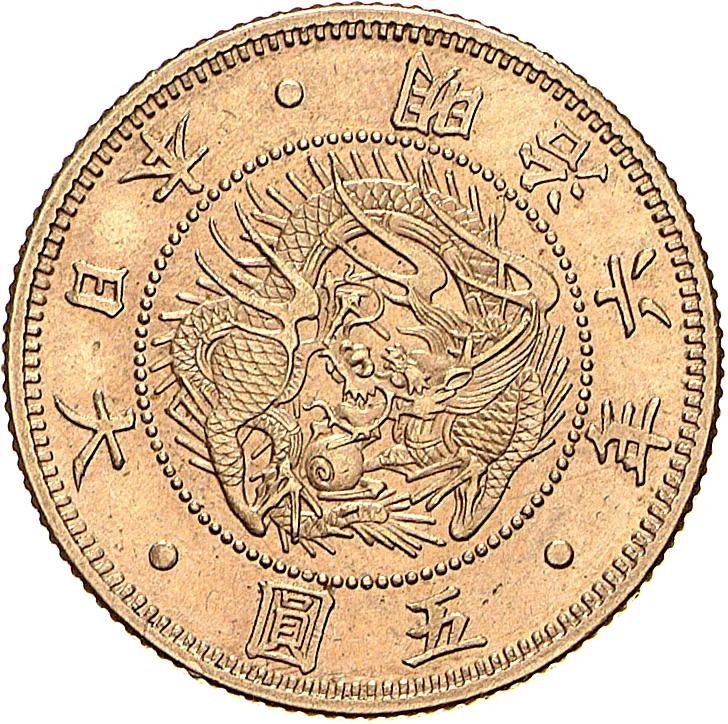
Dragon encircled by beads, legend above, value below.
Inscription:
年 六 治 明 · 本 日 大
· 圓 五 ·
· 圓 五 ·
Translation:
The sixth year of Meiji · Great Japan
· Five yen ·
· Five yen ·
Language: Chinese
Reverse
Description:
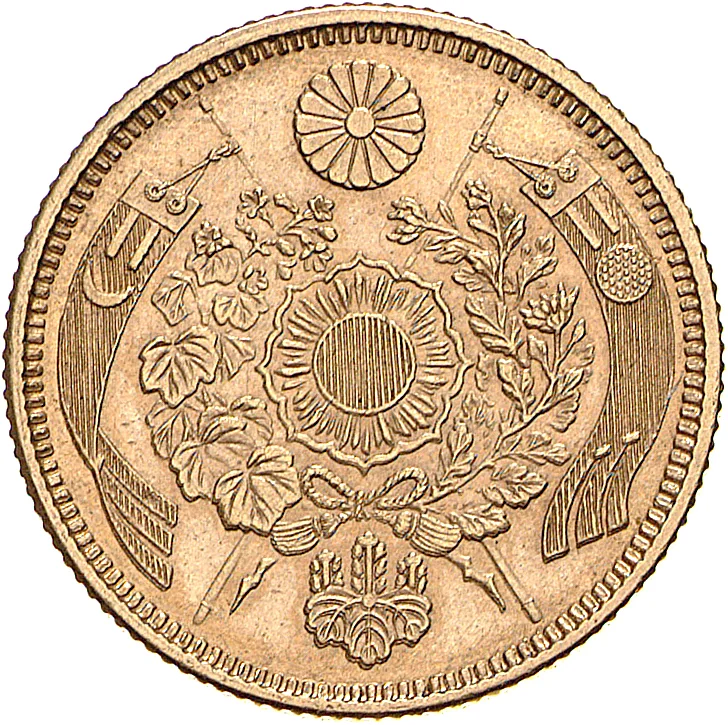
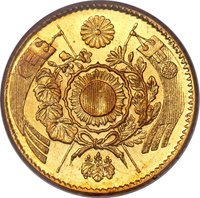
Sunburst crest on a sacred mirror, between banners, with chrysanthemum above and paulownia below.
Edge
Reeded
Categories
| Mythology> Fantastic animal |
| Symbol> Flag |
| Plants> Flower |
| Symbols> Coat of Arms |
| Symbol> Sun |
| Symbol> Wreath |
Mints
| Name | Mark |
|---|---|
| Japan Mint | — |
Mintings
| Year | Mint Mark | Mintage | Quality | Collection |
|---|---|---|---|---|
| 1872 | — | 1,057,000 | ||
| 1873 | — | 3,148,000 | ||
| 1874 | — | 728,000 | ||
| 1875 | — | 181,000 | ||
| 1876 | — | 146,000 | ||
| 1877 | — | 136,000 | ||
| 1878 | — | 101,000 | ||
| 1879 | — | — | ||
| 1880 | — | 78,000 | ||
| 1881 | — | 149,000 | ||
| 1882 | — | 113,000 | ||
| 1883 | — | 108,000 | ||
| 1884 | — | 113,000 | ||
| 1885 | — | 200,000 | ||
| 1886 | — | 179,000 | ||
| 1887 | — | 179,000 | ||
| 1888 | — | 165,000 | ||
| 1889 | — | 353,000 | ||
| 1890 | — | 238,000 | ||
| 1891 | — | 216,000 | ||
| 1892 | — | 263,000 | ||
| 1893 | — | 260,000 | ||
| 1894 | — | 314,000 | ||
| 1895 | — | 320,000 | ||
| 1896 | — | 224,000 | ||
| 1897 | — | 107,000 |
Historical background
In 1872, Japan stood at a pivotal moment in its monetary history, actively dismantling the complex feudal currency system of the Edo period. For centuries, the economy had relied on a chaotic mix of han (domain) notes, gold, silver, and copper coins issued by various clans and the shogunate, creating significant barriers to national trade and modernization. The new Meiji government, having restored imperial rule in 1868, recognized that a unified, modern currency was essential for centralizing state power, fostering industrial capitalism, and gaining recognition in the international economic order.
This imperative led directly to the enactment of the New Currency Act of June 1872 (Meiji 5), a landmark piece of legislation that established the yen as Japan's sole decimal-based currency unit, replacing the old ryō, bu, and shu denominations. The Act formally adopted the gold standard, with the yen defined as 1.5 grams of pure gold, aligning Japan with Western economic practices. Crucially, it granted a monopoly on note issue to the newly founded First National Bank (Dai-Ichi Kokuritsu Ginkō), a private institution chartered by the state, marking the beginning of a modern banking system.
However, the transition was fraught with difficulty. The government's limited gold reserves, drained by large trade deficits and the need to pay samurai stipends in bonds, made a pure gold standard untenable. In practice, silver coins remained the primary circulating medium, and the promised convertibility of banknotes into gold was soon suspended, leading to a de facto silver standard. Thus, while 1872 represents the formal birth of the modern yen and a decisive break from the past, it also inaugurated a period of monetary instability that would require further reforms, including the eventual establishment of the Bank of Japan in 1882, to fully consolidate.
This imperative led directly to the enactment of the New Currency Act of June 1872 (Meiji 5), a landmark piece of legislation that established the yen as Japan's sole decimal-based currency unit, replacing the old ryō, bu, and shu denominations. The Act formally adopted the gold standard, with the yen defined as 1.5 grams of pure gold, aligning Japan with Western economic practices. Crucially, it granted a monopoly on note issue to the newly founded First National Bank (Dai-Ichi Kokuritsu Ginkō), a private institution chartered by the state, marking the beginning of a modern banking system.
However, the transition was fraught with difficulty. The government's limited gold reserves, drained by large trade deficits and the need to pay samurai stipends in bonds, made a pure gold standard untenable. In practice, silver coins remained the primary circulating medium, and the promised convertibility of banknotes into gold was soon suspended, leading to a de facto silver standard. Thus, while 1872 represents the formal birth of the modern yen and a decisive break from the past, it also inaugurated a period of monetary instability that would require further reforms, including the eventual establishment of the Bank of Japan in 1882, to fully consolidate.
💎 Extremely Rare