

1000 yen (Meiji Restoration) – Japan
Add to wishlist
Non-circulating coins
Commemoration: 150th Anniversary of the Meiji Restoration
Japan
Context
Year: 2018
Japanese - Heisei era Year:: 30
Issuer: Japan
Ruler: Heisei
Currency:
(since 1871)
Total mintage: 50,000
Material
Diameter: 40 mm
Weight: 31.1 g
Silver Weight:: 31.07 g
Thickness: 3.5 mm
Shape: Round
Composition: 99.9% Silver
Standard: Silver ounce
Magnetic: No
Alignment: Medal alignment

flip
References
Y: #
Numista: #144554
Value
Exchange value: 1000 JPY
Bullion value: $75.99
Inflation-adjusted value: 1103.35 JPY
Obverse
Description:
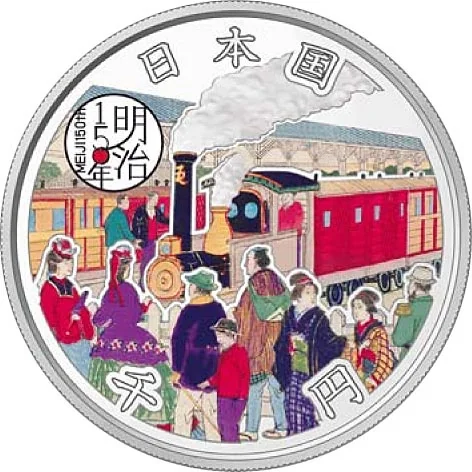
Colorized train station with MEIJI150th logo.
Inscription:
日 本 国
MEIJI150th
1 明
5 治
0
年
千 円
MEIJI150th
1 明
5 治
0
年
千 円
Translation:
Japan
MEIJI 150th
1
5
0
Year
1000 Yen
MEIJI 150th
1
5
0
Year
1000 Yen
Language: Japanese
Reverse
Description:
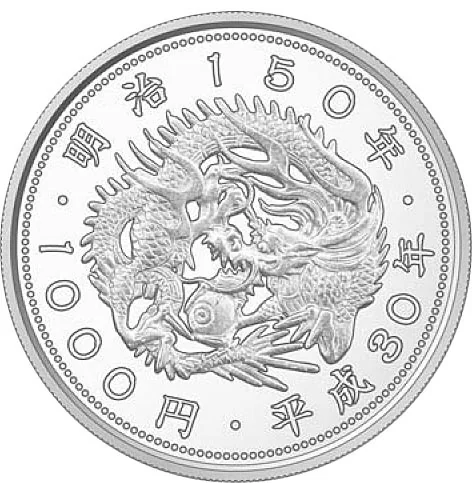
Entwined dragons from a Meiji 20-yen gold coin, encircled by text.
Inscription:
明治 150 年
• 1000 円 • 平成30年 •
• 1000 円 • 平成30年 •
Translation:
150th Year of Meiji
• 1000 Yen • Heisei 30 Year •
• 1000 Yen • Heisei 30 Year •
Language: Japanese
Edge
Slanted reeding
Categories
| Mythology> Fantastic animal |
| Art> Painting |
| Transportation> Train |
Mintings
| Year | Mint Mark | Mintage | Quality | Collection |
|---|---|---|---|---|
| 2018 | — | 50,000 | Proof |
Historical background
In 2018, Japan's currency situation was characterized by a persistent environment of ultra-low interest rates and a relatively weak yen, largely shaped by the divergent monetary policies of the Bank of Japan (BOJ) and the U.S. Federal Reserve. While the Fed continued its cycle of interest rate hikes and balance sheet normalization, the BOJ maintained its aggressive quantitative and qualitative easing (QQE) program with yield curve control, keeping short-term rates negative and the 10-year government bond yield near zero. This policy divergence kept the yen under pressure for much of the year, trading in a range of approximately ¥105 to ¥114 against the U.S. dollar, which supported the profits of Japan's major exporters but also contributed to subdued domestic inflation.
Despite the weak currency, Japan continued its long struggle to escape deflationary pressures and achieve the BOJ's elusive 2% inflation target. While core inflation (excluding fresh food) briefly touched 1% in early 2018, it remained well below target for most of the year, as modest wage growth and deeply entrenched consumer price sensitivity limited pass-through effects. This "low inflation despite weak yen" paradox underscored the structural challenges in the economy, leading the BOJ to repeatedly emphasize its commitment to powerful monetary easing with no clear exit strategy in sight.
The year was not without volatility, however, as the yen demonstrated its traditional role as a safe-haven currency during periods of global market stress. In the first quarter, concerns over a potential trade war and a sharp equity market correction prompted a rapid appreciation of the yen to around ¥105. Furthermore, by year-end, growing fears of a global economic slowdown and heightened financial market turbulence caused the currency to strengthen again, briefly pushing it below ¥110. This dynamic highlighted the ongoing tension for Japanese policymakers: a weaker yen was desirable for economic stimulus, but its sudden appreciation could destabilize financial markets and hurt corporate sentiment, all while failing to decisively lift domestic inflation.
Despite the weak currency, Japan continued its long struggle to escape deflationary pressures and achieve the BOJ's elusive 2% inflation target. While core inflation (excluding fresh food) briefly touched 1% in early 2018, it remained well below target for most of the year, as modest wage growth and deeply entrenched consumer price sensitivity limited pass-through effects. This "low inflation despite weak yen" paradox underscored the structural challenges in the economy, leading the BOJ to repeatedly emphasize its commitment to powerful monetary easing with no clear exit strategy in sight.
The year was not without volatility, however, as the yen demonstrated its traditional role as a safe-haven currency during periods of global market stress. In the first quarter, concerns over a potential trade war and a sharp equity market correction prompted a rapid appreciation of the yen to around ¥105. Furthermore, by year-end, growing fears of a global economic slowdown and heightened financial market turbulence caused the currency to strengthen again, briefly pushing it below ¥110. This dynamic highlighted the ongoing tension for Japanese policymakers: a weaker yen was desirable for economic stimulus, but its sudden appreciation could destabilize financial markets and hurt corporate sentiment, all while failing to decisively lift domestic inflation.



💎 Extremely Rare