

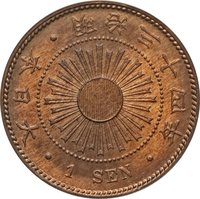
Obverse
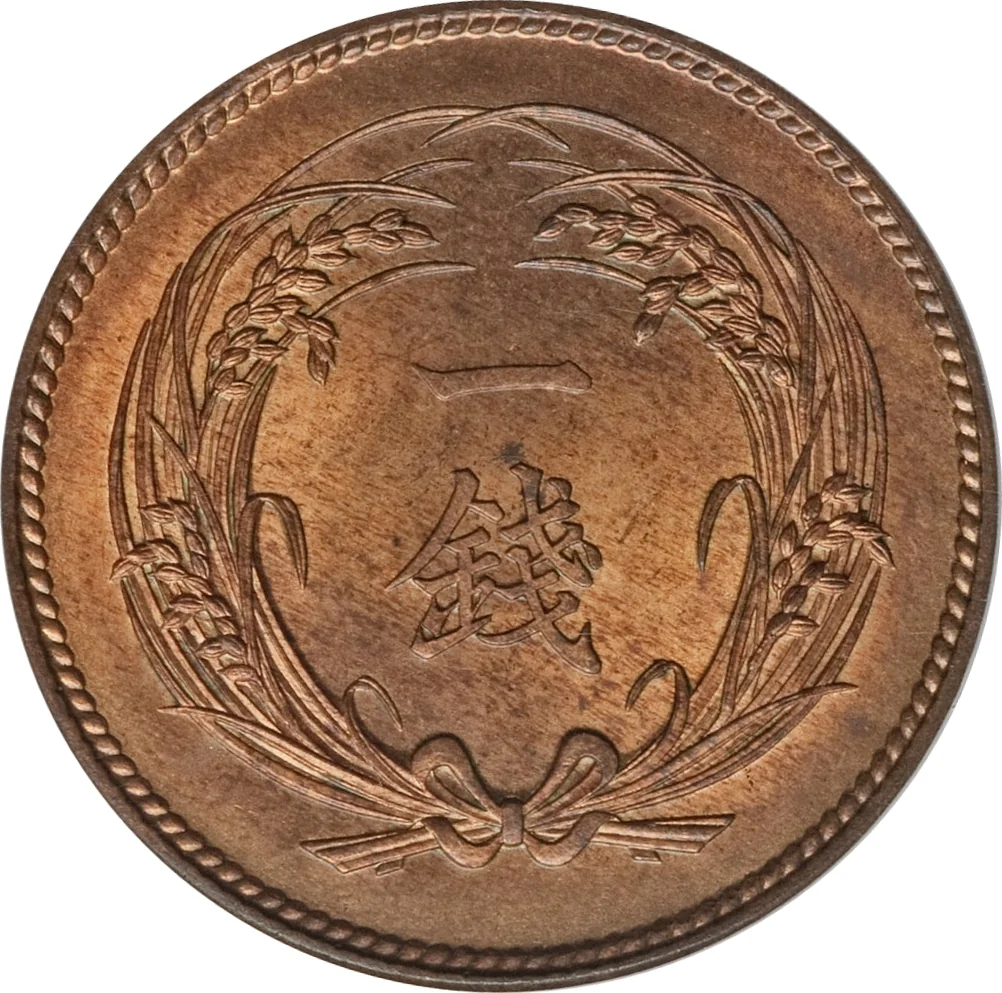
Description:
Rice stalks flank the denomination.
Inscription:
一
錢
錢
Translation:
One coin.
Language: Classical Chinese
Reverse
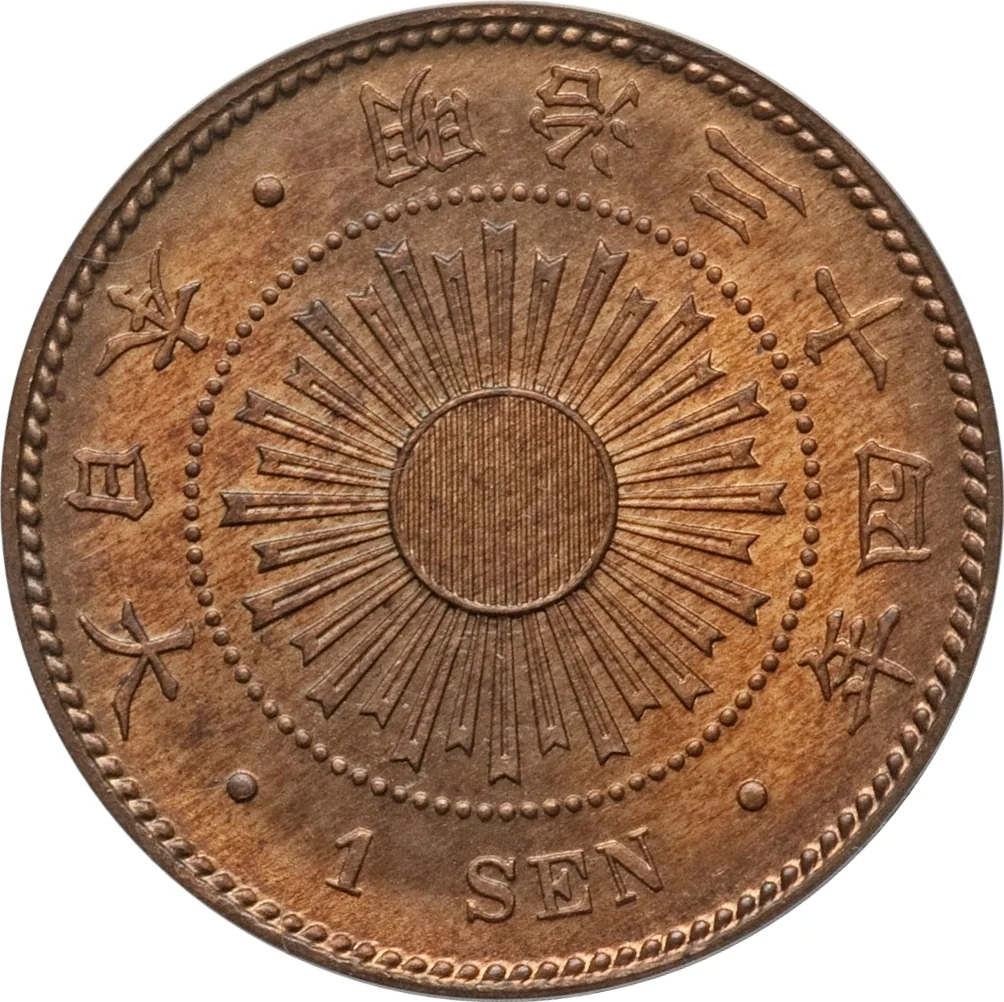
Description:
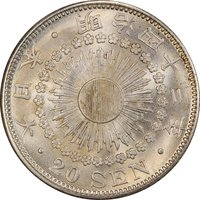
Beaded circle with radiant sun, encircled by text.
Inscription:
年 四十三 治 明 · 本 日 大 ·
· 1 SEN ·
· 1 SEN ·
Translation:
Forty-three years of enlightened rule; Origin: Great Japan;
1 SEN
1 SEN
Language: Japanese
Edge
Plain
Mints
| Name | Mark |
|---|---|
| Japan Mint | — |
Mintings
| Year | Mint Mark | Mintage | Quality | Collection |
|---|---|---|---|---|
| 1898 | — | 3,649,498 | ||
| 1899 | — | 9,764,028 | ||
| 1900 | — | 3,086,524 | ||
| 1901 | — | 5,555,155 | ||
| 1902 | — | 4,444,845 | ||
| 1906 | — | — | Proof | |
| 1909 | — | — | ||
| 1911 | — | — |
Historical background
In 1898, Japan's currency system was in a pivotal period of consolidation under the Gold Standard, which had been formally adopted in 1897 through the Currency Act. This move was a direct strategic response to the financial strains of the First Sino-Japanese War (1894-95) and was driven by the urgent need to stabilize the yen, control inflation, and integrate Japan into the global economic order. The indemnity of 230 million taels of silver paid by China following the war provided the crucial gold reserves needed to back this transition, replacing the previous, unstable silver-based system.
The new system established the yen as the sole unit of currency, with its value fixed at 0.75 grams of pure gold. This brought immediate benefits: it curbed the wild fluctuations of the silver-based yen, attracted foreign investment by providing exchange rate certainty, and facilitated international trade and borrowing. The Bank of Japan, founded in 1882, now operated as the central bank within this disciplined framework, issuing convertible banknotes (the "Bank of Japan notes") that were fully backed by gold reserves, thereby restoring public and international confidence in the currency.
However, this rigid system also created underlying tensions. The fixed exchange rate limited monetary policy flexibility, making the economy vulnerable to external gold flows. Furthermore, while the gold standard symbolized Japan's arrival as a modern imperial power, it also intensified the drive for industrial expansion and foreign aggression to secure the resources and capital needed to maintain its gold reserves. Thus, the currency situation in 1898 represented both the achievement of hard-won financial stability and the foundation for the economic pressures and imperial ambitions that would characterize the coming decades.
The new system established the yen as the sole unit of currency, with its value fixed at 0.75 grams of pure gold. This brought immediate benefits: it curbed the wild fluctuations of the silver-based yen, attracted foreign investment by providing exchange rate certainty, and facilitated international trade and borrowing. The Bank of Japan, founded in 1882, now operated as the central bank within this disciplined framework, issuing convertible banknotes (the "Bank of Japan notes") that were fully backed by gold reserves, thereby restoring public and international confidence in the currency.
However, this rigid system also created underlying tensions. The fixed exchange rate limited monetary policy flexibility, making the economy vulnerable to external gold flows. Furthermore, while the gold standard symbolized Japan's arrival as a modern imperial power, it also intensified the drive for industrial expansion and foreign aggression to secure the resources and capital needed to maintain its gold reserves. Thus, the currency situation in 1898 represented both the achievement of hard-won financial stability and the foundation for the economic pressures and imperial ambitions that would characterize the coming decades.
🌱 Fairly Common