

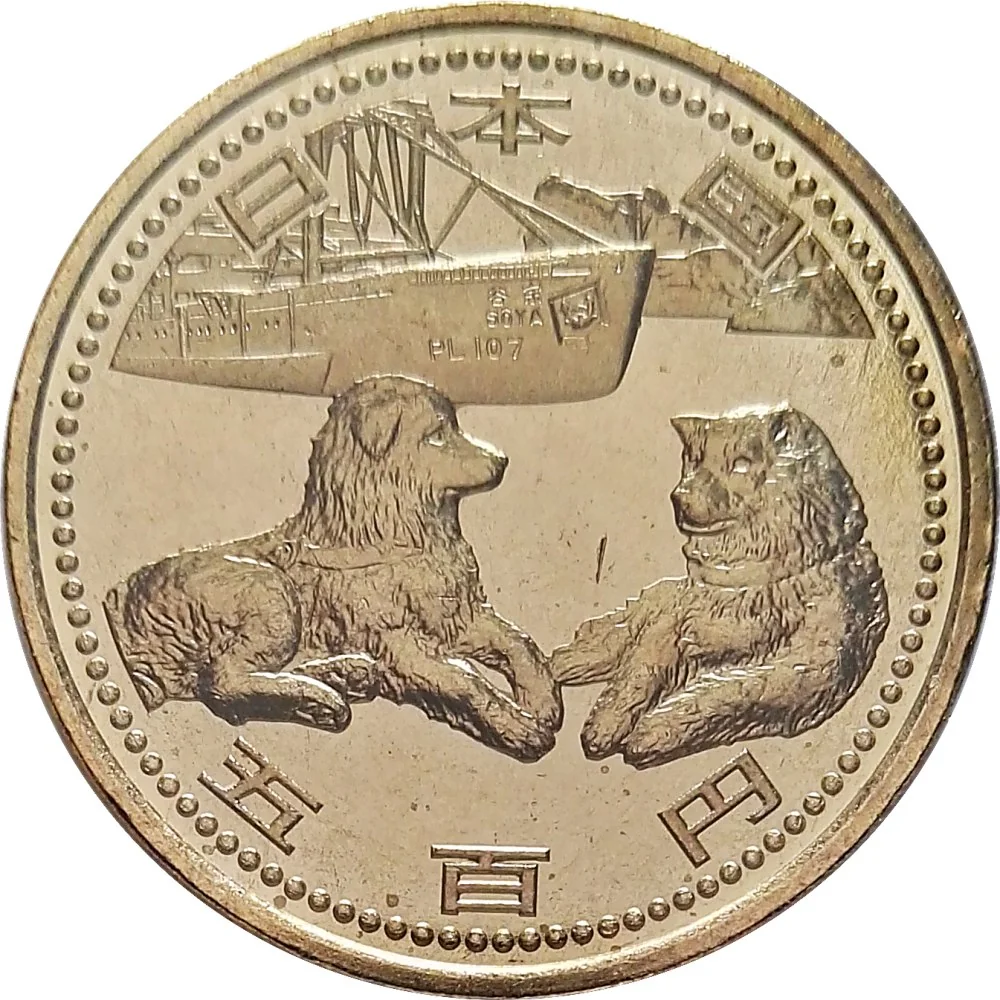
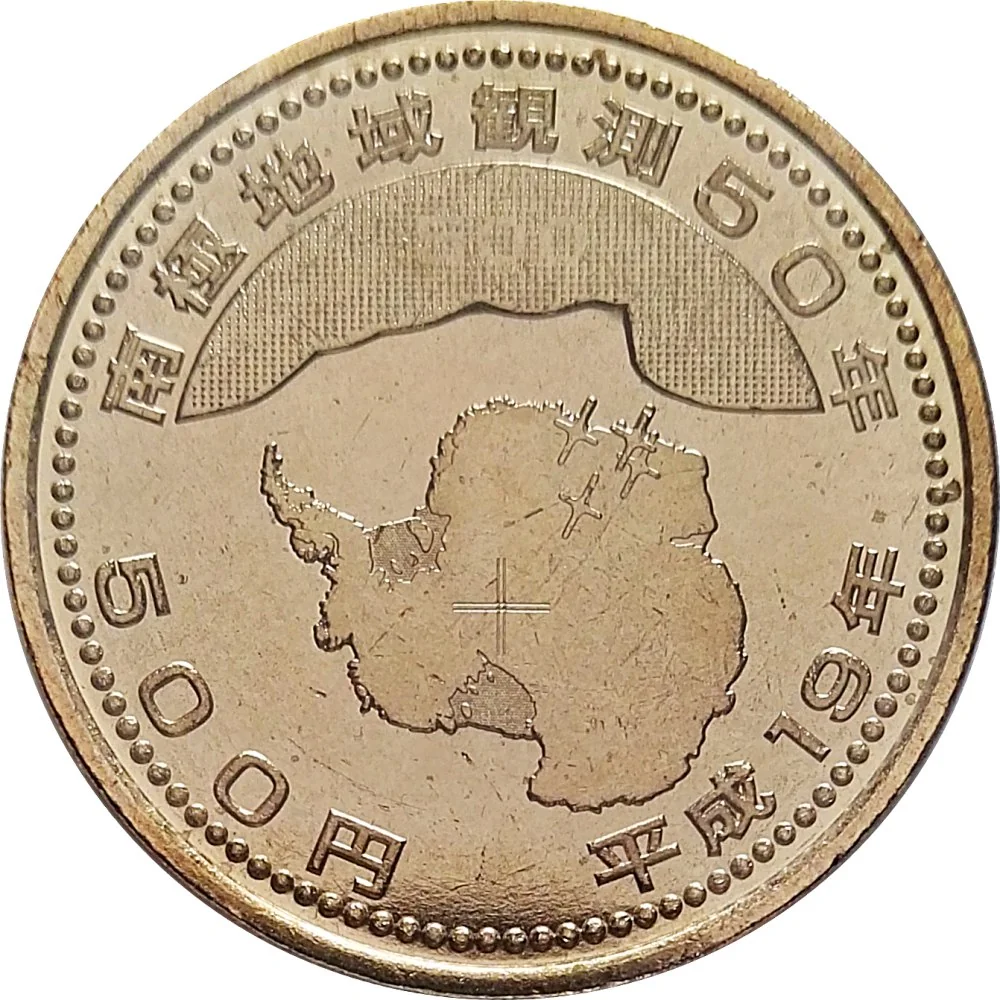
500 Yen (Japanese Antarctic Research) – Japan
Circulating commemorative coins
Commemoration: 50th Anniversary of Japanese Antarctic Research
Japan
Context
Year: 2007
Japanese - Heisei era Year: 19
Issuer: Japan 
Ruler: Heisei
Currency:
(since 1871)
Total mintage: 6,600,000
Material
Diameter: 26.5 mm
Weight: 7 g
Shape: Round
Magnetic: No
Techniques: Latent image, Milled
Alignment: Medal alignment
flip
References
Y: #Click to copy to clipboard137
Numista: #13734
Value
Exchange value: 500 JPY = $3.20
Inflation-adjusted value: 569.76 JPY
Obverse
Reverse
Description:
Antarctica map with legends and a latent image overlay.
Inscription:
南極地域観測50年
500
500円 平成19年
500
500円 平成19年
Translation:
50th Anniversary of Antarctic Research
500
500 Yen, Heisei 19
500
500 Yen, Heisei 19
Language: Japanese
Edge
Slanted reeding
Categories
| Animal> Dog |
| Map |
| Transportation> Watercraft |
Mintings
| Year | Mint Mark | Mintage | Quality | Collection |
|---|---|---|---|---|
| 2007 | — | 6,600,000 |
Historical background
In 2007, Japan's currency situation was characterized by the persistent challenge of the yen carry trade and a period of relative weakness for the yen against major currencies, particularly the US dollar. After years of near-zero interest rates aimed at combating deflation, the yen had become a favored source of cheap funding for global investors. They would borrow in yen at minimal cost and invest in higher-yielding assets abroad, primarily in currencies like the Australian and New Zealand dollars or emerging market assets. This constant selling pressure kept the yen subdued for much of the year, with the USD/JPY rate trading in a range generally above 115, reaching a peak near 124 in June—a level not seen since 2002.
Domestically, the Bank of Japan (BOJ) was in a cautious normalization phase. In February 2007, it raised the benchmark interest rate to 0.5%, a second incremental hike after ending the zero-interest-rate policy in 2006. This move was a tentative step away from the ultra-loose monetary policy that had defined the post-bubble era, driven by growing confidence in a sustained economic recovery and mild inflation. However, the BOJ remained highly sensitive to any threat of derailing fragile growth or re-igniting deflation, leading to a prolonged pause in further rate hikes. The domestic economy was experiencing its longest post-war expansion, yet wage growth remained stagnant, and deflationary pressures, while easing, had not been fully vanquished.
The dynamic shifted notably in the latter half of 2007 as the subprime mortgage crisis in the United States began to escalate into a global financial turmoil. This triggered a classic "flight to safety," where investors unwound risky carry trades and repatriated funds to the perceived safety of the Japanese yen. Consequently, the yen embarked on a sharp, sustained appreciation in the final months of the year, beginning a reversal that would accelerate dramatically in 2008. Thus, 2007 served as a pivotal transition year, ending a period of yen weakness fueled by the carry trade and setting the stage for the yen's surge as a safe-haven currency during the impending global financial crisis.
Domestically, the Bank of Japan (BOJ) was in a cautious normalization phase. In February 2007, it raised the benchmark interest rate to 0.5%, a second incremental hike after ending the zero-interest-rate policy in 2006. This move was a tentative step away from the ultra-loose monetary policy that had defined the post-bubble era, driven by growing confidence in a sustained economic recovery and mild inflation. However, the BOJ remained highly sensitive to any threat of derailing fragile growth or re-igniting deflation, leading to a prolonged pause in further rate hikes. The domestic economy was experiencing its longest post-war expansion, yet wage growth remained stagnant, and deflationary pressures, while easing, had not been fully vanquished.
The dynamic shifted notably in the latter half of 2007 as the subprime mortgage crisis in the United States began to escalate into a global financial turmoil. This triggered a classic "flight to safety," where investors unwound risky carry trades and repatriated funds to the perceived safety of the Japanese yen. Consequently, the yen embarked on a sharp, sustained appreciation in the final months of the year, beginning a reversal that would accelerate dramatically in 2008. Thus, 2007 served as a pivotal transition year, ending a period of yen weakness fueled by the carry trade and setting the stage for the yen's surge as a safe-haven currency during the impending global financial crisis.
🌟 Limited