

500 yen (Emperor Heisei) – Japan
Circulating commemorative coins
Commemoration: 10th Anniversary of the Reign of Emperor Heisei
Japan
Context
Year: 1999
Japanese - Heisei era Year: 11
Issuer: Japan 
Ruler: Heisei
Currency:
(since 1871)
Total mintage: 15,000,000
Material
References
Y: #Click to copy to clipboard123
Numista: #13620
Value
Exchange value: 500 JPY = $3.21
Inflation-adjusted value: 553.20 JPY
Obverse
Description:
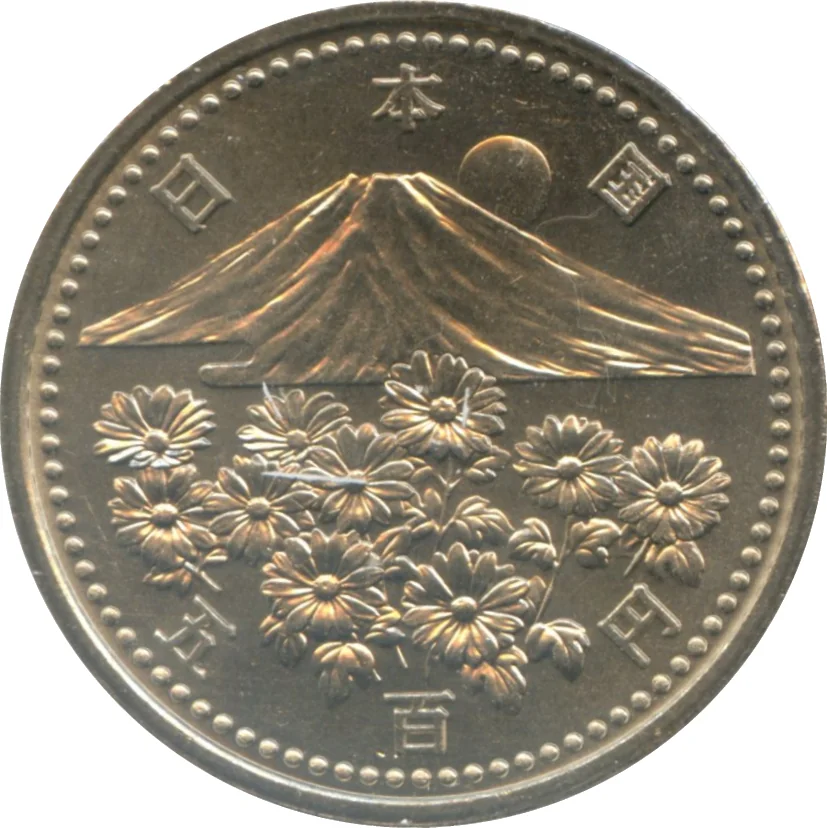
Mt. Fuji, moon above, chrysanthemums below. Authority over value.
Inscription:
日 本 国
五 百 円
五 百 円
Translation:
Japan
500 Yen
500 Yen
Language: Japanese
Reverse
Description:
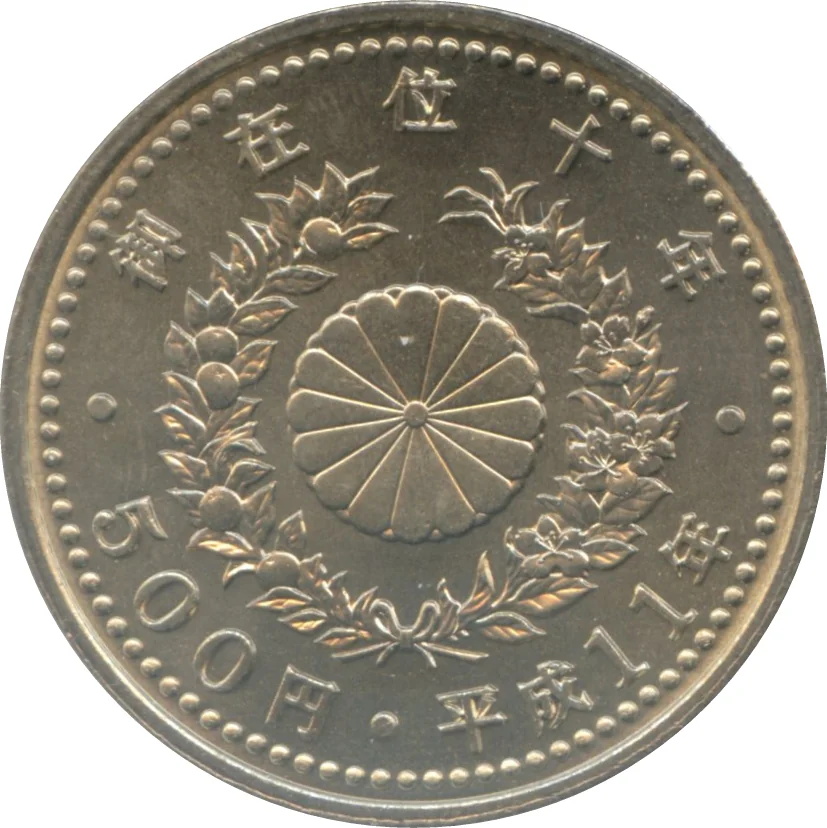
Chrysanthemum in wreath, encircled by text.
Inscription:
• 御在位十年 •
500 Yen • 平成11年
500 Yen • 平成11年
Translation:
The 10th Year of the Reign
500 Yen • Heisei 11 (1999)
500 Yen • Heisei 11 (1999)
Language: Japanese
Edge
Mintings
| Year | Mint Mark | Mintage | Quality | Collection |
|---|---|---|---|---|
| 1999 | — | 14,900,000 | ||
| 1999 | — | 100,000 | Proof |
Historical background
In 1999, Japan found itself mired in a prolonged period of economic stagnation and deflation known as the "Lost Decade." The bursting of the asset price bubble in the early 1990s had left the banking system burdened with non-performing loans, crippling business investment and consumer confidence. This deflationary environment—where falling prices encouraged consumers to delay spending in anticipation of even lower prices—created a vicious cycle that traditional monetary policy struggled to break. Interest rates were already near zero, limiting the Bank of Japan's (BOJ) conventional tools to stimulate the economy.
It was within this context that the BOJ made a historic policy shift in February 1999 by pioneering the "zero interest rate policy" (ZIRP), effectively guiding the uncollateralized overnight call rate to zero percent. This was a landmark moment in global monetary policy, representing the world's first formal commitment to a zero-interest-rate framework. The primary goal was to combat deflationary pressures by providing massive liquidity to the financial system and lowering longer-term interest rates across the yield curve. The policy was explicitly conditioned on the BOJ being convinced that deflationary concerns were dispelled.
The currency situation was directly impacted by these domestic struggles and policy responses. The yen experienced significant volatility, influenced by the stark interest rate differential with the United States, where the Federal Reserve was in a tightening cycle. While ZIRP aimed to weaken the yen to boost exports, its effect was often muted by the yen's traditional role as a safe-haven currency; during times of global financial stress, capital would flow into Japan despite its low yields. Thus, in 1999, the yen's value reflected a tension between Japan's weak domestic fundamentals and its persistent safe-haven status, all under the shadow of an unprecedented and uncertain zero-rate experiment.
It was within this context that the BOJ made a historic policy shift in February 1999 by pioneering the "zero interest rate policy" (ZIRP), effectively guiding the uncollateralized overnight call rate to zero percent. This was a landmark moment in global monetary policy, representing the world's first formal commitment to a zero-interest-rate framework. The primary goal was to combat deflationary pressures by providing massive liquidity to the financial system and lowering longer-term interest rates across the yield curve. The policy was explicitly conditioned on the BOJ being convinced that deflationary concerns were dispelled.
The currency situation was directly impacted by these domestic struggles and policy responses. The yen experienced significant volatility, influenced by the stark interest rate differential with the United States, where the Federal Reserve was in a tightening cycle. While ZIRP aimed to weaken the yen to boost exports, its effect was often muted by the yen's traditional role as a safe-haven currency; during times of global financial stress, capital would flow into Japan despite its low yields. Thus, in 1999, the yen's value reflected a tension between Japan's weak domestic fundamentals and its persistent safe-haven status, all under the shadow of an unprecedented and uncertain zero-rate experiment.
🌟 Limited