

500 Yen (Governmental Cabinet System) – Japan
Circulating commemorative coins
Commemoration: 100th anniversary of Governmental Cabinet System
Japan
Context
Year: 1985
Japanese - Shōwa era Year: 60
Issuer: Japan 
Ruler: Shōwa
Currency:
(since 1871)
Total mintage: 70,000,000
Material
References
Y: #Click to copy to clipboard89
Numista: #13608
Value
Exchange value: 500 JPY = $3.20
Inflation-adjusted value: 661.96 JPY
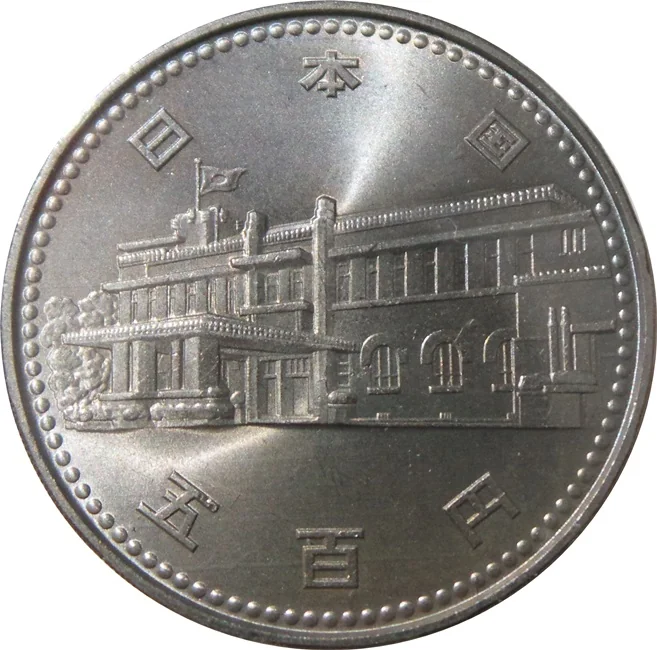
Obverse
Description:
Power above, worth beneath.
Inscription:
日 本 国
五 百 円
五 百 円
Translation:
Japan
500 Yen
500 Yen
Language: Japanese
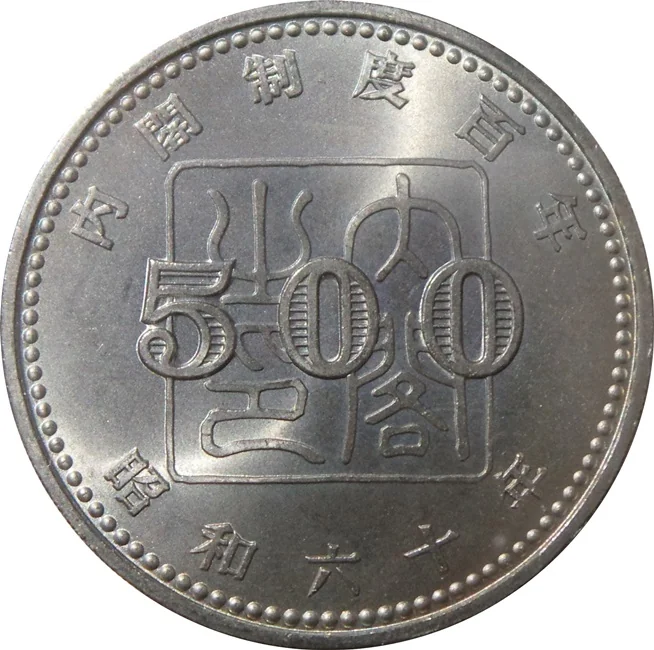
Reverse
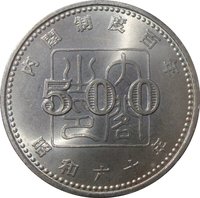
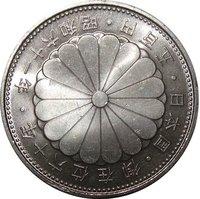
Description:
Premium seal, text atop, date beneath.
Inscription:
内閣制度百年
500
之内
印閣
昭和六十年
500
之内
印閣
昭和六十年
Translation:
Cabinet System Centennial
500
Within
Printing Bureau
Showa 60
500
Within
Printing Bureau
Showa 60
Language: Japanese
Mintings
| Year | Mint Mark | Mintage | Quality | Collection |
|---|---|---|---|---|
| 1985 | — | 70,000,000 |
Historical background
In 1985, Japan's currency situation was dominated by the dramatic and coordinated international effort known as the Plaza Accord. The agreement, signed in September at New York's Plaza Hotel by the finance ministers of the G5 nations (the US, Japan, West Germany, France, and the UK), aimed to correct what was seen as a severe misalignment of major currencies, particularly the overvalued US dollar. The yen was a primary target, as it was considered significantly undervalued, giving Japanese exporters a massive competitive advantage and contributing to large and growing trade imbalances, especially with the United States. The explicit goal was to engineer an orderly depreciation of the dollar through concerted foreign exchange intervention.
The immediate impact of the Plaza Accord was swift and profound. The yen, which had been trading at roughly 240 to the US dollar in the months leading up to the agreement, began a historic and relentless appreciation. Within two years, it would roughly double in value, reaching around 120 yen to the dollar by 1988. This sharp rise, or endaka, presented a severe challenge to Japan's export-driven economic model, as it made Japanese goods like cars and electronics more expensive overseas and squeezed corporate profits. The Japanese government and the Bank of Japan responded with aggressive monetary easing, slashing interest rates to counter the deflationary pressure of the strong yen and to stimulate domestic demand.
Consequently, the currency situation of 1985 set in motion a chain of events with far-reaching consequences. The combination of a soaring yen and ultra-low interest rates, intended as a short-term remedy, created a massive surplus of cheap capital. This liquidity flooded into financial assets and real estate, fueling rampant speculation and inflating a colossal asset-price bubble in stocks and property. While the Plaza Accord successfully reduced the US trade deficit, its aftermath in Japan was the genesis of the "bubble economy" of the late 1980s, which would eventually collapse and lead to the country's "Lost Decade" of economic stagnation in the 1990s. Thus, 1985 stands as a pivotal year where currency policy directly reshaped Japan's economic trajectory for decades to come.
The immediate impact of the Plaza Accord was swift and profound. The yen, which had been trading at roughly 240 to the US dollar in the months leading up to the agreement, began a historic and relentless appreciation. Within two years, it would roughly double in value, reaching around 120 yen to the dollar by 1988. This sharp rise, or endaka, presented a severe challenge to Japan's export-driven economic model, as it made Japanese goods like cars and electronics more expensive overseas and squeezed corporate profits. The Japanese government and the Bank of Japan responded with aggressive monetary easing, slashing interest rates to counter the deflationary pressure of the strong yen and to stimulate domestic demand.
Consequently, the currency situation of 1985 set in motion a chain of events with far-reaching consequences. The combination of a soaring yen and ultra-low interest rates, intended as a short-term remedy, created a massive surplus of cheap capital. This liquidity flooded into financial assets and real estate, fueling rampant speculation and inflating a colossal asset-price bubble in stocks and property. While the Plaza Accord successfully reduced the US trade deficit, its aftermath in Japan was the genesis of the "bubble economy" of the late 1980s, which would eventually collapse and lead to the country's "Lost Decade" of economic stagnation in the 1990s. Thus, 1985 stands as a pivotal year where currency policy directly reshaped Japan's economic trajectory for decades to come.
🌱 Fairly Common