

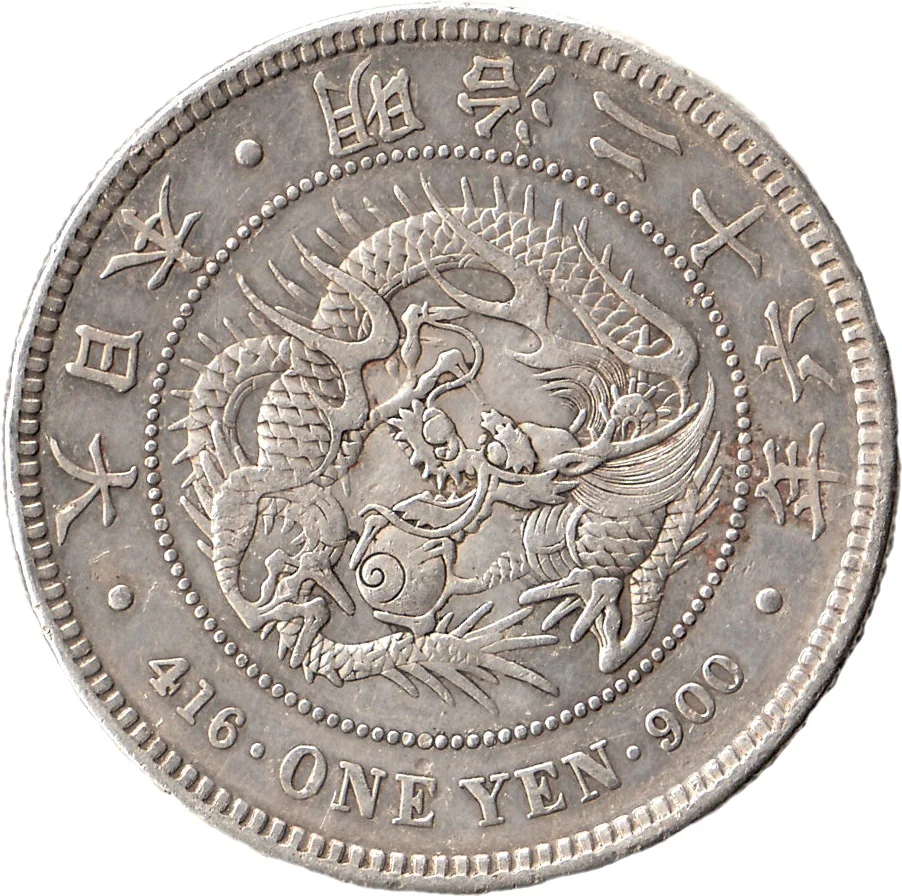
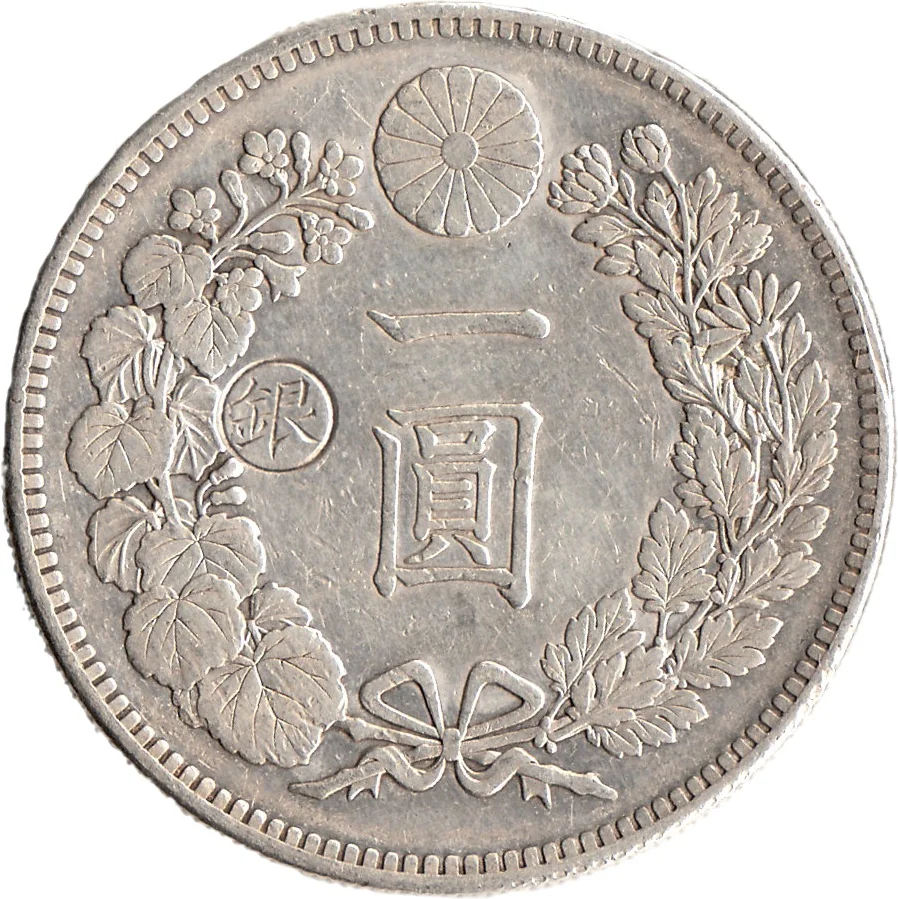
1 yen – Japan
Add to wishlist
Japan
Material
Diameter: 38.1 mm
Weight: 26.96 g
Silver Weight:: 24.26 g
Thickness: 2.76 mm
Shape: Round
Composition: 90% Silver
Magnetic: No
Techniques: Milled, Countermarked
Alignment: Coin alignment
flip
References
Y: #
Numista: #135906
Value
Exchange value: 1 JPY
Bullion value: $59.52
Obverse
Reverse
Description:
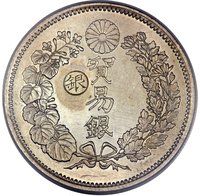
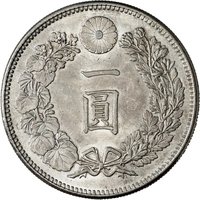
Chrysanthemum and paulownia branches flank the value, counterstamped on the left.
Inscription:
銀 一
圓
圓
Translation:
One Silver Yen
Language: Japanese
Edge
Reeded
Categories
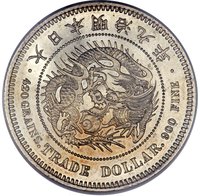
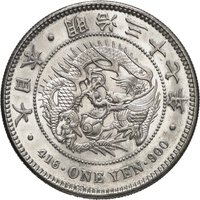
| Mythology> Fantastic animal |
Mints
| Name | Mark |
|---|---|
| Japan Mint | — |
Mintings
| Year | Mint Mark | Mintage | Quality | Collection |
|---|---|---|---|---|
| 1887 | — | — | ||
| 1888 | — | — | ||
| 1889 | — | — | ||
| 1890 | — | — | ||
| 1891 | — | — | ||
| 1892 | — | — | ||
| 1893 | — | — | ||
| 1894 | — | — | ||
| 1895 | — | — | ||
| 1896 | — | — | ||
| 1897 | — | — |
Historical background
In 1887, Japan was in the midst of a profound monetary transformation under the Meiji government's drive to modernize and strengthen the nation. The period was characterized by the transition from a complex, feudal-era system of gold, silver, and paper notes issued by both the central government and former feudal domains (hansatsu) to a unified, modern currency. The foundational Bank of Japan, established in 1882, had taken over note issuance, but the monetary landscape remained unstable. A critical problem was severe inflation triggered by the earlier government's decision to convert samurai stipends into lump-sum interest-bearing bonds and to finance modernization through the printing of non-convertible paper money. By the mid-1880, this had led to a drastic depreciation of paper currency against silver, disrupting trade and public confidence.
Finance Minister Matsukata Masayoshi's sweeping deflationary policies, initiated in 1881, were reaching a pivotal point by 1887. His strategy involved sharply increasing taxes, selling off government-owned industries to private interests (the zaibatsu), and strictly controlling the money supply to accumulate specie reserves. The goal was to establish a silver-convertible currency, moving Japan onto a de facto silver standard, which was the dominant system for Asian trade at the time. By 1885, the Bank of Japan had issued its first convertible banknotes (the "Daikokusatsu"), and by 1887, these notes were gaining acceptance, gradually replacing the old, discredited paper. The Matsukata financial retrenchment successfully ended the rampant inflation but came at a high social cost, including widespread agrarian distress and the consolidation of wealth into fewer hands.
Thus, the currency situation in 1887 was one of cautious stabilization and consolidation. The government was actively retiring old non-convertible notes and building the silver reserves needed to fully back the new yen. While the worst of the financial chaos was over, the economy was still adjusting to the harsh medicine of deflation. This period laid the essential groundwork for the Currency Act of 1897, which would later move Japan to the gold standard following the windfall from the Sino-Japanese War, marking the final step in Japan's integration into the Western-dominated international monetary system.
Finance Minister Matsukata Masayoshi's sweeping deflationary policies, initiated in 1881, were reaching a pivotal point by 1887. His strategy involved sharply increasing taxes, selling off government-owned industries to private interests (the zaibatsu), and strictly controlling the money supply to accumulate specie reserves. The goal was to establish a silver-convertible currency, moving Japan onto a de facto silver standard, which was the dominant system for Asian trade at the time. By 1885, the Bank of Japan had issued its first convertible banknotes (the "Daikokusatsu"), and by 1887, these notes were gaining acceptance, gradually replacing the old, discredited paper. The Matsukata financial retrenchment successfully ended the rampant inflation but came at a high social cost, including widespread agrarian distress and the consolidation of wealth into fewer hands.
Thus, the currency situation in 1887 was one of cautious stabilization and consolidation. The government was actively retiring old non-convertible notes and building the silver reserves needed to fully back the new yen. While the worst of the financial chaos was over, the economy was still adjusting to the harsh medicine of deflation. This period laid the essential groundwork for the Currency Act of 1897, which would later move Japan to the gold standard following the windfall from the Sino-Japanese War, marking the final step in Japan's integration into the Western-dominated international monetary system.
⭐ Somewhat Rare