


1 Ruble – Soviet Union
Circulating commemorative coins
Commemoration: International Year of Peace
Russia
Context
Years: 1986–1988
Year: 1986
Country: Russia 
Issuer: Soviet Union 
Period:
(1922—1991)
Currency:
(1961—1991)
Demonetization: 1991
Total mintage: 4,000,000
Material
Diameter: 31 mm
Weight: 12.9 g
Thickness: 2.2 mm
Shape: Round
Composition: Copper-nickel
Technique: Milled
Alignment: Medal alignment
flip

References
Y: #Click to copy to clipboard201.1
Numista: #4606
Value
Exchange value: 1 SUR
Obverse
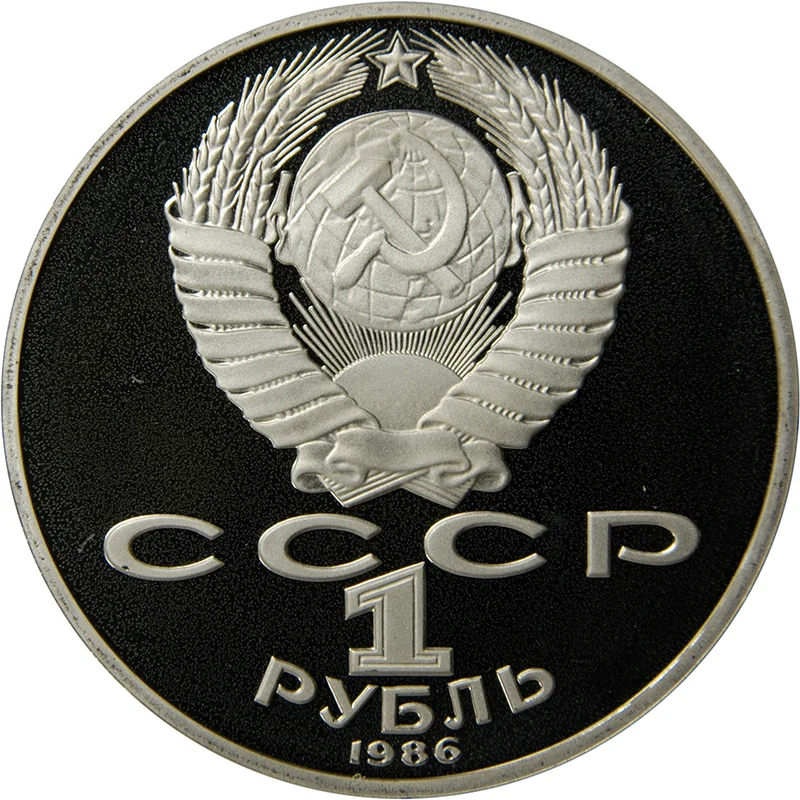
Description:
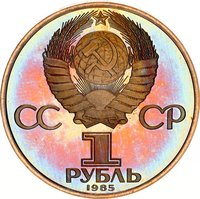
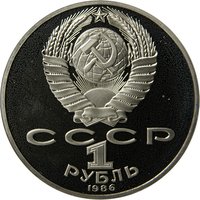
The Soviet Union's coat of arms; value.
Inscription:
СССР
1
РУБЛЬ
1986
1
РУБЛЬ
1986
Translation:
THE USSR
1
RUBLE
1986
1
RUBLE
1986
Script: Cyrillic
Language: Russian
Engraver: Sergey Mikhaylovich Ivanov
Reverse
Description:
Stylised hands releasing a dove.
Inscription:
МЕЖДУНАРОДНЫЙ ГОД МИРА
Translation:
INTERNATIONAL YEAR OF PEACE
Script: Cyrillic
Language: Russian
Engraver: Pavel Konstantinovich Potapov
Edge
Smooth with inscription
Legend:
Y#201.3 : ОДИН РУБЛЬ • ОДИН РУБЛЬ •
Y#201.4 : ОДИН РУБЛЬ • 1988 • Н •
Y#201.4 : ОДИН РУБЛЬ • 1988 • Н •
Translation:
ONE RUBLE • ONE RUBLE •
Language: Russian;
ONE RUBLE • 1988 • N •
Language: Russian;
ONE RUBLE • 1988 • N •
Language: Russian
Categories
| Animal> Bird |
| Organization> United Nations |
| History> Peace |
Mints
| Name | Mark |
|---|---|
| Saint Petersburg | — |
Mintings
| Year | Mint Mark | Mintage | Quality | Collection |
|---|---|---|---|---|
| 1986 | — | 3,955,000 | ||
| 1986 | — | 45,000 | Proof | |
| 1988 | — | — | Proof | |
| 1988 | — | — |
Historical background
By 1986, the Soviet Union's currency situation was characterized by a profound and worsening duality. Officially, the ruble was a non-convertible, state-controlled currency with an artificially high exchange rate (around 0.64 rubles to the US dollar) set by Gosbank. This "paper" ruble existed within the planned economy, where prices for basic goods were heavily subsidized and stable, but chronic shortages meant money often could not buy available goods. Savings accumulated in "ruble overhang," as citizens had few avenues for meaningful consumption, eroding the currency's real purchasing power and trust.
Alongside this official system thrived a vast shadow economy and a second, far more meaningful currency: the U.S. dollar and other hard currencies. Access to dollars, either from black market exchanges, remittances, or special state bonuses, was essential for purchasing quality or deficit goods in the beryozka stores (hard currency shops) or on the black market. This created a stark divide in society: those with access to valyuta (hard currency) lived in a parallel economy of relative abundance, while those reliant solely on rubles faced queues and empty shelves, despite having savings.
The situation was a glaring symptom of the systemic failures of the command economy, which Mikhail Gorbachev's reforms of perestroika and uskoreniye (acceleration) were beginning to expose but could not yet fix. The 1986 Law on Individual Labor Activity and discussions about enterprise self-financing hinted at a future need for monetary reform, but in the short term, they only increased the disconnect between controlled prices and economic reality. The currency duality thus symbolized the broader crisis: the ruble was increasingly a unit of account within a failing system, while real economic value and social privilege were measured in a foreign currency the state could not control.
Alongside this official system thrived a vast shadow economy and a second, far more meaningful currency: the U.S. dollar and other hard currencies. Access to dollars, either from black market exchanges, remittances, or special state bonuses, was essential for purchasing quality or deficit goods in the beryozka stores (hard currency shops) or on the black market. This created a stark divide in society: those with access to valyuta (hard currency) lived in a parallel economy of relative abundance, while those reliant solely on rubles faced queues and empty shelves, despite having savings.
The situation was a glaring symptom of the systemic failures of the command economy, which Mikhail Gorbachev's reforms of perestroika and uskoreniye (acceleration) were beginning to expose but could not yet fix. The 1986 Law on Individual Labor Activity and discussions about enterprise self-financing hinted at a future need for monetary reform, but in the short term, they only increased the disconnect between controlled prices and economic reality. The currency duality thus symbolized the broader crisis: the ruble was increasingly a unit of account within a failing system, while real economic value and social privilege were measured in a foreign currency the state could not control.
🌱 Very Common