

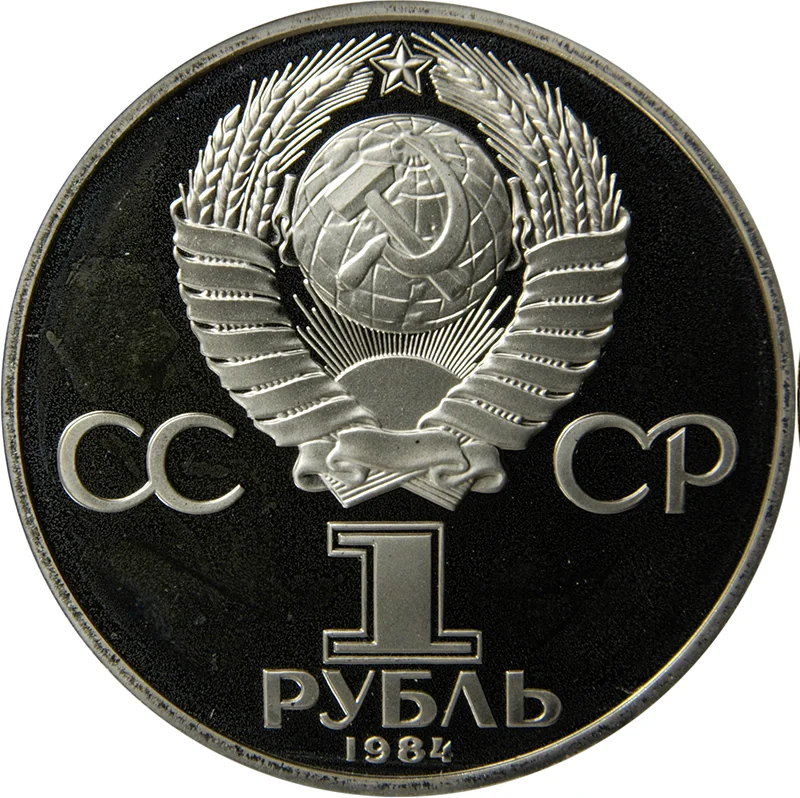
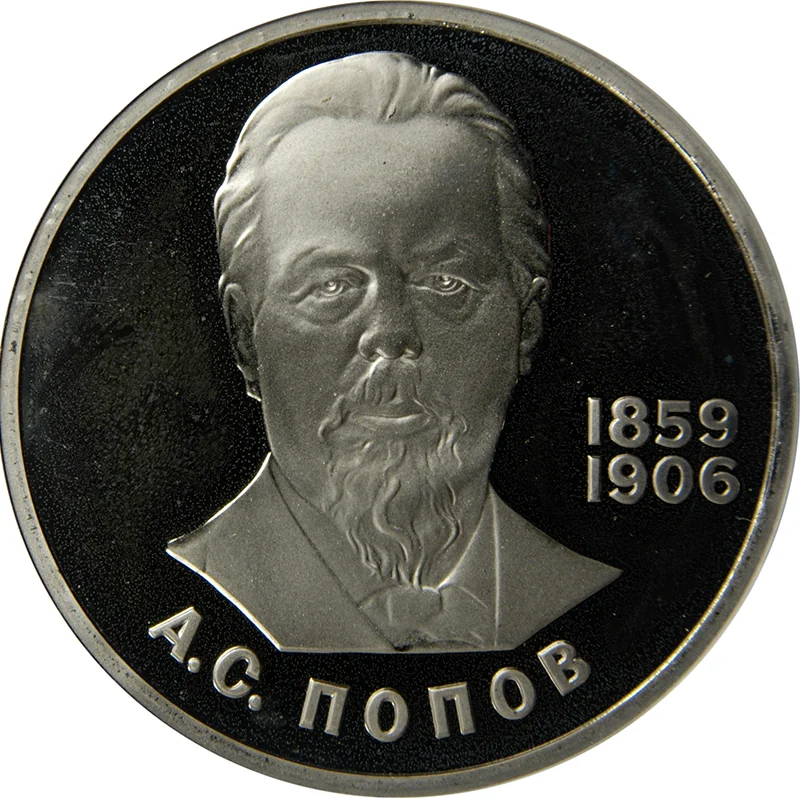
1 Ruble (Aleksandr Stepanovich Popov) – Soviet Union
Circulating commemorative coins
Commemoration: 125th Anniversary of the Birth of Aleksandr Stepanovich Popov
Russia
Context
Years: 1984–1988
Year: 1984
Country: Russia 
Issuer: Soviet Union 
Period:
(1922—1991)
Currency:
(1961—1991)
Demonetization: 1991
Total mintage: 2,055,000
Material
Diameter: 31 mm
Weight: 12.8 g
Thickness: 2.3 mm
Shape: Round
Composition: Copper-nickel
Technique: Milled
Alignment: Medal alignment
flip
References
Y: #Click to copy to clipboard195.1
Numista: #4603
Value
Exchange value: 1 SUR
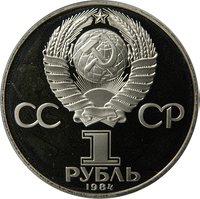
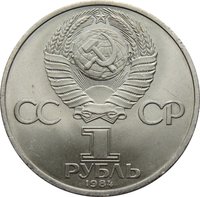
Obverse
Reverse
Description:
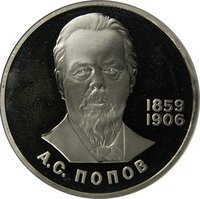
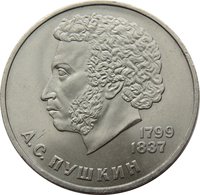
Bust of Alexander Popov, with his life years "1859–1906" and the inscription "A.S. POPOV". He was a Russian physicist who pioneered practical applications of radio waves.
Inscription:
1859
1906
А.С. ПОПОВ
1906
А.С. ПОПОВ
Translation:
1859
1906
A.S. POPOV
1906
A.S. POPOV
Script: Cyrillic
Language: Russian
Engraver: I.S. Komshilov
Edge
Smooth with inscription
Legend:
Y#195.1 : ОДИН РУБЛЬ • ОДИН РУБЛЬ •
Y#195.2 : ОДИН РУБЛЬ • 1988 • Н •
Y#195.2 : ОДИН РУБЛЬ • 1988 • Н •
Translation:
ONE RUBLE • ONE RUBLE •
Language: Russian;
ONE RUBLE • 1988 • N •
Language: Russian;
ONE RUBLE • 1988 • N •
Language: Russian
Categories
| Event> Birth anniversary |
| Science |
Mints
| Name | Mark |
|---|---|
| Saint Petersburg | — |
Mintings
| Year | Mint Mark | Mintage | Quality | Collection |
|---|---|---|---|---|
| 1984 | — | 1,965,000 | ||
| 1984 | — | 35,000 | Proof | |
| 1988 | — | 55,000 | Proof |
Historical background
In 1984, the Soviet Union's currency situation was characterized by a stark duality between the official, state-controlled economy and the informal, often illegal, shadow market. The ruble was a non-convertible "soft currency," meaning it could not be legally exchanged for foreign currencies like the US dollar or used outside the Soviet bloc. Its value was set artificially high by the state (around 0.6 rubles to 1 USD officially), but this rate was meaningless for ordinary citizens, who had no access to foreign goods at that price. Internally, the ruble functioned within a system of chronic shortages, where having money did not guarantee the ability to purchase desired goods, from basic groceries to automobiles.
This environment fostered a vast second economy where the ruble's real purchasing power was determined by underground bargaining and scarcity. While wages were stable and low, with an average monthly income of about 180 rubles, significant items like a car could cost 10,000 rubles, requiring years of saving. More critically, access to quality goods or services often required blat (connections) or transactions on the black market, where prices were significantly higher. Alongside this, a special parallel economy existed for the elite and foreigners, who used "certificate rubles" or hard currency (like USD) to shop in exclusive Beryozka stores stocked with imported luxuries and deficit goods unavailable to the general public.
The underlying cause was the rigid central planning system, which set prices without regard to supply or demand, leading to massive subsidies for basic goods and persistent imbalances. By 1984, the currency situation was a clear symptom of economic stagnation. The ruble's isolation and the thriving black market undermined official economic statistics and planning, eroding public confidence in the state's economic management. This unstable monetary environment, though not yet in crisis, created pervasive distortions that would become a critical pressure point as Mikhail Gorbachev's reforms began just a year later.
This environment fostered a vast second economy where the ruble's real purchasing power was determined by underground bargaining and scarcity. While wages were stable and low, with an average monthly income of about 180 rubles, significant items like a car could cost 10,000 rubles, requiring years of saving. More critically, access to quality goods or services often required blat (connections) or transactions on the black market, where prices were significantly higher. Alongside this, a special parallel economy existed for the elite and foreigners, who used "certificate rubles" or hard currency (like USD) to shop in exclusive Beryozka stores stocked with imported luxuries and deficit goods unavailable to the general public.
The underlying cause was the rigid central planning system, which set prices without regard to supply or demand, leading to massive subsidies for basic goods and persistent imbalances. By 1984, the currency situation was a clear symptom of economic stagnation. The ruble's isolation and the thriving black market undermined official economic statistics and planning, eroding public confidence in the state's economic management. This unstable monetary environment, though not yet in crisis, created pervasive distortions that would become a critical pressure point as Mikhail Gorbachev's reforms began just a year later.
🌱 Common