

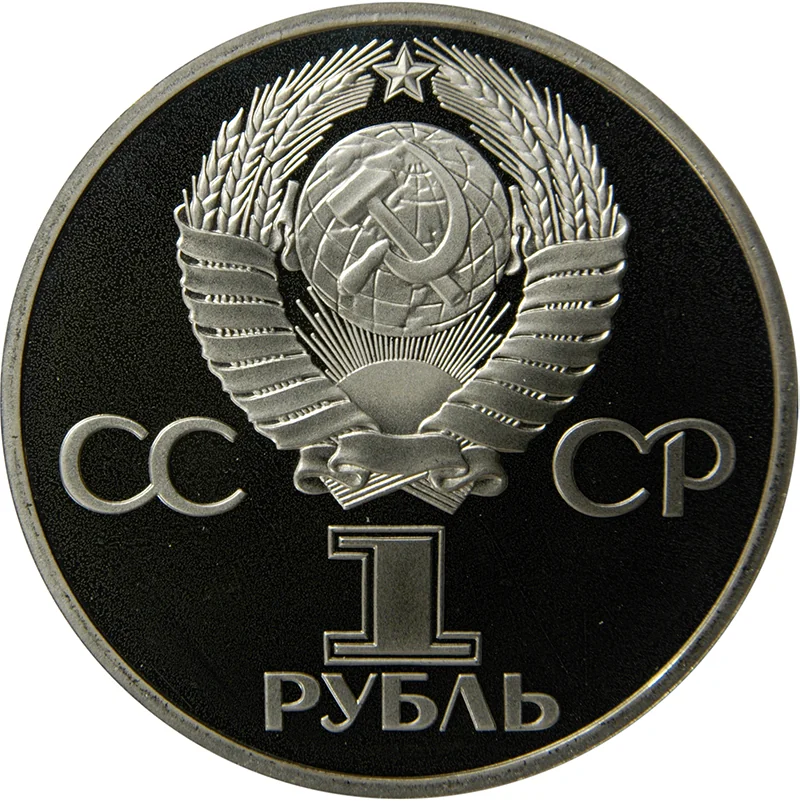
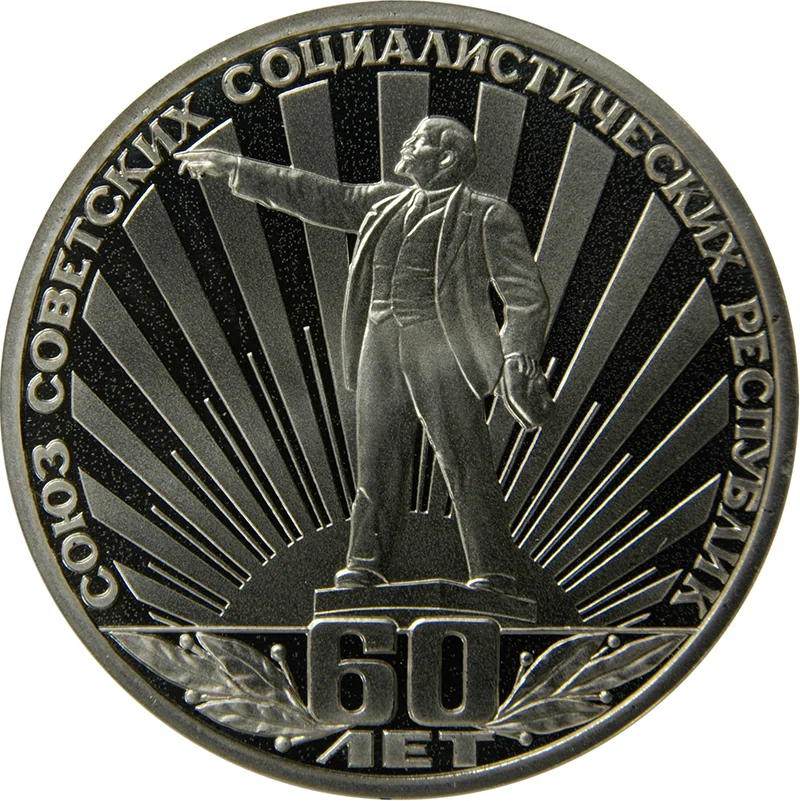
1 Ruble (Soviet Union) – Soviet Union
Circulating commemorative coins
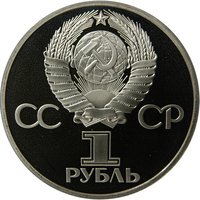
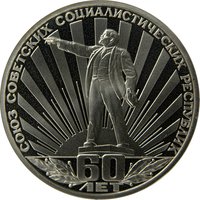
Commemoration: 60th Anniversary of the Soviet Union
Russia
Context
Years: 1982–1988
Year: 1988
Country: Russia 
Issuer: Soviet Union 
Period:
(1922—1991)
Currency:
(1961—1991)
Demonetization: 1991
Total mintage: 2,055,000
Material
Diameter: 31 mm
Weight: 12.8 g
Thickness: 2.3 mm
Shape: Round
Composition: Copper-nickel
Technique: Milled
Alignment: Medal alignment
flip
References
Y: #Click to copy to clipboard190.1
Numista: #4601
Value
Exchange value: 1 SUR
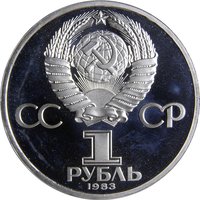
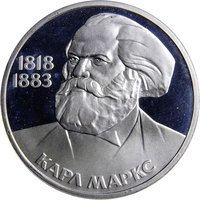
Obverse
Reverse
Edge
Smooth with inscription
Legend:
ОДИН РУБЛЬ • ОДИН РУБЛЬ •
Translation:
ONE RUBLE • ONE RUBLE •
Language: Russian
Mints
| Name | Mark |
|---|---|
| Saint Petersburg | — |
Mintings
| Year | Mint Mark | Mintage | Quality | Collection |
|---|---|---|---|---|
| 1982 | — | 1,921,000 | ||
| 1982 | — | 79,000 | Proof | |
| 1988 | — | 55,000 | Proof |
Historical background
By 1982, the Soviet Union's currency system was a study in profound contradictions, characterized by strict official control masking growing underlying instability. The ruble was a non-convertible "wooden" currency, meaning it could not be legally exchanged for foreign currencies or taken out of the country. Its value was set artificially high by the state (around 0.67 rubles to the US dollar) for propaganda purposes, bearing no relation to its actual purchasing power or the health of the economy. Domestically, this official ruble functioned within a vast, inefficient planned economy where most prices were fixed and shortages of basic goods were increasingly common.
Beneath this facade, a critical duality existed: the parallel circulation of a special "certificate ruble" for foreign trade and a thriving black market. For international transactions, the state used a separate, convertible currency known as the chemodan or "certificate" ruble, valued significantly lower (closer to 4-6 to the dollar). More importantly, within the USSR itself, a vast shadow economy operated where goods and services unavailable through state stores could be obtained for hard currency (like US dollars or Deutsche Marks) or through blat (connections). This created a de facto multi-tiered system that severely undermined the official ruble's legitimacy.
The root cause was the stagnating economy of the Brezhnev era, exacerbated by falling global oil prices after 1981—a crucial source of hard currency for the state. To finance imports and cover budget deficits, the government was secretly increasing the money supply, leading to suppressed inflation known as the "ruble overhang." This was a massive accumulation of ruble savings in state banks with few desirable goods to purchase, creating immense pent-up demand. While price controls prevented open inflation, the phenomenon manifested as empty shelves, long queues, and a growing reliance on the black market, setting the stage for the monetary crises that would erupt during the perestroika reforms later in the decade.
Beneath this facade, a critical duality existed: the parallel circulation of a special "certificate ruble" for foreign trade and a thriving black market. For international transactions, the state used a separate, convertible currency known as the chemodan or "certificate" ruble, valued significantly lower (closer to 4-6 to the dollar). More importantly, within the USSR itself, a vast shadow economy operated where goods and services unavailable through state stores could be obtained for hard currency (like US dollars or Deutsche Marks) or through blat (connections). This created a de facto multi-tiered system that severely undermined the official ruble's legitimacy.
The root cause was the stagnating economy of the Brezhnev era, exacerbated by falling global oil prices after 1981—a crucial source of hard currency for the state. To finance imports and cover budget deficits, the government was secretly increasing the money supply, leading to suppressed inflation known as the "ruble overhang." This was a massive accumulation of ruble savings in state banks with few desirable goods to purchase, creating immense pent-up demand. While price controls prevented open inflation, the phenomenon manifested as empty shelves, long queues, and a growing reliance on the black market, setting the stage for the monetary crises that would erupt during the perestroika reforms later in the decade.
🌱 Common