

1 Ruble (Victory over fascist Germany) – Soviet Union
Circulating commemorative coins
Commemoration: 20th Anniversary of the Victory over fascist Germany
Russia
Context
Years: 1965–1988
Year: 1965
Country: Russia 
Issuer: Soviet Union 
Period:
(1922—1991)
Currency:
(1961—1991)
Demonetization: 1991
Total mintage: 60,055,250
Material
Diameter: 31 mm
Weight: 9.85 g
Thickness: 1.9 mm
Shape: Round
Composition: Nickel brass
Magnetic: No
Technique: Milled
Alignment: Medal alignment
flip
References
Value
Exchange value: 1 SUR
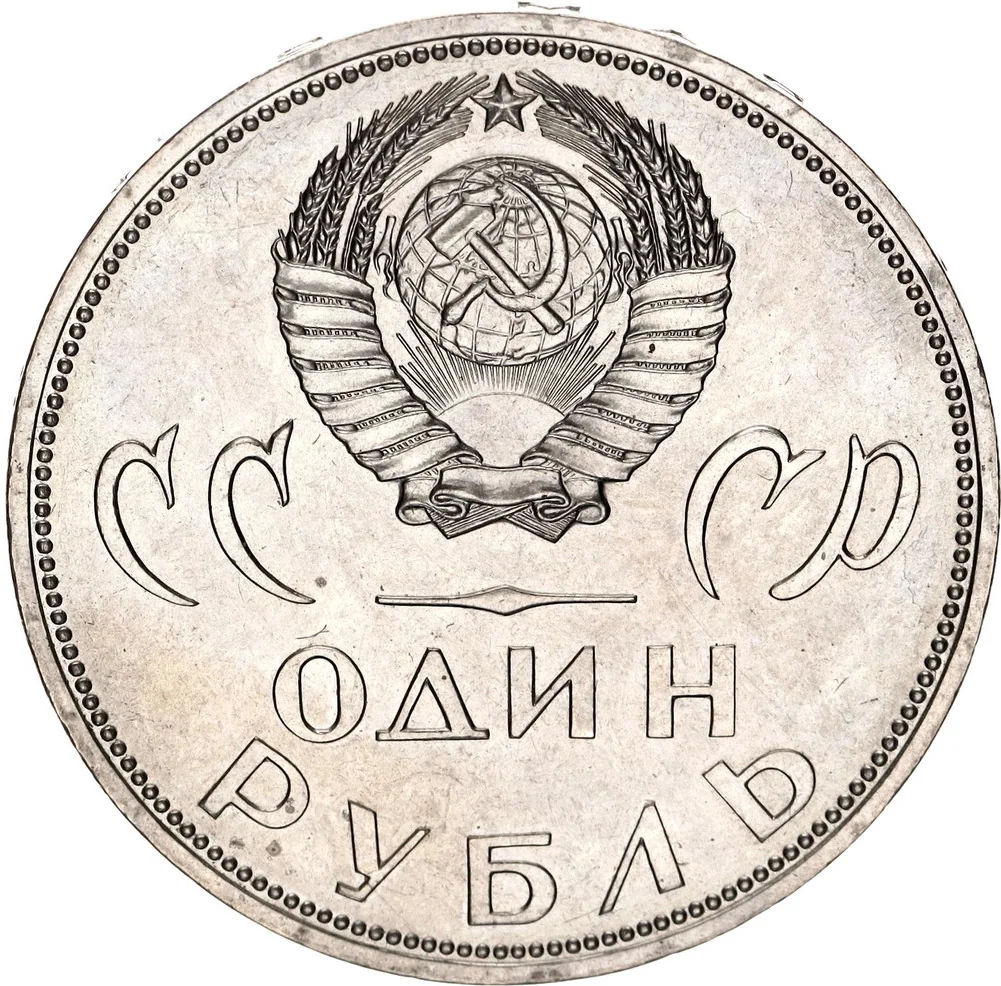
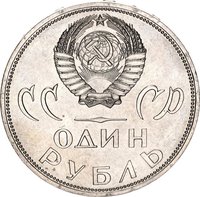
Obverse
Description:
Soviet emblem above the value.
Inscription:
СС СР
ОДИН
РУБЛЬ
ОДИН
РУБЛЬ
Translation:
ONE
RUBLE
RUBLE
Script: Cyrillic
Language: Russian
Engraver: Nikolay Sokolov
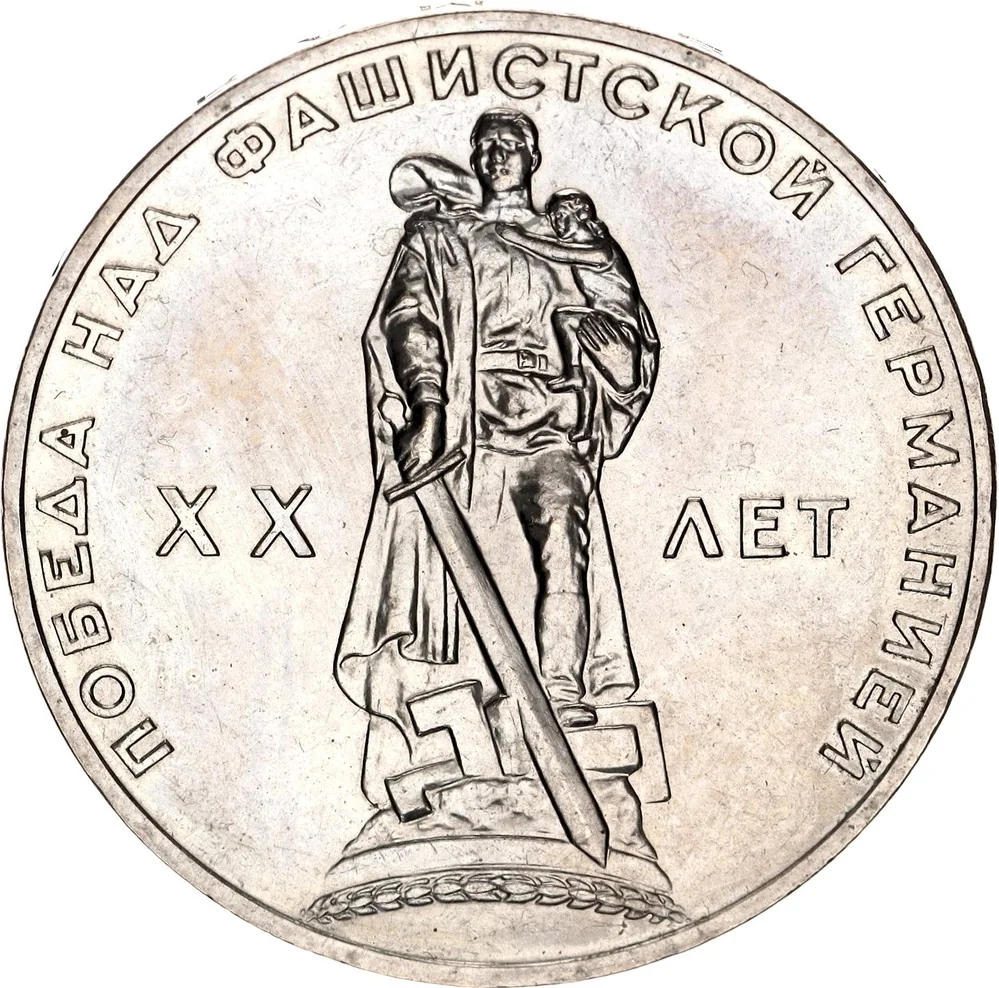
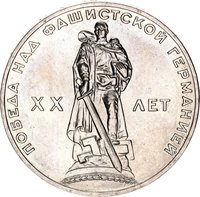
Reverse
Description:
Soviet War Memorial in Treptow Park, Berlin.
Inscription:
ПОБЕДА НАД ФАШИСТСКОЙ ГЕРМАНИЕЙ
XX ЛЕТ
XX ЛЕТ
Translation:
Victory over Fascist Germany
XX Years
XX Years
Script: Cyrillic
Language: Russian
Engraver: Alexander Vasilievich Kozlov
Edge
Plain with incuse lettering
Legend:
ОДИН РУБЛЬ ⋆ 9 МАЯ 1965 ⋆
Translation:
ONE RUBLE ⋆ 9 MAY 1965 ⋆
Language: Russian
Mints
| Name | Mark |
|---|---|
| Saint Petersburg | — |
Mintings
| Year | Mint Mark | Mintage | Quality | Collection |
|---|---|---|---|---|
| 1965 | — | 59,989,000 | ||
| 1965 | — | 11,250 | Proof | |
| 1965 | — | — | Prooflike | |
| 1988 | — | 55,000 | Proof |
Historical background
By 1965, the Soviet Union’s currency system was a study in contrasts, defined by the strict separation of the domestic "ruble zone" from the global economy. Internally, the State Bank (Gosbank) issued the Soviet ruble (SUR), which was a non-convertible administrative instrument rather than a market-driven currency. Its value was set arbitrarily by the state, with an official exchange rate wildly divorced from reality—pegged at 0.90 rubles to the US dollar for propaganda purposes, while the actual economic worth, as reflected on the limited black market, was closer to 6-10 rubles per dollar. This system facilitated central planning, but masked severe inefficiencies and a growing gap between the money supply and the availability of quality consumer goods.
The domestic economy operated on a dual monetary track. The cash ruble was used by the population for everyday transactions in the consumer sector, which was chronically plagued by shortages and queues. Simultaneously, a separate system of "non-cash" or "transferable" rubles existed exclusively for state-owned enterprises to record transactions within the planned economy. This artificial division prevented citizens from accessing the funds in the industrial sector, but it also allowed the state to hide the true cost of production and subsidize essential goods, creating an illusion of stability.
Internationally, the ruble was virtually meaningless for trade. Soviet foreign trade was conducted through a handful of state banks using hard currency reserves (like dollars or gold) or through complex bilateral barter agreements with other Comecon countries. A separate "transferable ruble" was used for accounting within the Eastern Bloc, but it was not a real currency and could not be converted. Thus, by 1965, the Soviet monetary situation was stable on the surface but fundamentally fragile, insulating the population from world prices while accumulating the distortions that would contribute to stagnation in the following decades.
The domestic economy operated on a dual monetary track. The cash ruble was used by the population for everyday transactions in the consumer sector, which was chronically plagued by shortages and queues. Simultaneously, a separate system of "non-cash" or "transferable" rubles existed exclusively for state-owned enterprises to record transactions within the planned economy. This artificial division prevented citizens from accessing the funds in the industrial sector, but it also allowed the state to hide the true cost of production and subsidize essential goods, creating an illusion of stability.
Internationally, the ruble was virtually meaningless for trade. Soviet foreign trade was conducted through a handful of state banks using hard currency reserves (like dollars or gold) or through complex bilateral barter agreements with other Comecon countries. A separate "transferable ruble" was used for accounting within the Eastern Bloc, but it was not a real currency and could not be converted. Thus, by 1965, the Soviet monetary situation was stable on the surface but fundamentally fragile, insulating the population from world prices while accumulating the distortions that would contribute to stagnation in the following decades.
🌱 Very Common