

100 Kurush – Ottoman Empire
Turkey
Context
Years: 1909–1914
Islamic (Hijri) Year: 1327
Country: Turkey 
Issuer: Ottoman Empire
Ruler: Mehmed V Reşâd
Currency:
(1844—1923)
Demonetized: Yes
Total mintage: 210,942
Material
References
KM: #Click to copy to clipboard755
Numista: #119339
Value
Bullion value: $1075.12
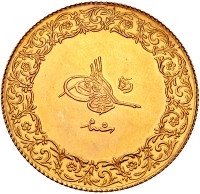
Obverse
Description:
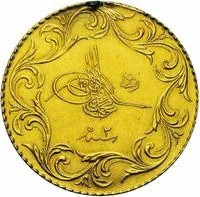
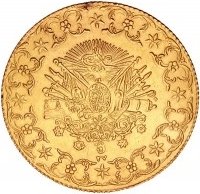
Toughra in a wavy wreath.
Script: Arabic
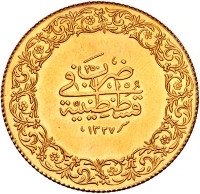
Reverse
Description:
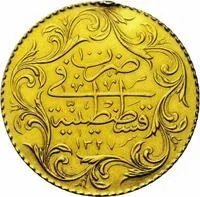
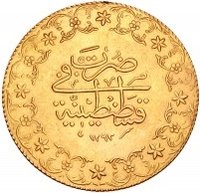
Date, denomination, and text inside a wavy wreath.
Script: Arabic
Edge
Mints
| Name | Mark |
|---|---|
| Constantinople | — |
Mintings
| Year | Mint Mark | Mintage | Quality | Collection |
|---|---|---|---|---|
| 1909 | — | — | ||
| 1910 | — | 37,110 | ||
| 1911 | — | 53,738 | ||
| 1912 | — | 41,507 | ||
| 1913 | — | 58,819 | ||
| 1914 | — | 19,768 |
Historical background
By 1909, the Ottoman Empire’s currency system was a complex and fragile reflection of its broader political and economic decline. The empire operated on a bimetallic standard in theory, but in practice it relied heavily on the kaime, a paper currency that was chronically depreciated and deeply distrusted by the public. The primary silver coin was the kuruş, with 100 kuruş making one gold lira, but the value of these coins fluctuated wildly against foreign currencies. Decades of fiscal mismanagement, massive external debt, and trade deficits had led to severe inflation and a loss of monetary sovereignty, with many transactions in major port cities conducted in foreign gold coins like the British sovereign or French franc.
This instability was institutionalized by the Ottoman Public Debt Administration (OPDA), established in 1881 by European creditor powers. The OPDA took direct control of key state revenues to service the empire's colossal debt, severely limiting the government's financial autonomy. Consequently, attempts to reform the currency or issue stable paper money were hamstrung by a lack of credible fiscal reserves and international oversight. The monetary landscape was a patchwork of various coins, both Ottoman and foreign, circulating at values determined more by market forces and metal content than by official decree.
The Young Turk Revolution of 1908, which restored the constitution, brought hopes of comprehensive reform, including to the chaotic currency. The new government in 1909 inherited this dire monetary situation as an immediate crisis. Stabilizing the currency was understood as essential for modernizing the state, restoring economic confidence, and asserting national sovereignty. However, the fundamental weaknesses—empty treasuries, ongoing debt, and the need for foreign loans—meant that any lasting solution would be extraordinarily difficult to achieve, setting the stage for future attempts at monetary unification and the eventual establishment of a new national bank.
This instability was institutionalized by the Ottoman Public Debt Administration (OPDA), established in 1881 by European creditor powers. The OPDA took direct control of key state revenues to service the empire's colossal debt, severely limiting the government's financial autonomy. Consequently, attempts to reform the currency or issue stable paper money were hamstrung by a lack of credible fiscal reserves and international oversight. The monetary landscape was a patchwork of various coins, both Ottoman and foreign, circulating at values determined more by market forces and metal content than by official decree.
The Young Turk Revolution of 1908, which restored the constitution, brought hopes of comprehensive reform, including to the chaotic currency. The new government in 1909 inherited this dire monetary situation as an immediate crisis. Stabilizing the currency was understood as essential for modernizing the state, restoring economic confidence, and asserting national sovereignty. However, the fundamental weaknesses—empty treasuries, ongoing debt, and the need for foreign loans—meant that any lasting solution would be extraordinarily difficult to achieve, setting the stage for future attempts at monetary unification and the eventual establishment of a new national bank.
✨ Legendary