

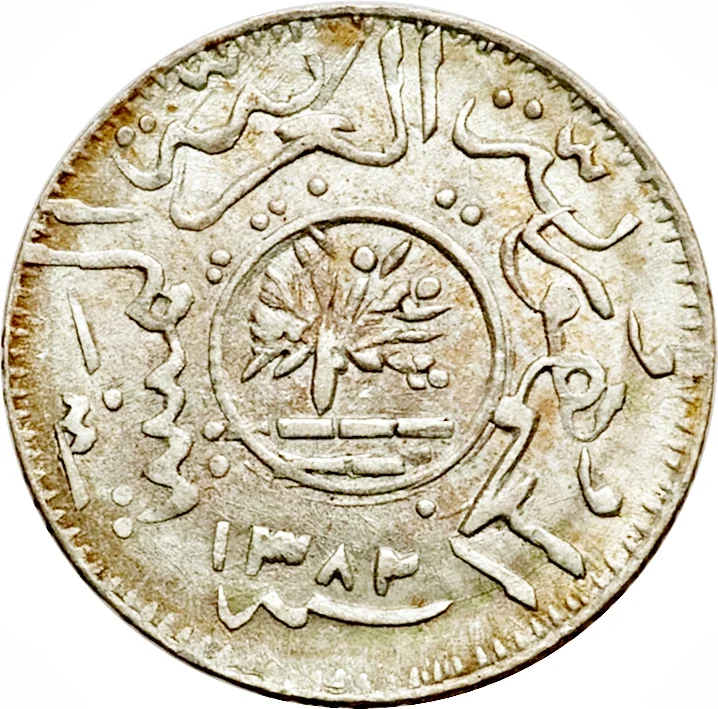
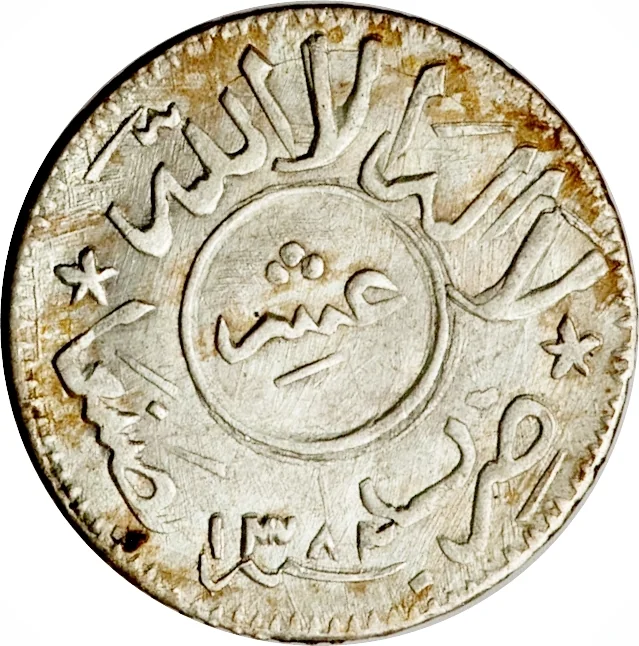
⅒ rial – North Yemen
Add to wishlist
Yemen
Context
Years: 1962–1963
Islamic (Hijri) Year:: 1382
Country: Yemen
Issuer: North Yemen
Period:
(1962—1990)
Currency:
(1918—1974)
Demonetized: Yes
Material
References
Y: #
Numista: #39072
Value
Bullion value: $2.99
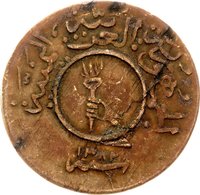
Obverse
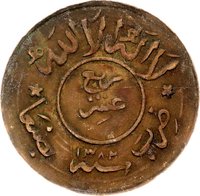
Reverse
Edge
Edge varieties exist
Mintings
| Year | Mint Mark | Mintage | Quality | Collection |
|---|---|---|---|---|
| 1962 | — | — | ||
| 1963 | — | — |
Historical background
In 1962, the currency situation in North Yemen (the Yemen Arab Republic) was defined by fragmentation and transition following the September revolution that overthrew the Mutawakkilite Kingdom. The new republican government, immediately recognized and supported by Egypt, faced the dual challenge of establishing its legitimacy and unifying a country divided by civil war between royalist and republican factions. Economically, this meant asserting control over a monetary system where the primary circulating coin was the Imadi Riyal, a silver coin named after Imam Ahmad that had been the kingdom's standard unit. However, its circulation was inconsistent, and barter remained common in many rural areas, reflecting the underdeveloped and localized nature of the economy.
The revolution accelerated a shift towards a more modern, centralized currency. The new government quickly moved to replace the old Imadi Riyal, issuing new banknotes for the Yemeni Rial as a fiat currency. These early republican notes, printed in Cairo and bearing simple designs, were symbolic instruments of the new state's authority. However, their acceptance and circulation were largely confined to urban centers and areas under firm republican control, while royalist-held regions in the north and east continued to use older coinage or relied on traditional forms of exchange. This created a de facto dual monetary system split along political and geographic lines.
Furthermore, the currency landscape was complicated by the influx of foreign money due to the proxy nature of the civil war. Saudi Arabia, supporting the royalists, funneled gold sovereigns and Maria Theresa thalers to its allies, while Egypt, backing the republic, pumped its own resources and currency into the areas it militarily occupied. This injection of external funds distorted local economies and underscored how North Yemen's money supply was not yet under sovereign control but was instead a reflection of the broader regional power struggle. Thus, in 1962, North Yemen's currency was less a unified national instrument and more a patchwork of old coins, new paper, and foreign specie, mirroring the country's profound political fragmentation.
The revolution accelerated a shift towards a more modern, centralized currency. The new government quickly moved to replace the old Imadi Riyal, issuing new banknotes for the Yemeni Rial as a fiat currency. These early republican notes, printed in Cairo and bearing simple designs, were symbolic instruments of the new state's authority. However, their acceptance and circulation were largely confined to urban centers and areas under firm republican control, while royalist-held regions in the north and east continued to use older coinage or relied on traditional forms of exchange. This created a de facto dual monetary system split along political and geographic lines.
Furthermore, the currency landscape was complicated by the influx of foreign money due to the proxy nature of the civil war. Saudi Arabia, supporting the royalists, funneled gold sovereigns and Maria Theresa thalers to its allies, while Egypt, backing the republic, pumped its own resources and currency into the areas it militarily occupied. This injection of external funds distorted local economies and underscored how North Yemen's money supply was not yet under sovereign control but was instead a reflection of the broader regional power struggle. Thus, in 1962, North Yemen's currency was less a unified national instrument and more a patchwork of old coins, new paper, and foreign specie, mirroring the country's profound political fragmentation.
💎 Extremely Rare