

100 Kurush – Ottoman Empire
Turkey
Context
Years: 1885–1908
Islamic (Hijri) Year: 1293
Country: Turkey 
Issuer: Ottoman Empire
Ruler: Abdul Hamid II
Currency:
(1844—1923)
Demonetized: Yes
Total mintage: 12,830,611
Material
References
KM: #Click to copy to clipboard730
Numista: #37640
Value
Bullion value: $1105.75
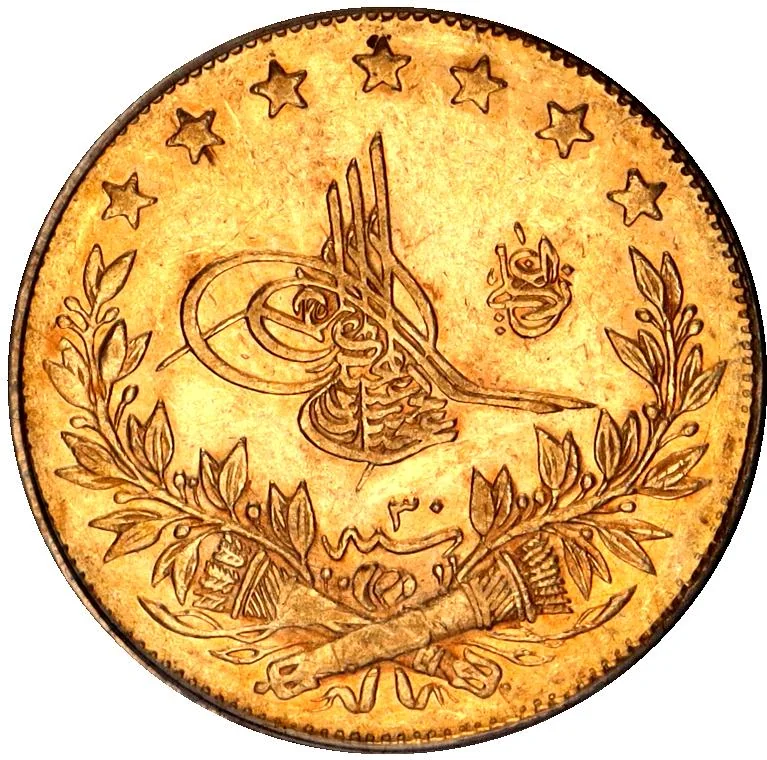
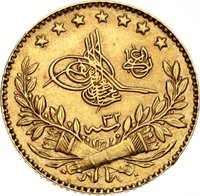
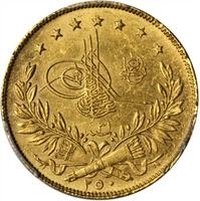
Obverse
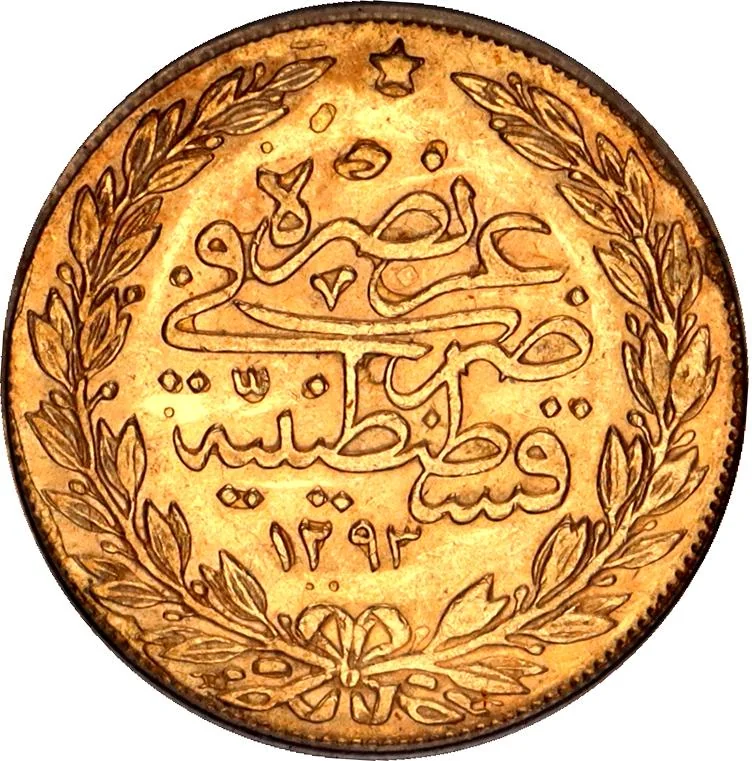
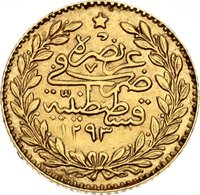
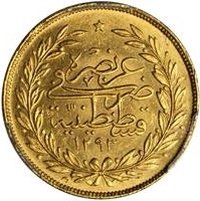
Reverse
Edge
Reeded
Mintings
| Year | Mint Mark | Mintage | Quality | Collection |
|---|---|---|---|---|
| 1885 | — | 572,000 | ||
| 1886 | — | 255,000 | ||
| 1887 | — | 2,000 | ||
| 1888 | — | 2,000 | ||
| 1889 | — | 18,000 | ||
| 1890 | — | 2,000 | ||
| 1891 | — | 722,000 | ||
| 1892 | — | 3,350 | ||
| 1893 | — | 165,000 | ||
| 1894 | — | 3,000 | ||
| 1895 | — | 728,000 | ||
| 1896 | — | 4,400 | ||
| 1897 | — | 186,000 | ||
| 1898 | — | 225,000 | ||
| 1899 | — | 2,850 | ||
| 1900 | — | 3,000 | ||
| 1901 | — | 2,000 | ||
| 1902 | — | 48,200 | ||
| 1903 | — | 865,011 | ||
| 1904 | — | 1,643,795 | ||
| 1905 | — | 2,748,448 | ||
| 1906 | — | 1,951,611 | ||
| 1907 | — | 962,672 | ||
| 1908 | — | 1,715,274 |
Historical background
By 1885, the Ottoman Empire's currency situation was a complex and precarious reflection of its broader financial and political decline. The empire operated on a bimetallic system nominally based on the kuruş (piastre) and the lira (Ottoman gold pound), but decades of fiscal mismanagement, costly wars, and heavy foreign borrowing had led to severe depreciation and chaos. A proliferation of debased coinage, including various foreign and counterfeit coins, circulated alongside official issues, creating a confusing monetary environment that hampered trade and economic stability. The state's reliance on printing paper money (kaime) to cover deficits had repeatedly ended in disastrous devaluations, eroding public trust.
The situation was fundamentally governed by the Decree of Muharrem (1881), which had established the Ottoman Public Debt Administration (OPDA). This international entity, controlled by European creditors, had taken direct charge of key state revenues to service the massive foreign debt. While this brought a measure of fiscal discipline, it also severely constrained the Porte's financial sovereignty. The OPDA's priority was debt repayment, not monetary reform, leaving the underlying structural issues of the currency unaddressed. Consequently, the silver kuruş continued to fluctuate wildly against the gold-based currencies of international trade, causing significant exchange rate instability.
Therefore, in 1885, the Ottoman monetary system was in a state of fragmented transition, caught between its archaic past and coercive external control. The government lacked both the resources and the full autonomy to implement a unified, modern currency standard. This instability discouraged investment, complicated taxation, and acted as a drag on economic development, symbolizing the empire's struggle to adapt its institutions to modern financial pressures while under the watchful eye of European powers.
The situation was fundamentally governed by the Decree of Muharrem (1881), which had established the Ottoman Public Debt Administration (OPDA). This international entity, controlled by European creditors, had taken direct charge of key state revenues to service the massive foreign debt. While this brought a measure of fiscal discipline, it also severely constrained the Porte's financial sovereignty. The OPDA's priority was debt repayment, not monetary reform, leaving the underlying structural issues of the currency unaddressed. Consequently, the silver kuruş continued to fluctuate wildly against the gold-based currencies of international trade, causing significant exchange rate instability.
Therefore, in 1885, the Ottoman monetary system was in a state of fragmented transition, caught between its archaic past and coercive external control. The government lacked both the resources and the full autonomy to implement a unified, modern currency standard. This instability discouraged investment, complicated taxation, and acted as a drag on economic development, symbolizing the empire's struggle to adapt its institutions to modern financial pressures while under the watchful eye of European powers.
⭐ Rare