

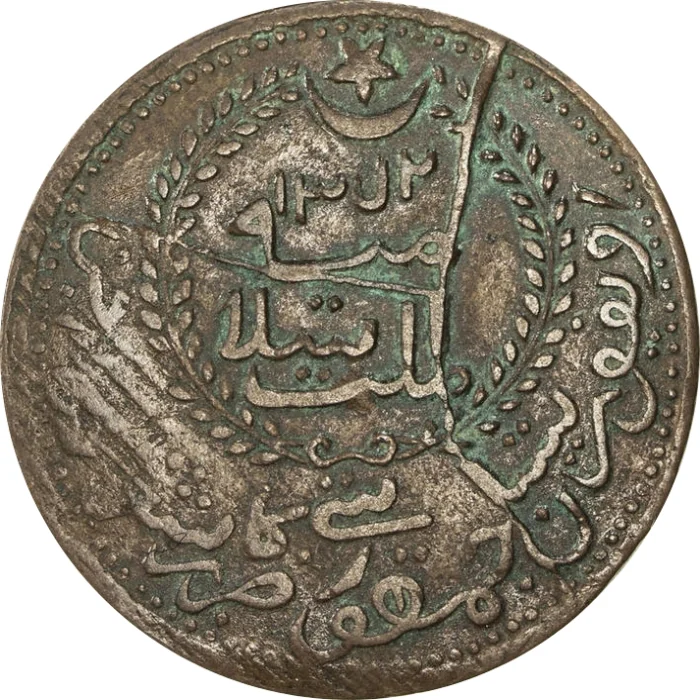
10 Cash – First East Turkestan Republic
China
Context
Years: 1933–1934
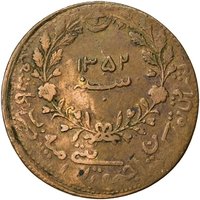
Islamic (Hijri) Year: 1352
Country: China 
Issuer: First East Turkestan Republic
Period:
(1933—1934)
Demonetized: Yes
Material
References
Y: #Click to copy to clipboardD38
Numista: #111063
Obverse
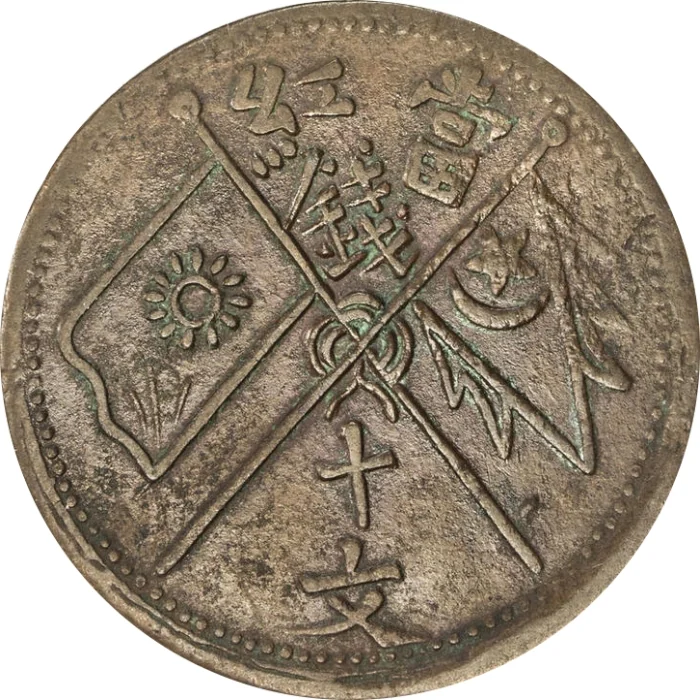
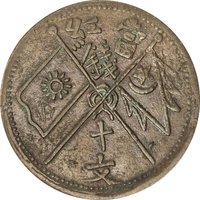
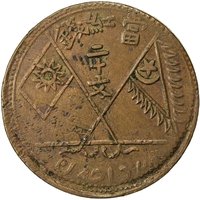
Reverse
Description:
Chinese flags with crossed characters.
Inscription:
紅當
錢
十
文
錢
十
文
Translation:
Red Dang
Cash
Ten
Coins
Cash
Ten
Coins
Language: Chinese
Edge
Plain
Mints
| Name | Mark |
|---|---|
| Kashgar Mint | — |
Mintings
| Year | Mint Mark | Mintage | Quality | Collection |
|---|---|---|---|---|
| 1933 | — | — | ||
| 1934 | — | — |
Historical background
The First East Turkestan Republic (FETR), declared in November 1933 in Kashgar, existed during a period of profound monetary chaos. The region's economy was fractured, with the preceding Xinjiang provincial government under Jin Shuren having debased its currency through excessive printing to fund military campaigns, leading to hyperinflation and a collapse in public trust. This was compounded by the circulation of multiple older currencies from various Chinese administrations, Russian Tsarist rubles, and Soviet rubles, creating a complex and unstable monetary environment where barter often became more reliable than cash.
The nascent republic, led by President Khoja Niyaz, faced the immediate challenge of establishing economic sovereignty and funding its government and army. In response, it issued its own currency, known as "Sher" or "Shinjang Pul" (Xinjiang money). These notes, printed locally with simple designs, were denominated in pul and tanga and bore Islamic symbols and text in the Uyghur Arabic script, representing a clear break from Chinese authority. The currency was intended to unify the monetary space under the republic's control and signal its independent political legitimacy.
However, the FETR's currency situation remained tenuous and ultimately short-lived. The republic's limited territorial control, constant military pressure from provincial forces allied with the Soviet Union, and a lack of substantial economic reserves or sophisticated minting capabilities meant the Sher never achieved stability or widespread acceptance. The FETR itself lasted only a few months, collapsing in early 1934, which rendered its currency obsolete. Thus, while a significant symbolic act of state-building, the FETR's monetary experiment was a practical failure, reflecting the republic's broader struggle for survival in a turbulent geopolitical context.
The nascent republic, led by President Khoja Niyaz, faced the immediate challenge of establishing economic sovereignty and funding its government and army. In response, it issued its own currency, known as "Sher" or "Shinjang Pul" (Xinjiang money). These notes, printed locally with simple designs, were denominated in pul and tanga and bore Islamic symbols and text in the Uyghur Arabic script, representing a clear break from Chinese authority. The currency was intended to unify the monetary space under the republic's control and signal its independent political legitimacy.
However, the FETR's currency situation remained tenuous and ultimately short-lived. The republic's limited territorial control, constant military pressure from provincial forces allied with the Soviet Union, and a lack of substantial economic reserves or sophisticated minting capabilities meant the Sher never achieved stability or widespread acceptance. The FETR itself lasted only a few months, collapsing in early 1934, which rendered its currency obsolete. Thus, while a significant symbolic act of state-building, the FETR's monetary experiment was a practical failure, reflecting the republic's broader struggle for survival in a turbulent geopolitical context.
✨ Legendary