

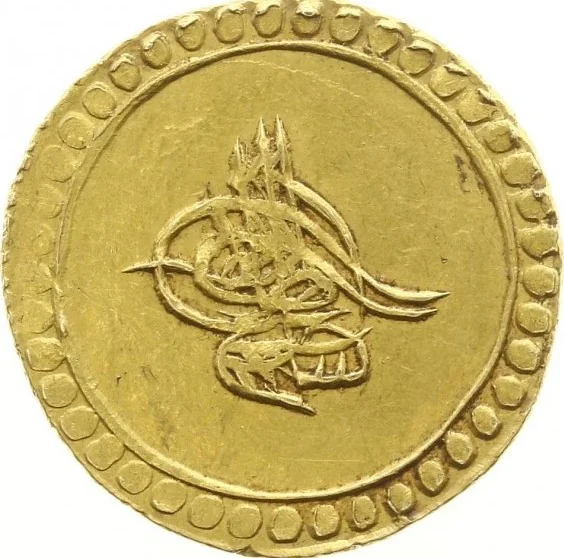
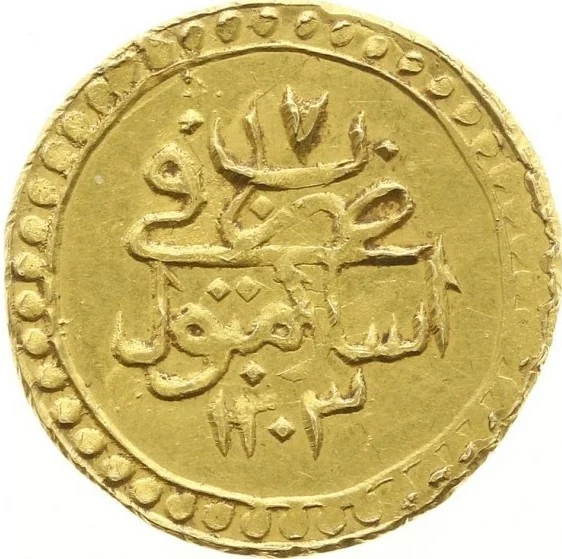
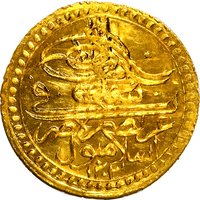
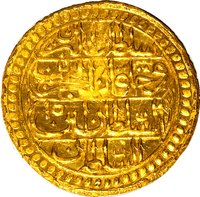
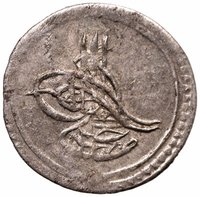
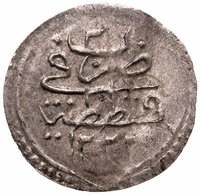
1 Findik – Ottoman Empire
Turkey
Context
Years: 1804–1806
Islamic (Hijri) Year: 1203
Country: Turkey 
Issuer: Ottoman Empire
Ruler: Selim III
Currency:
(1688—1844)
Demonetized: Yes
Material
References
KM: #Click to copy to clipboard527
Numista: #176278
Value
Bullion value: $460.07
Mints
| Name | Mark |
|---|---|
| Constantinople | — |
Mintings
| Year | Mint Mark | Mintage | Quality | Collection |
|---|---|---|---|---|
| 1804 | — | — | ||
| 1805 | — | — | ||
| 1806 | — | — |
Historical background
In 1804, the Ottoman Empire's currency system was in a state of profound crisis and transition, reflecting the broader political and military strains of the era. The empire was grappling with the Napoleonic Wars, internal rebellions like the First Serbian Uprising which began that very year, and the persistent challenge of a decentralizing state. The primary silver coin, the kuruş (piastre), had been repeatedly debased over the preceding decades to finance military expenditures, leading to severe inflation and a loss of public confidence. Concurrently, a multitude of foreign coins, particularly the Spanish silver dollar (riyal), circulated widely, often preferred for their stable silver content over the debased Ottoman issues.
This monetary chaos was exacerbated by the chronic shortage of silver and the complex, multi-tiered system in place. The empire lacked a unified, modern minting system, leading to significant variations in the weight and purity of coins produced in different regional mints like Istanbul, Cairo, and the Balkans. Furthermore, the ancient akçe, once the fundamental unit, had become virtually worthless, while the gold sultani (altın) was used for large transactions and state finance. The disconnect between the official accounting system, based on a theoretical "ideal" kuruş, and the actual depreciated coins in circulation created a labyrinthine financial environment that hampered trade and tax collection.
Sultan Selim III (r. 1789-1807), recognizing the need for reform, had already initiated the Nizam-ı Cedid (New Order) program, which included attempts at financial modernization. However, by 1804, these efforts were struggling. His government understood that currency stability was essential for military and administrative revitalization, but the constant state of war drained the treasury and made a proper monetary reform impossible. Thus, the currency situation in 1804 was a key symptom of imperial decline—a fragmented system of depreciating coinage, reliant on foreign specie, undermining the economy and the central authority's ability to project power at a critical juncture in its history.
This monetary chaos was exacerbated by the chronic shortage of silver and the complex, multi-tiered system in place. The empire lacked a unified, modern minting system, leading to significant variations in the weight and purity of coins produced in different regional mints like Istanbul, Cairo, and the Balkans. Furthermore, the ancient akçe, once the fundamental unit, had become virtually worthless, while the gold sultani (altın) was used for large transactions and state finance. The disconnect between the official accounting system, based on a theoretical "ideal" kuruş, and the actual depreciated coins in circulation created a labyrinthine financial environment that hampered trade and tax collection.
Sultan Selim III (r. 1789-1807), recognizing the need for reform, had already initiated the Nizam-ı Cedid (New Order) program, which included attempts at financial modernization. However, by 1804, these efforts were struggling. His government understood that currency stability was essential for military and administrative revitalization, but the constant state of war drained the treasury and made a proper monetary reform impossible. Thus, the currency situation in 1804 was a key symptom of imperial decline—a fragmented system of depreciating coinage, reliant on foreign specie, undermining the economy and the central authority's ability to project power at a critical juncture in its history.
✨ Legendary