

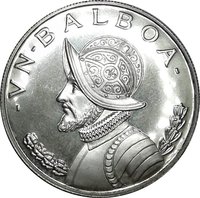
Obverse
Description:
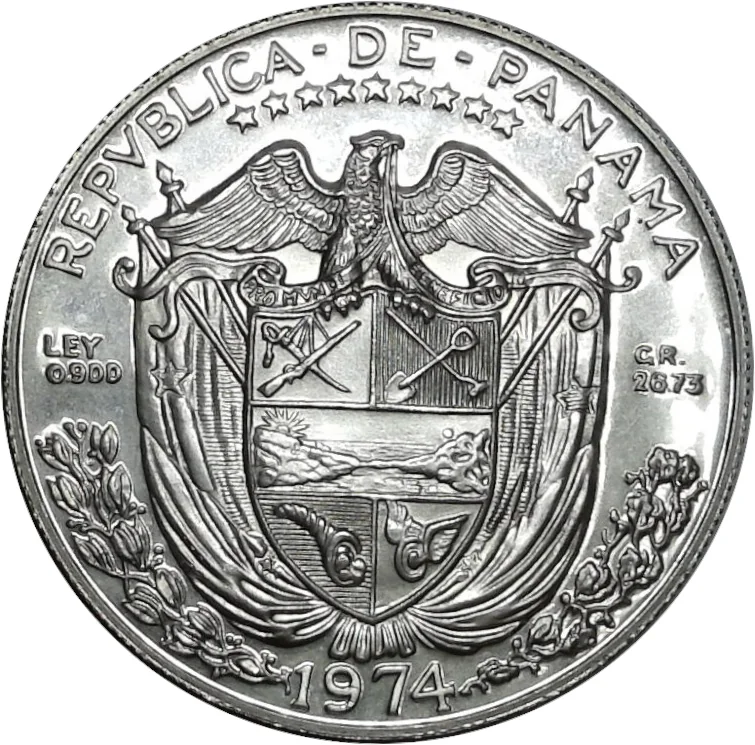
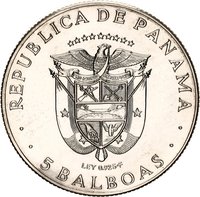
Coat of arms with nine stars above, country name above, silver content on sides, wreath and date below.
Inscription:
REPVBLICA - DE - PANAMA
PRO MVNDI BENEFICIO
LEY GR.
0.900 26.73
1974
PRO MVNDI BENEFICIO
LEY GR.
0.900 26.73
1974
Translation:
REPUBLIC OF PANAMA
FOR THE BENEFIT OF THE WORLD
LAW GRAMS
0.900 26.73
1974
FOR THE BENEFIT OF THE WORLD
LAW GRAMS
0.900 26.73
1974
Script: Latin
Reverse
Edge
Reeded
Categories
| Symbols> Coat of Arms |
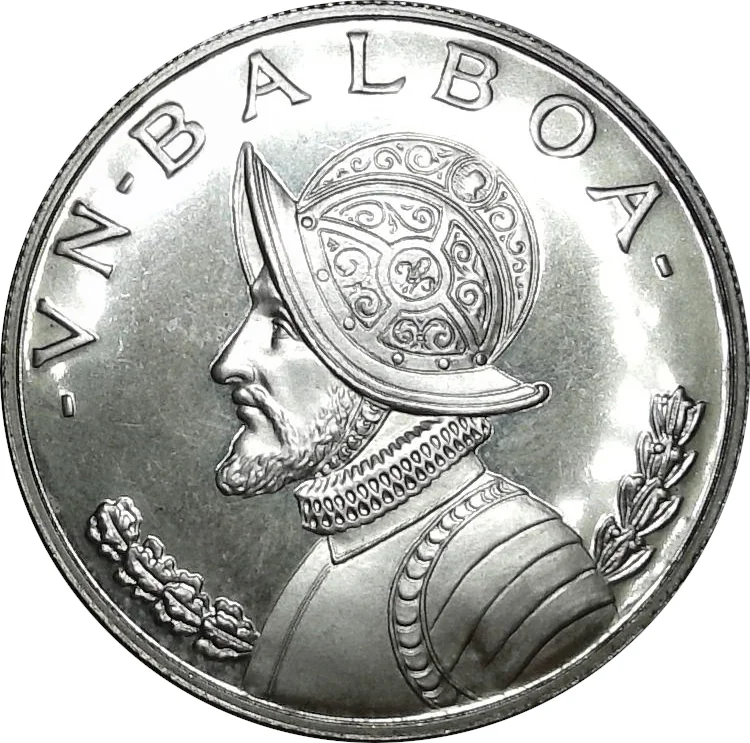
| Person> Explorer |
Mints
| Name | Mark |
|---|---|
| Royal Mint (Tower Hill) | — |
| United States Mint of San Francisco | — |
Mintings
| Year | Mint Mark | Mintage | Quality | Collection |
|---|---|---|---|---|
| 1966 | Royal British Mint | 240,000 | ||
| 1966 | San Francisco Mint; Minted in 1967 | 12,701 | Proof | |
| 1966 | Royal British Mint | 240,000 | ||
| 1966 | San Francisco Mint; Minted in 1967 | 12,701 | Proof | |
| 1966 | Royal British Mint | 240,000 | ||
| 1966 | San Francisco Mint; Minted in 1967 | 12,701 | Proof | |
| 1966 | Royal British Mint | 240,000 | ||
| 1966 | San Francisco Mint; Minted in 1967 | 12,701 | Proof | |
| 1966 | Royal British Mint | 240,000 | ||
| 1966 | San Francisco Mint; Minted in 1967 | 12,701 | Proof | |
| 1966 | — | 240,000 | ||
| 1966 | — | 12,701 | Proof | |
| 1967 | San Francisco Mint; Minted in 1968 | 19,983 | Proof | |
| 1967 | San Francisco Mint; Minted in 1968 | 19,983 | Proof | |
| 1967 | San Francisco Mint; Minted in 1968 | 19,983 | Proof | |
| 1967 | San Francisco Mint; Minted in 1968 | 19,983 | Proof | |
| 1967 | San Francisco Mint; Minted in 1968 | 19,983 | Proof | |
| 1967 | — | 19,983 | Proof | |
| 1968 | San Francisco Mint | 23,210 | Proof | |
| 1968 | San Francisco Mint | 23,210 | Proof | |
| 1968 | San Francisco Mint | 23,210 | Proof | |
| 1968 | San Francisco Mint | 23,210 | Proof | |
| 1968 | San Francisco Mint | 23,210 | Proof | |
| 1968 | — | 23,210 | Proof | |
| 1969 | San Francisco Mint | 14,000 | Proof | |
| 1969 | San Francisco Mint | 14,000 | Proof | |
| 1969 | San Francisco Mint | 14,000 | Proof | |
| 1969 | San Francisco Mint | 14,000 | Proof | |
| 1969 | San Francisco Mint | 14,000 | Proof | |
| 1969 | — | 14,000 | Proof | |
| 1970 | San Francisco Mint | 13,304 | Proof | |
| 1970 | San Francisco Mint | 13,304 | Proof | |
| 1970 | San Francisco Mint | 13,304 | Proof | |
| 1970 | San Francisco Mint | 13,304 | Proof | |
| 1970 | San Francisco Mint | 13,304 | Proof | |
| 1970 | — | 13,304 | Proof | |
| 1972 | San Francisco Mint; Minted in 1972 | 17,559 | Proof | |
| 1972 | San Francisco Mint; Minted in 1972 | 17,559 | Proof | |
| 1972 | San Francisco Mint; Minted in 1972 | 17,559 | Proof | |
| 1972 | San Francisco Mint; Minted in 1972 | 17,559 | Proof | |
| 1972 | San Francisco Mint; Minted in 1972 | 17,559 | Proof | |
| 1972 | — | 17,559 | Proof | |
| 1973 | San Francisco Mint; Minted in 1973 | 23,413 | Proof | |
| 1973 | San Francisco Mint; Minted in 1973 | 23,413 | Proof | |
| 1973 | San Francisco Mint; Minted in 1973 | 23,413 | Proof | |
| 1973 | San Francisco Mint; Minted in 1973 | 23,413 | Proof | |
| 1973 | San Francisco Mint; Minted in 1973 | 23,413 | Proof | |
| 1973 | — | 23,413 | Proof | |
| 1974 | San Francisco Mint; Minted in 1974 | 30,161 | Proof | |
| 1974 | San Francisco Mint; Minted in 1974 | 30,161 | Proof | |
| 1974 | San Francisco Mint; Minted in 1974 | 30,161 | Proof | |
| 1974 | San Francisco Mint; Minted in 1974 | 30,161 | Proof | |
| 1974 | San Francisco Mint; Minted in 1974 | 30,161 | Proof | |
| 1974 | — | 30,161 | Proof | |
| 1975 | San Francisco Mint; Minted in 1975 | 29,566 | Proof | |
| 1975 | San Francisco Mint; Minted in 1975 | 29,566 | Proof | |
| 1975 | San Francisco Mint; Minted in 1975 | 29,566 | Proof | |
| 1975 | San Francisco Mint; Minted in 1975 | 29,566 | Proof | |
| 1975 | San Francisco Mint; Minted in 1975 | 29,566 | Proof | |
| 1975 | — | 29,566 | Proof |
Historical background
In 1966, Panama's currency situation was defined by a unique and stable dual-currency system centered on the Balboa (PAB), which existed only as coins, and the United States dollar (USD), which served as the de facto paper currency. This arrangement was a direct legacy of Panama's independence from Colombia in 1903 and its subsequent treaty with the United States, which granted the U.S. rights to build and control the Panama Canal. The monetary system was formally established in 1904, tying the Balboa at par (1:1) with the U.S. dollar, with U.S. notes circulating freely alongside Panamanian silver coins.
This dollarized economy provided significant macroeconomic stability, insulating Panama from the balance-of-payments crises and inflation that affected many Latin American countries during the mid-20th century. There was no central bank; instead, currency issuance was managed by the National Bank of Panama and the National Treasury. While this system facilitated international trade and canal operations, it also meant Panama relinquished control over its independent monetary policy, interest rates, and the ability to print money for fiscal needs. The economy's health was therefore closely tied to U.S. economic policy and the inflow of dollar reserves.
By 1966, this framework was well-entrenched and largely uncontroversial in daily economic life, providing a predictable financial environment. However, the political context was charged. The year fell within a period of growing nationalist sentiment and negotiations between Panama and the United States over the Canal Treaty, which would culminate in the 1964 Flag Protests and eventual new treaties in 1977. While the currency system itself was not a primary point of contention, it was a constant reminder of Panama's deep economic and political entanglement with the United States, forming the bedrock of an economy whose most vital asset—the Canal—was under foreign control.
This dollarized economy provided significant macroeconomic stability, insulating Panama from the balance-of-payments crises and inflation that affected many Latin American countries during the mid-20th century. There was no central bank; instead, currency issuance was managed by the National Bank of Panama and the National Treasury. While this system facilitated international trade and canal operations, it also meant Panama relinquished control over its independent monetary policy, interest rates, and the ability to print money for fiscal needs. The economy's health was therefore closely tied to U.S. economic policy and the inflow of dollar reserves.
By 1966, this framework was well-entrenched and largely uncontroversial in daily economic life, providing a predictable financial environment. However, the political context was charged. The year fell within a period of growing nationalist sentiment and negotiations between Panama and the United States over the Canal Treaty, which would culminate in the 1964 Flag Protests and eventual new treaties in 1977. While the currency system itself was not a primary point of contention, it was a constant reminder of Panama's deep economic and political entanglement with the United States, forming the bedrock of an economy whose most vital asset—the Canal—was under foreign control.
Navigation: Non-circulating coins from Panama
🌱 Common