

50 Paisas (Muhammad Ali Jinnah) – Pakistan
Circulating commemorative coins
Commemoration: 100th birth anniversary of Muhammad Ali Jinnah
Pakistan
Context
Year: 1976
Issuer: Pakistan 
Period:
(since 1956)
Currency:
(since 1961)
Demonetization: 30 September 2014
Total mintage: 5,600,000
Material
References
KM: #Click to copy to clipboard39
Numista: #9748
Value
Exchange value: 0.50 PKR
Obverse
Description:
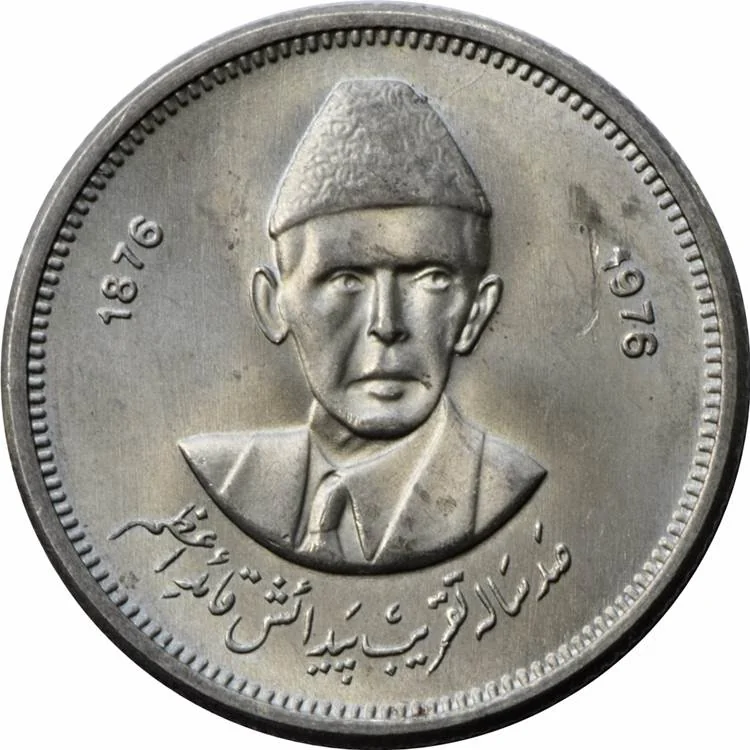
Bust of Muhammad Ali Jinnah.
Inscription:
1876 1976
Translation:
ONE THOUSAND EIGHT HUNDRED SEVENTY-SIX ONE THOUSAND NINE HUNDRED SEVENTY-SIX
Language: English
Reverse
Description:
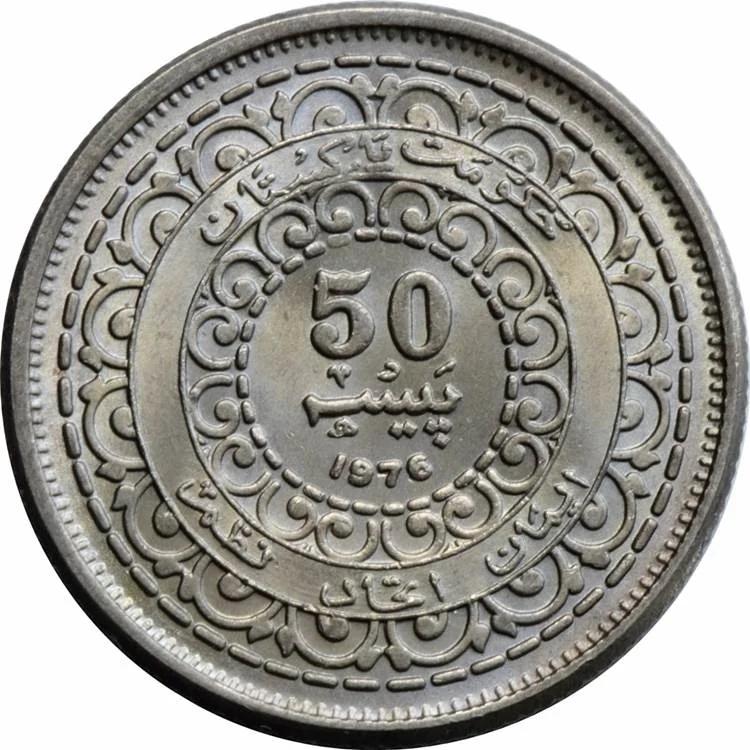
Government of Pakistan 50 paisa.
Date below denomination, surrounded by wreath.
Motto: "Faith, Unity, Discipline".
Date below denomination, surrounded by wreath.
Motto: "Faith, Unity, Discipline".
Inscription:
حکومت پاکستان
50
پیسہ
1976
ایمان، اتحاد، نظم
50
پیسہ
1976
ایمان، اتحاد، نظم
Translation:
Government of Pakistan
50
Paisa
1976
Faith, Unity, Discipline
50
Paisa
1976
Faith, Unity, Discipline
Language: Urdu
Edge
Reeded
Mints
| Name | Mark |
|---|---|
| Lahore | — |
Mintings
| Year | Mint Mark | Mintage | Quality | Collection |
|---|---|---|---|---|
| 1976 | — | 5,600,000 |
Historical background
In 1976, Pakistan’s currency situation was characterized by relative stability under a managed exchange rate regime, a legacy of the 1972 economic reforms. Following the traumatic loss of East Pakistan and the 1971 war, the government of Prime Minister Zulfikar Ali Bhutto had devalued the Pakistani rupee significantly in 1972, moving from a fixed parity of PKR 4.76 to PKR 11.00 per US dollar. This sharp devaluation aimed to correct a severe balance of payments crisis, boost exports (particularly of cotton and textiles), and discourage costly imports. By 1976, this adjusted rate was being maintained through administrative controls, with the State Bank of Pakistan managing the currency within a narrow band.
The economy in this period was defined by Bhutto's nationalization policies, which had expanded the state's role in major industries, banking, and insurance. While this fostered a large public sector, it also dampened private investment and foreign capital inflows. Consequently, the stability of the rupee in 1976 was somewhat artificial, underpinned more by regulatory measures than by strong underlying economic fundamentals. Remittances from Pakistani workers in the Gulf states, which began to surge after the 1973 oil boom, provided a crucial source of foreign exchange, helping to shore up reserves and support the currency's official valuation.
Looking ahead, the stability of 1976 was precarious. The controlled exchange regime masked growing macroeconomic imbalances, including rising fiscal deficits and inflationary pressures. This rigid system would come under intense strain later in the decade, leading to a gradual shift towards a more market-oriented exchange rate mechanism in the early 1980s. Thus, 1976 represents a point of calibrated calm between the major devaluation of the early 1970s and the persistent currency challenges that would follow.
The economy in this period was defined by Bhutto's nationalization policies, which had expanded the state's role in major industries, banking, and insurance. While this fostered a large public sector, it also dampened private investment and foreign capital inflows. Consequently, the stability of the rupee in 1976 was somewhat artificial, underpinned more by regulatory measures than by strong underlying economic fundamentals. Remittances from Pakistani workers in the Gulf states, which began to surge after the 1973 oil boom, provided a crucial source of foreign exchange, helping to shore up reserves and support the currency's official valuation.
Looking ahead, the stability of 1976 was precarious. The controlled exchange regime masked growing macroeconomic imbalances, including rising fiscal deficits and inflationary pressures. This rigid system would come under intense strain later in the decade, leading to a gradual shift towards a more market-oriented exchange rate mechanism in the early 1980s. Thus, 1976 represents a point of calibrated calm between the major devaluation of the early 1970s and the persistent currency challenges that would follow.
🌱 Common