

5 cents – Curaçao
Add to wishlist
Netherlands
Context
Year: 1948
Country: Netherlands
Issuer: Curaçao
Ruler: Wilhelmina
Currency:
(since 1828)
Demonetized: Yes
Total mintage: 1,000,075
Material
Weight: 4.48 g
Thickness: 1.85 mm
Shape: Square with rounded corners
Composition: Copper-nickel
Technique: Milled
Alignment: Coin alignment
flip
References
KM: #
Numista: #974
Value
Exchange value: 0.05 ANG
Obverse
Description:
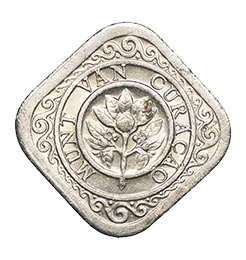
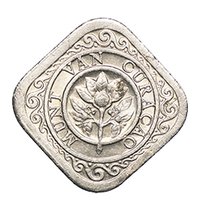
Dutch legend between circles; central orange branch with fruit. Surrounding design.
Inscription:
MUNT VAN CURAÇAO
Translation:
Coin of Curaçao
Script: Latin
Language: Dutch
Designer: Johannes Cornelis Wienecke
Reverse
Description:
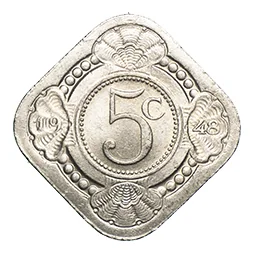
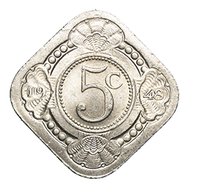
Center denomination within concentric circles: fine pearls, thick band, coarse pearls. Shells adorn each corner, with dates on the left and right shells.
Inscription:
5c
1948
1948
Script: Latin
Designer: Johannes Cornelis Wienecke
Edge
Plain
Mints
| Name | Mark |
|---|---|
| Royal Dutch Mint | — |
Mintings
| Year | Mint Mark | Mintage | Quality | Collection |
|---|---|---|---|---|
| 1948 | — | 1,000,000 | ||
| 1948 | — | 75 | Proof |
Historical background
In 1948, Curaçao, as part of the Netherlands Antilles, operated under a distinct colonial currency system. The official currency was the Netherlands Antillean guilder (NAf), which was pegged at a fixed rate to the U.S. dollar rather than the Dutch guilder. This peg, established in the early 20th century, was a direct result of the island's economic reality: its economy was profoundly tied to the nearby oil refinery of the Royal Dutch Shell at Isla, which conducted all its transactions in U.S. dollars. Consequently, the U.S. dollar was also widely circulated and accepted alongside the official guilder, creating a de facto dual-currency economy.
This monetary arrangement provided significant stability and facilitated international trade, particularly for the vital oil sector. The central banking authority was the Curaçaosche Bank, which acted as the bank of issue and managed the currency board-style system. The fixed exchange rate (approximately 1.79 NAf to 1 USD in the modern era, with roots in this period) ensured low inflation and predictability for import-dependent businesses, anchoring the local economy to the strong U.S. dollar.
However, this system also reflected and reinforced Curaçao's colonial economic structure. The monetary policy was primarily designed to serve the export-oriented oil industry and Dutch commercial interests, with less focus on fostering broader local economic diversification or development. While financially stable, the currency situation of 1948 underscored the island's external dependencies, a characteristic that would shape economic debates long after the constitutional reforms of the 1950s that granted the Netherlands Antilles internal autonomy.
This monetary arrangement provided significant stability and facilitated international trade, particularly for the vital oil sector. The central banking authority was the Curaçaosche Bank, which acted as the bank of issue and managed the currency board-style system. The fixed exchange rate (approximately 1.79 NAf to 1 USD in the modern era, with roots in this period) ensured low inflation and predictability for import-dependent businesses, anchoring the local economy to the strong U.S. dollar.
However, this system also reflected and reinforced Curaçao's colonial economic structure. The monetary policy was primarily designed to serve the export-oriented oil industry and Dutch commercial interests, with less focus on fostering broader local economic diversification or development. While financially stable, the currency situation of 1948 underscored the island's external dependencies, a characteristic that would shape economic debates long after the constitutional reforms of the 1950s that granted the Netherlands Antilles internal autonomy.
🌱 Very Common