

20 kroner (Queen Margrethe II and Prince Henrik) – Denmark
Add to wishlist
Circulating commemorative coins
Commemoration: Golden wedding anniversary of Her Majesty Queen Margrethe II and His Royal Highness Prince Henrik
Denmark
Context
Material
Diameter: 27 mm
Weight: 9.3 g
Thickness: 2.35 mm
Shape: Round
Composition: Aluminium bronze
Magnetic: No
Technique: Milled
Alignment: Medal alignment
flip
References
KM: #
Numista: #115598
Value
Exchange value: 20 DKK
Inflation-adjusted value: 23.76 DKK
Obverse
Description:
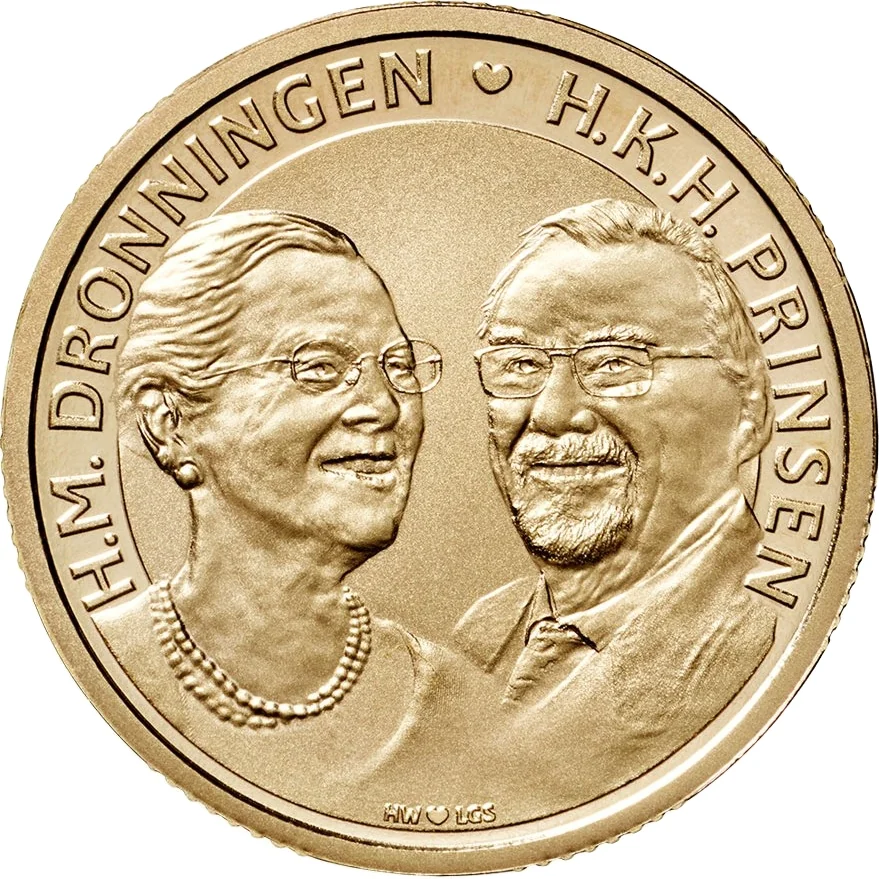
The obverse shows the Queen and Prince facing each other in three-quarter profile.
Inscription:
H.M. DRONNINGEN ♥ H.K.H. PRINSEN
HW ♥ LGS
HW ♥ LGS
Translation:
Her Majesty the Queen ♥ Her Royal Highness the Prince
HW ♥ LGS
HW ♥ LGS
Script: Latin
Engraver: Henrik Wiberg
Reverse
Description:
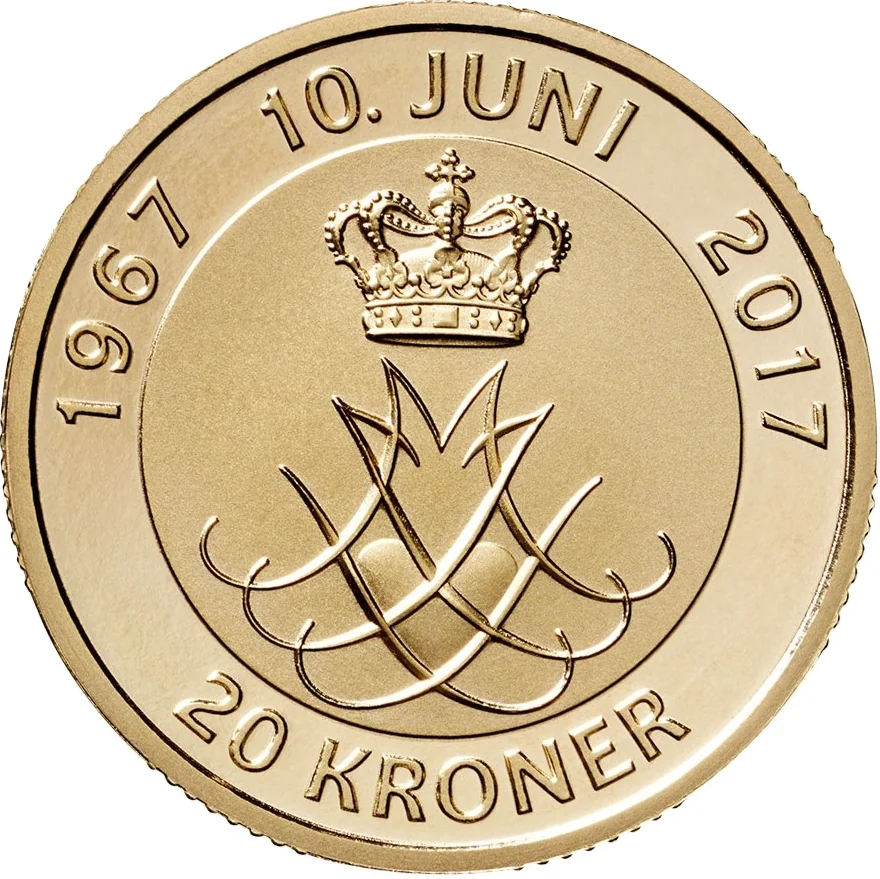
The reverse features the Queen and Prince's joint monogram, with their wedding and anniversary dates above. Below is the Mint's heart, a symbol of love.
Inscription:
1967 10. JUNI 2017
20 KRONER
20 KRONER
Script: Latin
Engraver: Henrik Wiberg
Edge
Rim with interrupted milling
Mints
| Name | Mark |
|---|---|
| Royal Danish Mint | — |
Mintings
| Year | Mint Mark | Mintage | Quality | Collection |
|---|---|---|---|---|
| 2017 | — | — | Proof | |
| 2017 | HW | — |
Historical background
In 2017, Denmark maintained its long-standing and stable currency regime, with the Danish krone (DKK) pegged to the euro through the European Exchange Rate Mechanism II (ERM II). This fixed exchange rate policy, managed by Danmarks Nationalbank, had been a cornerstone of Danish economic policy for decades, aimed at ensuring monetary stability and low inflation. The central bank stood ready to intervene in foreign exchange markets and adjust interest rates to keep the krone within its narrow band of 2.25% around the central rate of 7.46038 kroner per euro, a commitment that required occasional action in previous years but saw relative calm in 2017.
The year was characterized by a lack of speculative pressure on the krone, a contrast to the significant interventions needed during the 2015 Swiss franc shock. Denmark's key policy interest rates remained negative throughout the year, with the certificate of deposit rate at -0.65%, aligning with the European Central Bank's accommodative stance to maintain the peg. This environment of monetary policy alignment with the Eurozone, coupled with a strong Danish economy and healthy foreign exchange reserves, meant the currency peg was not a subject of political or market concern.
Domestically, there was no serious political movement to adopt the euro or abandon the peg, as the arrangement enjoyed broad support for the stability it provided. The Danish economy performed well in 2017, with robust growth and declining unemployment, further underpinning confidence in the krone. Consequently, the currency situation was largely perceived as a technical success story of a small, open economy successfully maintaining a fixed exchange rate, operating smoothly in the background without the turbulence seen earlier in the decade.
The year was characterized by a lack of speculative pressure on the krone, a contrast to the significant interventions needed during the 2015 Swiss franc shock. Denmark's key policy interest rates remained negative throughout the year, with the certificate of deposit rate at -0.65%, aligning with the European Central Bank's accommodative stance to maintain the peg. This environment of monetary policy alignment with the Eurozone, coupled with a strong Danish economy and healthy foreign exchange reserves, meant the currency peg was not a subject of political or market concern.
Domestically, there was no serious political movement to adopt the euro or abandon the peg, as the arrangement enjoyed broad support for the stability it provided. The Danish economy performed well in 2017, with robust growth and declining unemployment, further underpinning confidence in the krone. Consequently, the currency situation was largely perceived as a technical success story of a small, open economy successfully maintaining a fixed exchange rate, operating smoothly in the background without the turbulence seen earlier in the decade.
🌱 Fairly Common