

5 Centimes – French West Indies
France
Context
Years: 1839–1844
Country: France 
Issuer: French West Indies
Ruler: Louis Philippe I
Currency:
(1795—1959)
Demonetized: Yes
Total mintage: 1,603,674
Material
References
KM: #Click to copy to clipboard12
Numista: #9716
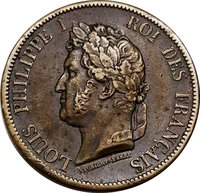
Obverse
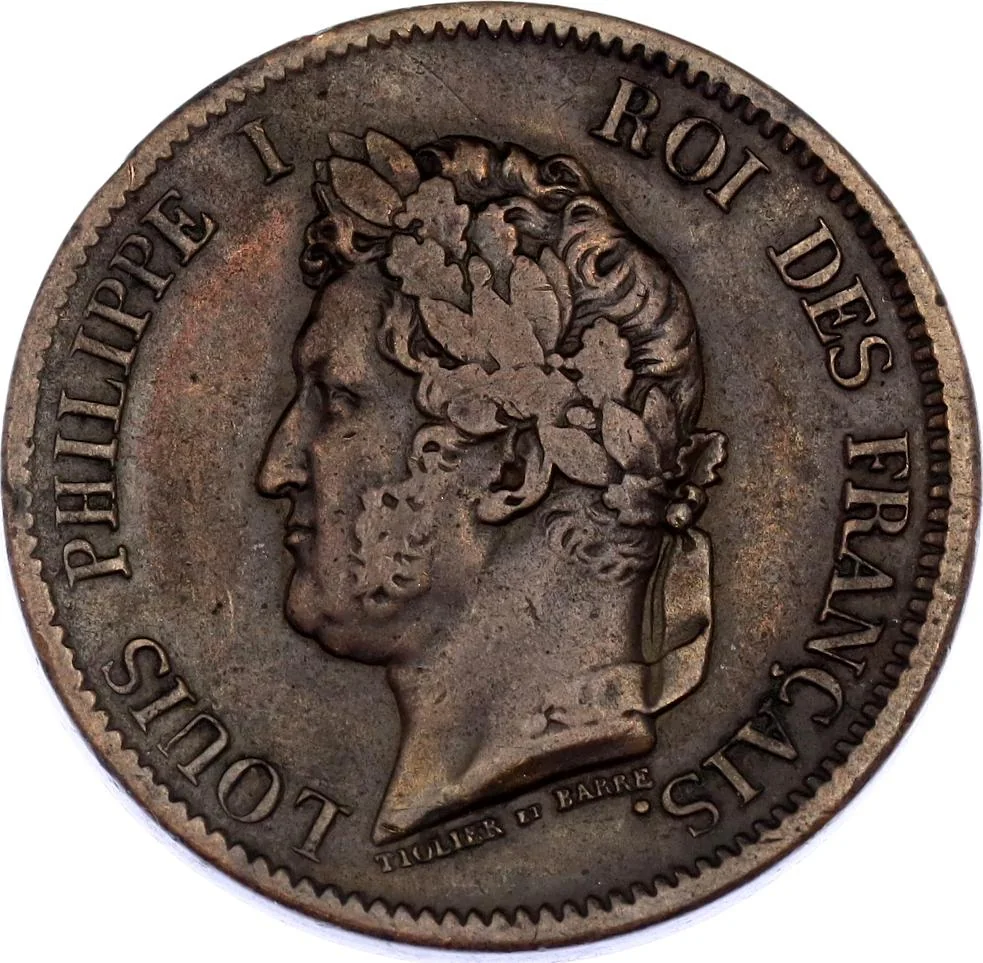
Description:
Left portrait
Inscription:
LOUIS PHILIPPE I ROI DES FRANÇAIS.
Translation:
Louis Philippe I, King of the French.
Script: Latin
Language: French
Engraver: Nicolas-Pierre Tiolier
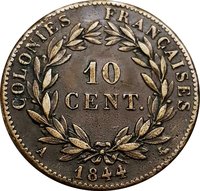
Reverse
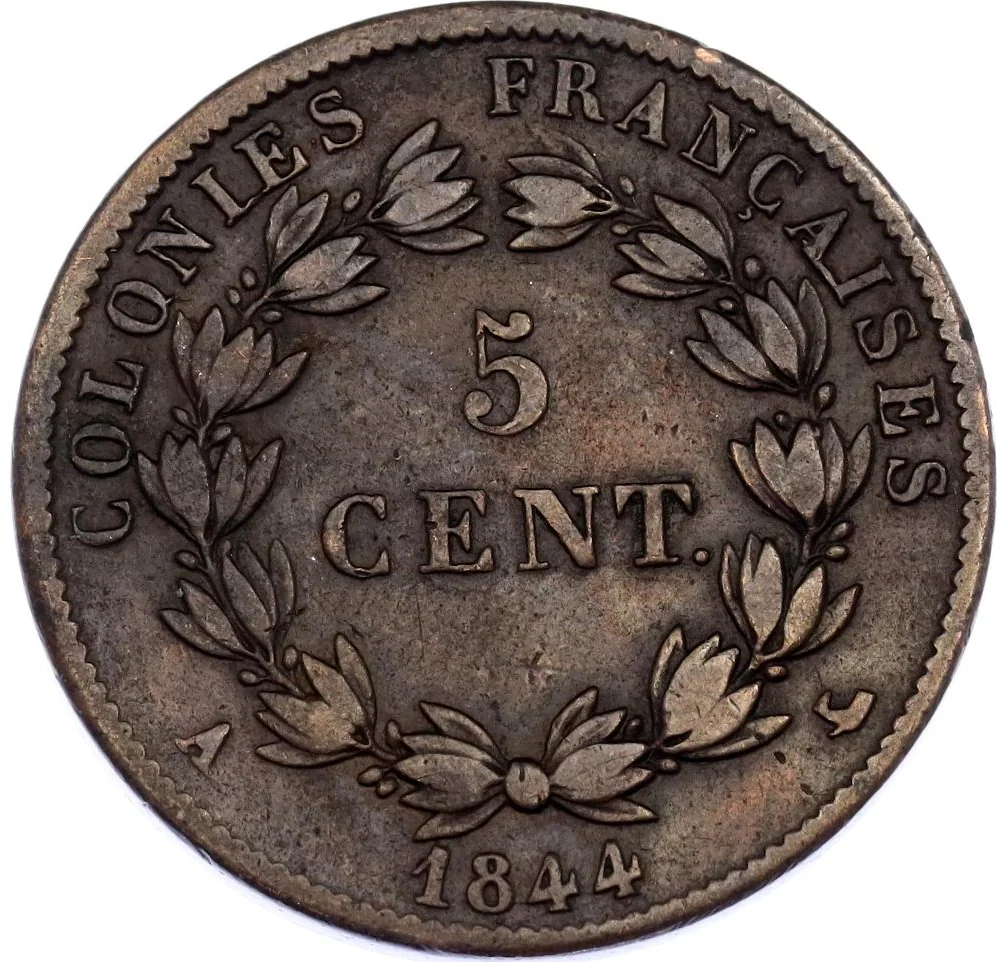
Description:
"5 cent" encircled by a plant crown.
Inscription:
COLONIES FRANÇAISES
5
CENT.
A 1844
5
CENT.
A 1844
Translation:
FRENCH COLONIES
5
CENTS
A 1844
5
CENTS
A 1844
Script: Latin
Language: French
Engraver: Jacques-Jean Barre
Edge
Plain
Mints
| Name | Mark |
|---|---|
| Monnaie de Paris | A |
Mintings
Historical background
In 1839, the currency situation in the French West Indies (primarily Guadeloupe and Martinique) was a complex and burdensome system inherited from the colonial plantation economy. Officially, the French franc was the legal tender, but in practice, the islands suffered from a severe shortage of metallic currency. This scarcity was a chronic issue for colonial economies, where hard currency was constantly drained to pay for imports from the metropole, leaving the local cash-starved plantations and merchants to seek alternatives.
The primary solution, and a major point of contention, was the widespread use of monnaie de sucre (sugar money). This was not official government currency but a system of private tokens or paper notes issued by plantation owners and major merchants. These notes, theoretically redeemable for goods or currency, were used to pay laborers and settle local debts, effectively tying the workforce to the issuer's estate or store. While it facilitated daily transactions, the system was rife with abuse, as the notes often depreciated in value and could be refused by anyone other than the issuer, exploiting the very people—primarily newly emancipated slaves since the 1794 abolition (re-instated definitively in 1848)—who had little economic power.
Furthermore, alongside this local script, a bewildering variety of foreign coins circulated out of necessity. Spanish piastres, Portuguese joes, and various other Latin American and European coins were accepted in commerce, their values fluctuating based on weight and metallic content. This monetary chaos created significant inefficiency and risk for trade. Therefore, the 1839 situation was one of transition and tension, caught between an inadequate official currency, a exploitative private token system, and a disorderly international specie circulation, all reflecting the islands' struggle to adapt their economic infrastructure in the volatile pre-emancipation era.
The primary solution, and a major point of contention, was the widespread use of monnaie de sucre (sugar money). This was not official government currency but a system of private tokens or paper notes issued by plantation owners and major merchants. These notes, theoretically redeemable for goods or currency, were used to pay laborers and settle local debts, effectively tying the workforce to the issuer's estate or store. While it facilitated daily transactions, the system was rife with abuse, as the notes often depreciated in value and could be refused by anyone other than the issuer, exploiting the very people—primarily newly emancipated slaves since the 1794 abolition (re-instated definitively in 1848)—who had little economic power.
Furthermore, alongside this local script, a bewildering variety of foreign coins circulated out of necessity. Spanish piastres, Portuguese joes, and various other Latin American and European coins were accepted in commerce, their values fluctuating based on weight and metallic content. This monetary chaos created significant inefficiency and risk for trade. Therefore, the 1839 situation was one of transition and tension, caught between an inadequate official currency, a exploitative private token system, and a disorderly international specie circulation, all reflecting the islands' struggle to adapt their economic infrastructure in the volatile pre-emancipation era.
🌱 Common