

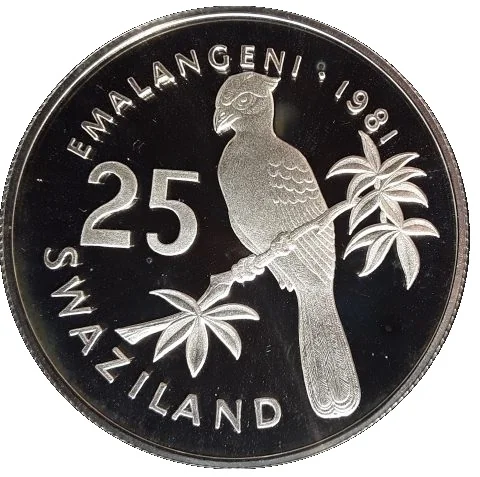
25 Emalangeni – Kingdom of Swaziland
Non-circulating coins
Commemoration: Diamond Jubilee of King
Eswatini
Context
Year: 1981
Country: Eswatini 
Issuer: Kingdom of Swaziland
Ruler: Sobhuza II
Currency:
(1974—2018)
Demonetization: 1 February 2016
Total mintage: 20,000
Material
References
KM: #Click to copy to clipboard34
Numista: #97149
Value
Exchange value: 25 SZL
Bullion value: $72.88
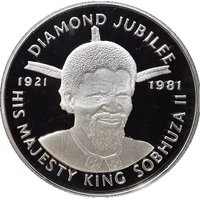
Obverse
Description:
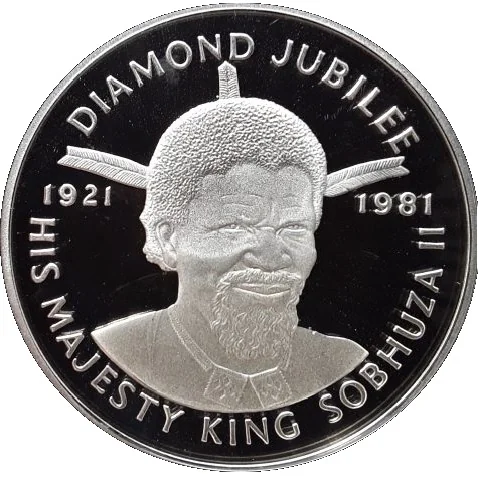
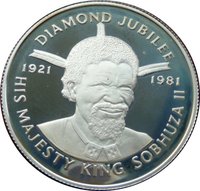
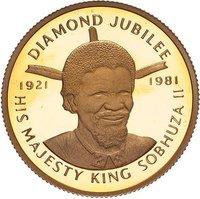
Head right 1/4 turn.
Inscription:
DIAMOND JUBILEE
1921 1981
HIS MAJESTY KING SOBHUZA II
1921 1981
HIS MAJESTY KING SOBHUZA II
Translation:
DIAMOND JUBILEE
1921 1981
HIS MAJESTY KING SOBHUZA II
1921 1981
HIS MAJESTY KING SOBHUZA II
Script: Latin
Language: English
Engraver: Michael Rizzello
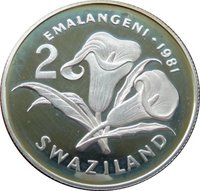
Reverse
Edge
Reeded
Mintings
| Year | Mint Mark | Mintage | Quality | Collection |
|---|---|---|---|---|
| 1981 | — | 10,000 | ||
| 1981 | — | 10,000 | Proof |
Historical background
In 1981, the Kingdom of Swaziland (renamed Eswatini in 2018) operated within the multinational Rand Monetary Area (RMA), a formalized agreement established in 1974 with South Africa and Lesotho. This arrangement meant the South African rand was legal tender in Swaziland and circulated alongside the national currency, the lilangeni (plural: emalangeni), which was introduced in 1974 and maintained a strict 1:1 parity with the rand. This system effectively ceded Swaziland's independent monetary policy to the South African Reserve Bank, making its economy highly sensitive to South Africa's economic conditions and policy decisions, including those influenced by international sanctions against the apartheid regime.
The domestic currency situation was stable but reflected the nation's broader economic challenges. Swaziland's economy was heavily dependent on South Africa, not only for currency but also for trade, investment, and a significant portion of its government revenue through the Southern African Customs Union (SACU). The dual circulation of rand and emalangeni underscored this dependency. While the parity provided stability and facilitated seamless cross-border trade, it also meant Swaziland had no direct control over interest rates or money supply to manage its own economic objectives, such as addressing unemployment or stimulating specific sectors.
Politically and economically, 1981 fell during the long reign of King Sobhuza II, a period characterized by a cautious and conservative approach to governance. There was no serious consideration of leaving the rand zone, as the benefits of monetary stability and integrated trade were deemed vital for the small, landlocked kingdom. Therefore, the currency situation of 1981 was one of entrenched dependency and managed stability, a deliberate trade-off that sacrificed monetary sovereignty for the perceived security of integration with the region's dominant economy.
The domestic currency situation was stable but reflected the nation's broader economic challenges. Swaziland's economy was heavily dependent on South Africa, not only for currency but also for trade, investment, and a significant portion of its government revenue through the Southern African Customs Union (SACU). The dual circulation of rand and emalangeni underscored this dependency. While the parity provided stability and facilitated seamless cross-border trade, it also meant Swaziland had no direct control over interest rates or money supply to manage its own economic objectives, such as addressing unemployment or stimulating specific sectors.
Politically and economically, 1981 fell during the long reign of King Sobhuza II, a period characterized by a cautious and conservative approach to governance. There was no serious consideration of leaving the rand zone, as the benefits of monetary stability and integrated trade were deemed vital for the small, landlocked kingdom. Therefore, the currency situation of 1981 was one of entrenched dependency and managed stability, a deliberate trade-off that sacrificed monetary sovereignty for the perceived security of integration with the region's dominant economy.
✨ Legendary