

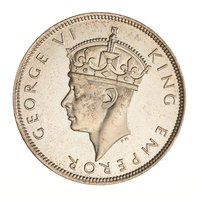
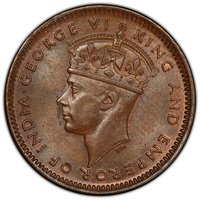
Obverse
Description:
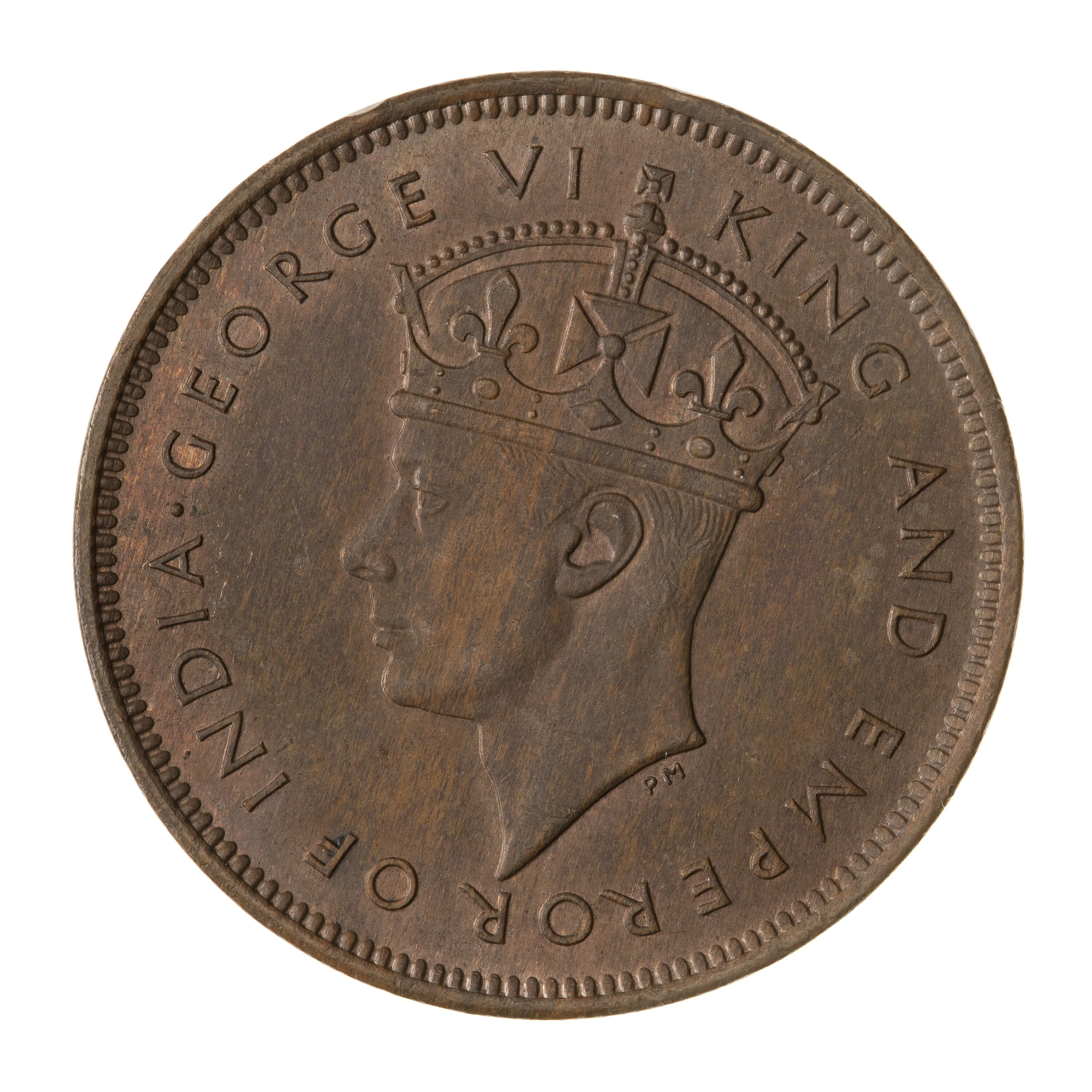
King facing left
Inscription:
GEORGE VI KING AND EMPEROR OF INDIA
PM
PM
Translation:
GEORGE VI KING AND EMPEROR OF INDIA
PM
PM
Script: Latin
Language: English
Engraver: Percy Metcalfe
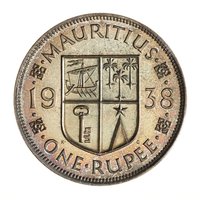
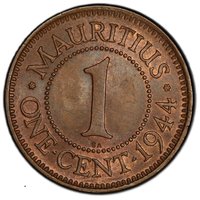
Reverse
Description:
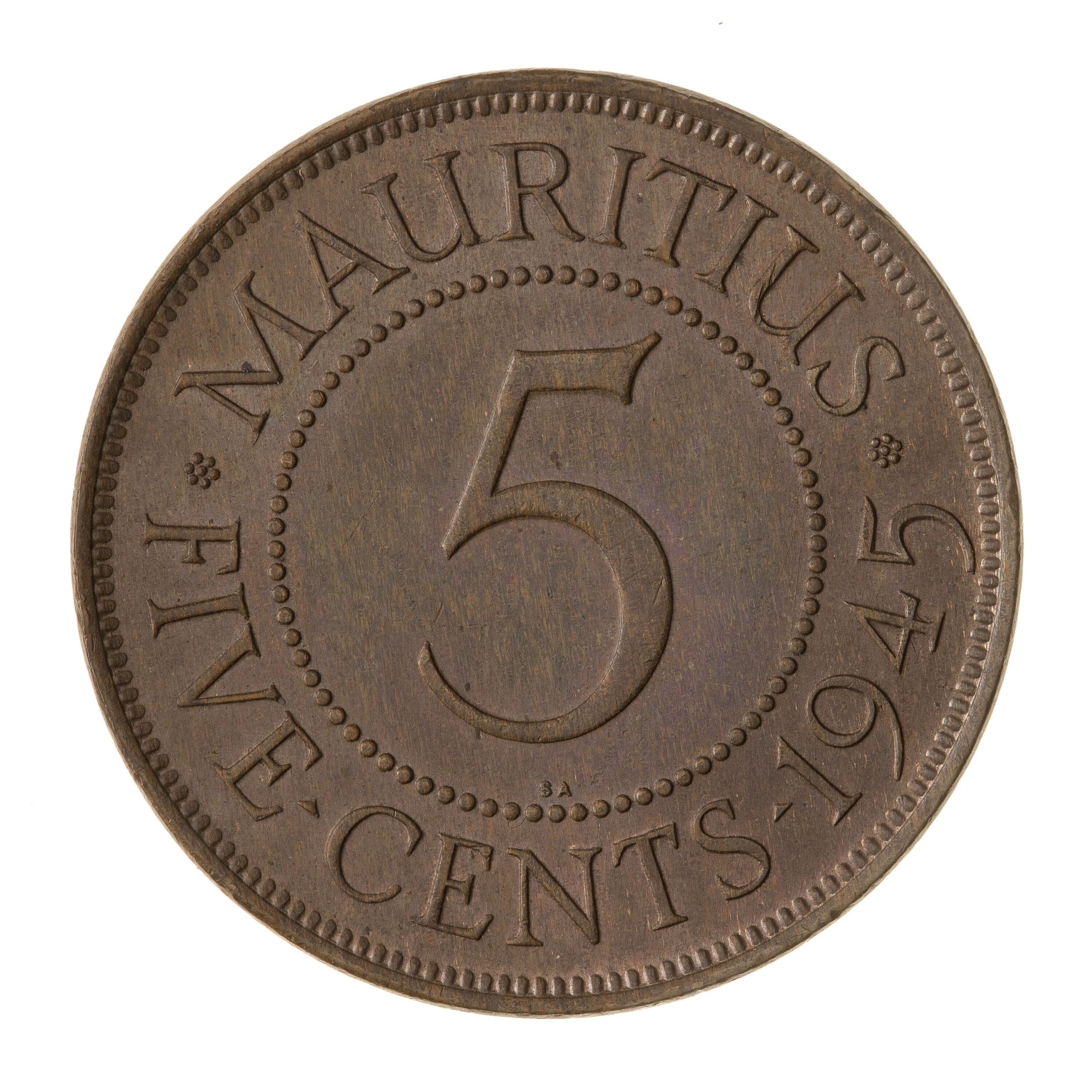
Beaded circle with value, date below.
Inscription:
*MAURITIUS*
5
SA
FIVE·CENTS·1945
5
SA
FIVE·CENTS·1945
Script: Latin
Edge
Plain
Mints
| Name | Mark |
|---|---|
| Pretoria | SA |
Historical background
In 1942, Mauritius, then a British Crown Colony, was grappling with a severe currency crisis rooted in the disruptions of World War II. The island's official currency was the Mauritian Rupee, pegged to the Indian Rupee, which was itself tied to the Sterling. However, the war severed vital shipping lanes, causing acute shortages of imported goods and leading to rampant inflation. Crucially, the physical supply of coinage and banknotes from the UK and India was severely interrupted, creating a critical shortage of cash in circulation for daily transactions.
To address the cash shortage, the colonial government took emergency measures. The most significant was the issuance of Mauritius Government Low Denomination Notes. These were provisional, locally printed paper notes in small denominations (25 cents, 50 cents, and 1 Rupee), authorized by Ordinance No. 34 of 1940 but circulating widely by 1942. They were essentially a form of wartime "scrip" or emergency money, intended to facilitate small-scale commerce. Simultaneously, the use of Indian Rupees and British coins remained legal tender, but their scarcity drove much economic activity into barter or reliance on these new, less familiar local notes.
The situation was further complicated by the presence of thousands of Allied troops, primarily British, who spent Sterling and military payment vouchers, adding another layer of currency to the local economy. This period highlighted Mauritius's economic vulnerability and dependence on external sources for its currency supply. The 1942 experience directly paved the way for post-war monetary reform, culminating in the establishment of the Mauritius Currency Board in 1949, which formalized and stabilized the Mauritian Rupee as a distinct currency unit.
To address the cash shortage, the colonial government took emergency measures. The most significant was the issuance of Mauritius Government Low Denomination Notes. These were provisional, locally printed paper notes in small denominations (25 cents, 50 cents, and 1 Rupee), authorized by Ordinance No. 34 of 1940 but circulating widely by 1942. They were essentially a form of wartime "scrip" or emergency money, intended to facilitate small-scale commerce. Simultaneously, the use of Indian Rupees and British coins remained legal tender, but their scarcity drove much economic activity into barter or reliance on these new, less familiar local notes.
The situation was further complicated by the presence of thousands of Allied troops, primarily British, who spent Sterling and military payment vouchers, adding another layer of currency to the local economy. This period highlighted Mauritius's economic vulnerability and dependence on external sources for its currency supply. The 1942 experience directly paved the way for post-war monetary reform, culminating in the establishment of the Mauritius Currency Board in 1949, which formalized and stabilized the Mauritian Rupee as a distinct currency unit.
🌱 Common