

25 øre – Denmark
Add to wishlist
Denmark
Context
Years: 1966–1972
Issuer: Denmark
Ruler: Frederick IX
Currency:
(since 1873)
Demonetization: 30 September 2008
Total mintage: 105,655,763
Material
Diameter: 23 mm
Weight: 4.3 g
Thickness: 1.49 mm
Shape: Round with a round hole
Technique: Milled
Alignment: Medal alignment
flip
References
KM: #
Numista: #971
Value
Exchange value: 0.25 DKK
Inflation-adjusted value: 3.02 DKK
Obverse
Description:
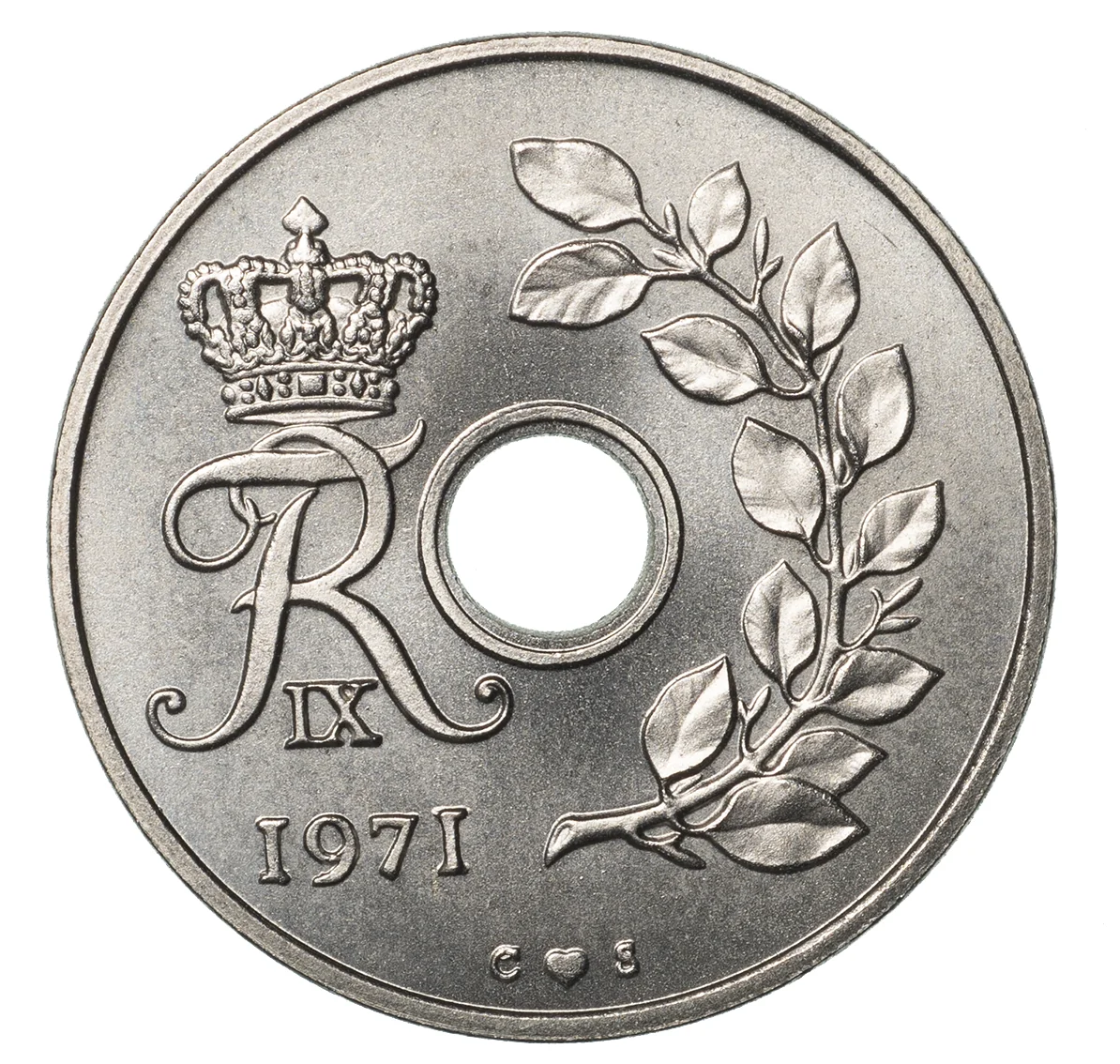
Frederik IX monogram left, beech branch right.
Inscription:
FR IX
1967
C ♥ S
1967
C ♥ S
Translation:
FR IX
1967
C ♥ S
1967
C ♥ S
Script: Latin
Engraver: H. Salomon
Reverse
Description:
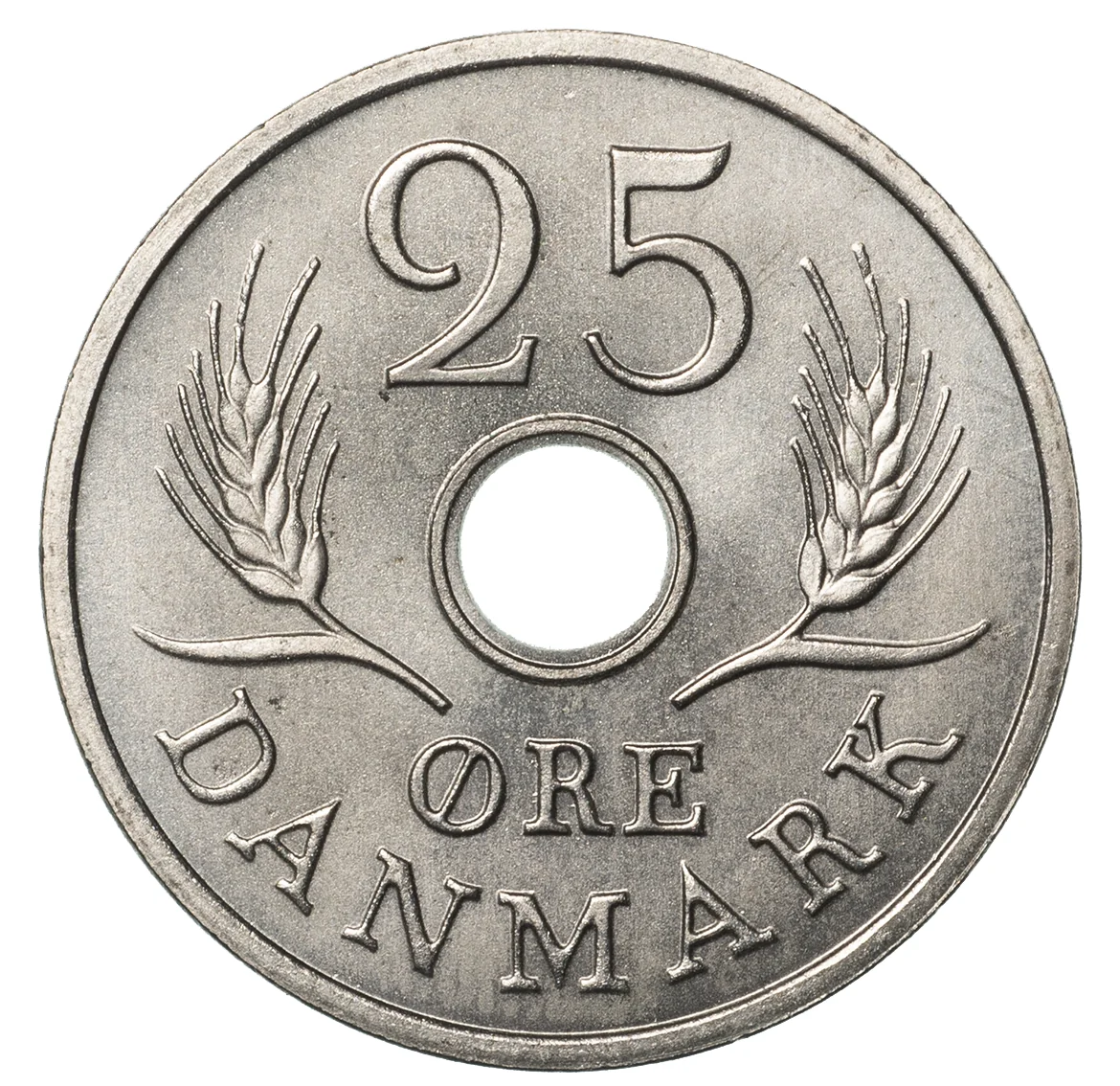
Value, barley encircling the central hole.
Inscription:
25
ØRE
DANMARK
ØRE
DANMARK
Translation:
25
ØRE
DENMARK
ØRE
DENMARK
Script: Latin
Engraver: H. Salomon
Edge
Plain
Mints
| Name | Mark |
|---|---|
| Royal Danish Mint | (♥) |
Mintings
| Year | Mint Mark | Mintage | Quality | Collection |
|---|---|---|---|---|
| 1966 | C♥S | — | ||
| 1967 | C♥S | — | ||
| 1968 | C♥S | 39,141,909 | ||
| 1969 | C♥S | 16,974,353 | ||
| 1970 | C♥S | 5,392,994 | ||
| 1971 | C♥S | 12,724,505 | ||
| 1972 | S♥S | 31,422,002 |
Historical background
In 1966, Denmark's currency situation was defined by its participation in the Bretton Woods system, which pegged the Danish krone (DKK) to the US dollar at a fixed rate of 7.5 DKK per 1 USD. This arrangement, managed by the Danish National Bank, required strict monetary discipline to maintain the parity. The primary economic challenge of the mid-1960s was a persistent and growing current account deficit, driven by strong domestic demand, rising wages, and high levels of imports, which put sustained downward pressure on the krone's fixed value.
To defend the peg, Danish authorities relied on a combination of tight monetary policy, occasional foreign exchange interventions, and restrictions on capital flows. High interest rates were used to attract short-term capital inflows and support the currency, but this also risked stifling domestic investment. Furthermore, Denmark had to maintain substantial foreign exchange reserves, often drawing on standby credits from the International Monetary Fund (IMF) to bolster confidence in its ability to uphold the fixed exchange rate.
The situation in 1966 was one of underlying strain, setting the stage for the greater turbulence that would follow in the late 1960s. While the peg held firm that year, the structural trade imbalances and the inherent pressures of the Bretton Woods system were becoming increasingly apparent. This period highlighted the difficult balancing act between a fixed exchange rate, free capital movement, and an independent national economic policy—a tension that would eventually lead to a major devaluation of the krone in 1967 and contribute to the broader collapse of the Bretton Woods system in the early 1970s.
To defend the peg, Danish authorities relied on a combination of tight monetary policy, occasional foreign exchange interventions, and restrictions on capital flows. High interest rates were used to attract short-term capital inflows and support the currency, but this also risked stifling domestic investment. Furthermore, Denmark had to maintain substantial foreign exchange reserves, often drawing on standby credits from the International Monetary Fund (IMF) to bolster confidence in its ability to uphold the fixed exchange rate.
The situation in 1966 was one of underlying strain, setting the stage for the greater turbulence that would follow in the late 1960s. While the peg held firm that year, the structural trade imbalances and the inherent pressures of the Bretton Woods system were becoming increasingly apparent. This period highlighted the difficult balancing act between a fixed exchange rate, free capital movement, and an independent national economic policy—a tension that would eventually lead to a major devaluation of the krone in 1967 and contribute to the broader collapse of the Bretton Woods system in the early 1970s.
🌱 Very Common