

50 dīnār – Iran
Add to wishlist
Iran
Context
Years: 1953–1975
Issuer: Iran
Ruler: Mohammad Reza
Currency:
(since 1932)
Demonetized: Yes
Total mintage: 191,597,568
Material
References
KM: #
Numista: #9709
Value
Exchange value: 0.50 IRR
Obverse
Description:
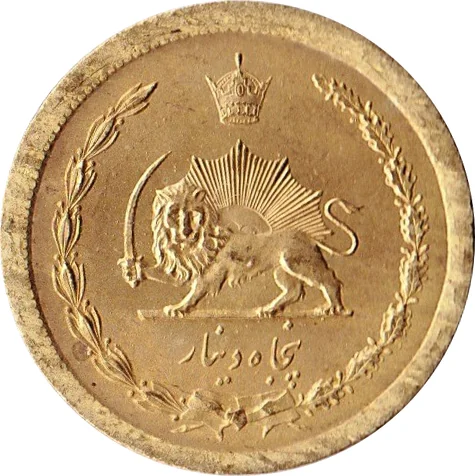
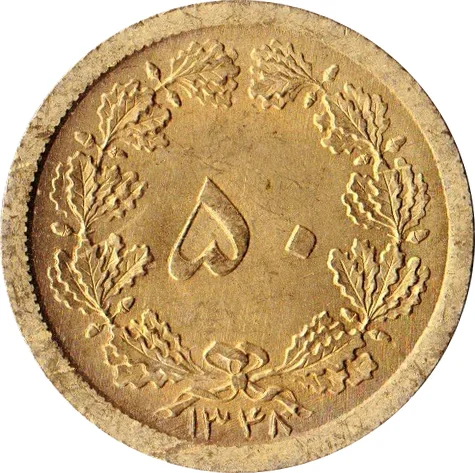
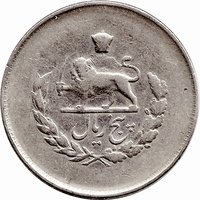
Persian lion with sword, sun behind.
Reverse
Edge
Reeded
Mints
| Name | Mark |
|---|---|
| Tehran | — |
Mintings
| Year | Mint Mark | Mintage | Quality | Collection |
|---|---|---|---|---|
| 1953 | — | 22,892,000 | ||
| 1954 | — | 4,035,820 | ||
| 1955 | — | 1,370,000 | ||
| 1956 | — | 926,000 | ||
| 1957 | — | — | ||
| 1959 | — | 20,000 | ||
| 1963 | — | 80,000 | ||
| 1964 | — | 1,400,000 | ||
| 1965 | — | 1,600,000 | ||
| 1966 | — | 1,690,000 | ||
| 1967 | — | 153,647,748 | ||
| 1968 | — | 2,000,000 | ||
| 1969 | — | 1,500,000 | ||
| 1970 | — | 360,000 | ||
| 1971 | — | — | ||
| 1972 | — | — | ||
| 1974 | — | 60,000 | ||
| 1975 | — | 16,000 |
Historical background
In 1953, Iran's currency situation was intrinsically tied to the political and economic crisis surrounding the nationalization of the Anglo-Iranian Oil Company (AIOC). The primary currency, the rial, faced severe pressure due to a British-led international boycott of Iranian oil following Prime Minister Mohammad Mossadegh's nationalization decree in 1951. This blockade crippled Iran's main source of foreign exchange earnings, leading to a sharp decline in government revenue and a growing budget deficit. By 1953, the country's foreign reserves were nearly exhausted, severely limiting its ability to finance essential imports.
The economic strain manifested in rising inflation, shortages of goods, and a contraction in economic activity. The government, unable to access oil income, resorted to printing money to cover its expenses, which further devalued the rial and eroded public purchasing power. This economic distress contributed to social unrest and became a key factor undermining Mossadegh's popular support, creating fertile ground for political opposition. The currency instability was both a symptom and a cause of the broader crisis, reflecting a state in financial isolation.
The situation reached its climax during the August 1953 coup that overthrew Mossadegh. While the immediate currency crisis was not resolved overnight, the restoration of the Shah and the subsequent 1954 oil agreement, which gave a consortium of Western companies control over Iranian oil production, reopened the flow of petrodollars. This influx of foreign exchange ultimately stabilized the rial and provided the capital for the Shah's subsequent state-led development programs, fundamentally altering Iran's economic trajectory. Thus, the currency situation of 1953 was a pivotal chapter in the transition from nationalistic economic independence to a renewed, though altered, integration into the Western-led global oil market.
The economic strain manifested in rising inflation, shortages of goods, and a contraction in economic activity. The government, unable to access oil income, resorted to printing money to cover its expenses, which further devalued the rial and eroded public purchasing power. This economic distress contributed to social unrest and became a key factor undermining Mossadegh's popular support, creating fertile ground for political opposition. The currency instability was both a symptom and a cause of the broader crisis, reflecting a state in financial isolation.
The situation reached its climax during the August 1953 coup that overthrew Mossadegh. While the immediate currency crisis was not resolved overnight, the restoration of the Shah and the subsequent 1954 oil agreement, which gave a consortium of Western companies control over Iranian oil production, reopened the flow of petrodollars. This influx of foreign exchange ultimately stabilized the rial and provided the capital for the Shah's subsequent state-led development programs, fundamentally altering Iran's economic trajectory. Thus, the currency situation of 1953 was a pivotal chapter in the transition from nationalistic economic independence to a renewed, though altered, integration into the Western-led global oil market.
🌱 Common