

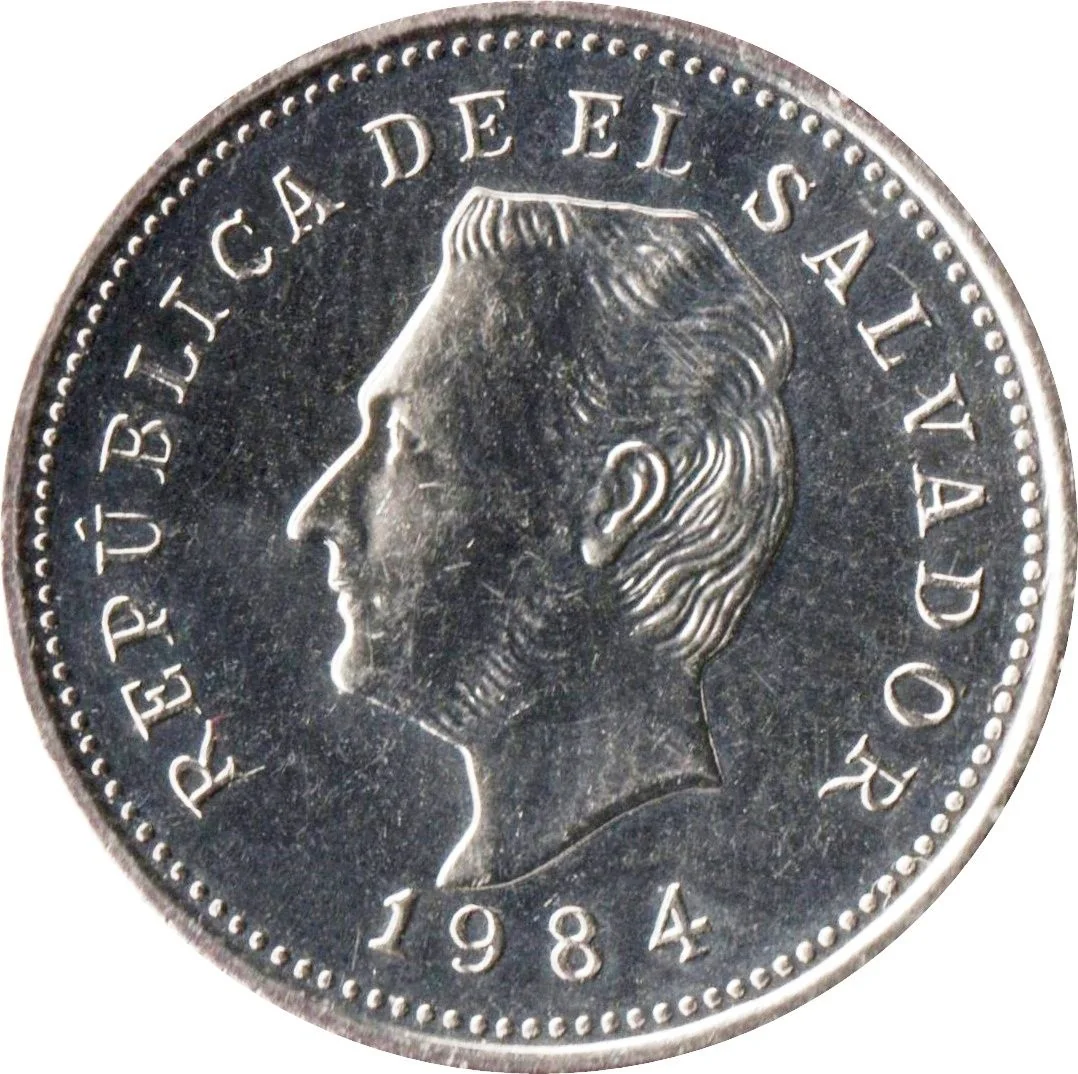
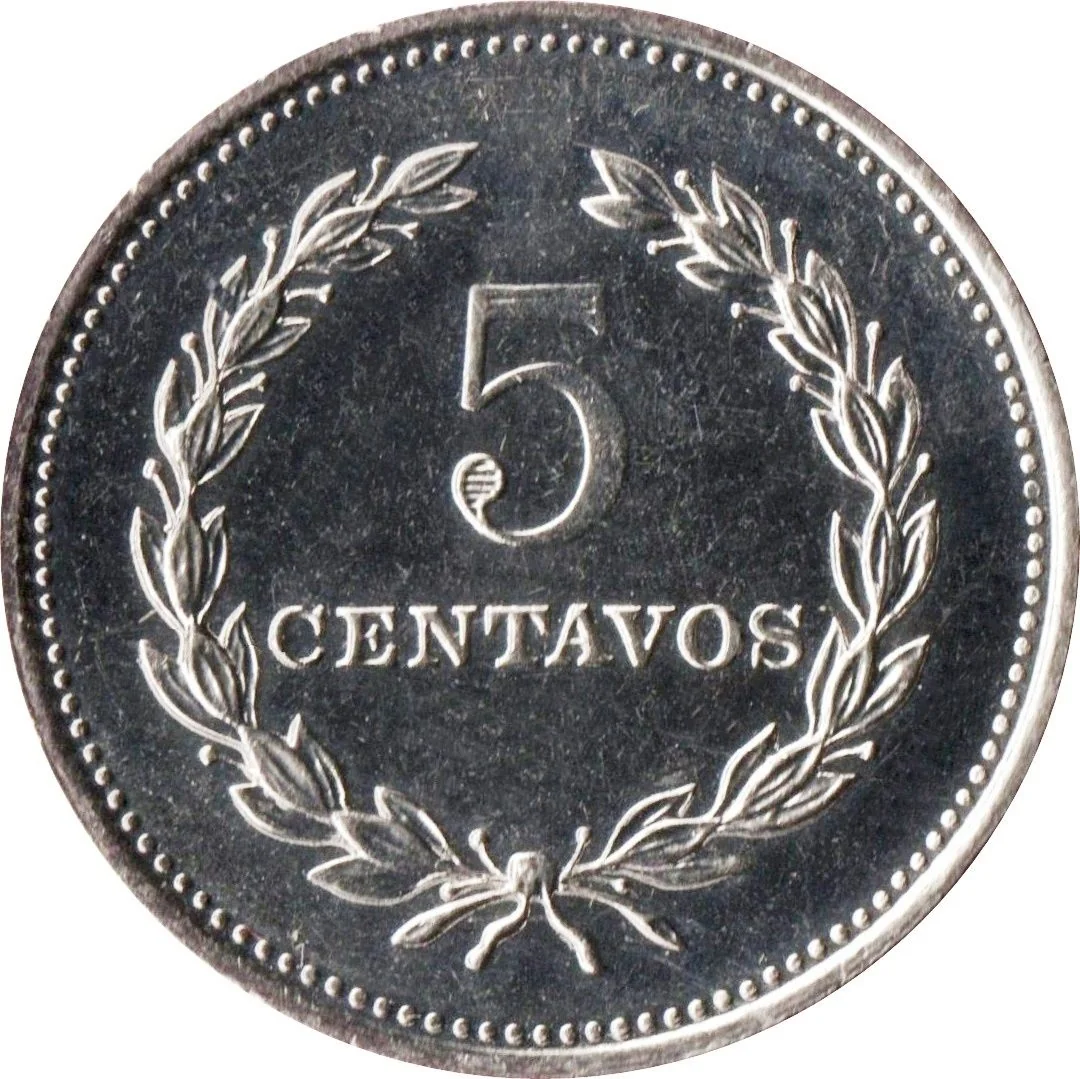
5 Centavos – El Salvador
El Salvador
Context
Years: 1976–1984
Issuer: El Salvador 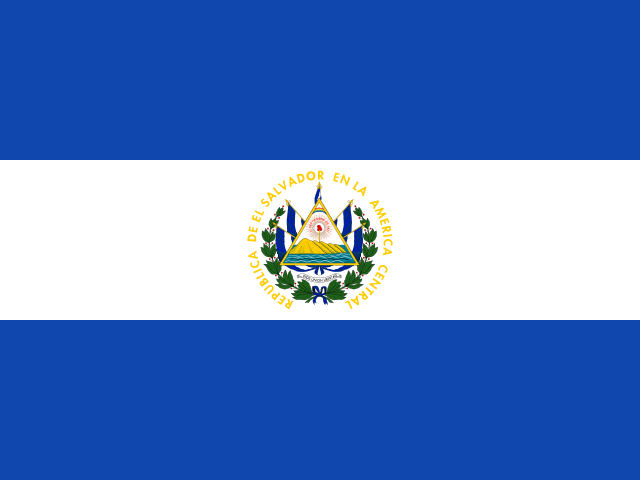
Issuing organization: Central Reserve Bank of El Salvador
Period:
(since 1841)
Currency:
(since 1892)
Demonetization: 1 January 2001
Total mintage: 30,000,000
Material
References
KM: #Click to copy to clipboard149a
Numista: #9705
Value
Exchange value: 0.05 SVC
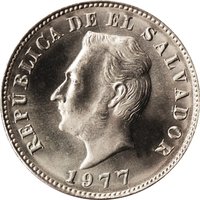
Obverse
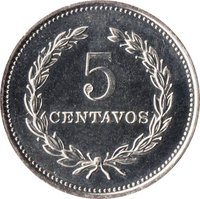
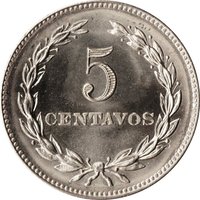
Reverse
Edge
Reeded
Categories
| Person> Politician |
| Symbol> Wreath |
Mints
| Name | Mark |
|---|---|
| Royal Mint | — |
| Sherritt Mint | — |
Mintings
| Year | Mint Mark | Mintage | Quality | Collection |
|---|---|---|---|---|
| 1976 | — | 15,000,000 | ||
| 1984 | — | 15,000,000 |
Historical background
In 1976, El Salvador operated under a fixed exchange rate system, with its currency, the colón, pegged to the United States dollar at a rate of 2.50 colones per dollar. This peg, established in 1934, provided a long period of monetary stability and was a cornerstone of the country's economic policy, which favored the powerful agricultural export sector (often called the "Fourteen Families"). This stability was crucial for coffee and sugar exporters, as it minimized exchange rate risk and facilitated predictable international trade and investment.
However, by the mid-1970s, this rigid system began to show significant strain. The country was facing mounting internal and external pressures, including rising inflation imported from the global oil shocks of 1973, increasing fiscal deficits from public spending, and growing social unrest. While the official rate remained fixed, a parallel black market for dollars emerged, indicating that the colón was overvalued. This overvaluation hurt the competitiveness of Salvadoran exports and encouraged capital flight, as individuals and businesses sought to move money abroad amid growing political uncertainty.
Consequently, 1976 was a year of quiet crisis within a decaying economic model. The government, led by President Arturo Armando Molina, resisted a formal devaluation to avoid social backlash and maintain an appearance of stability. Instead, it relied on foreign borrowing and gradual adjustments, such as introducing a small exchange tax. These measures were stopgaps, failing to address the fundamental imbalances. The currency situation thus reflected the broader pre-war tensions in Salvadoran society, where an entrenched elite defended a rigid economic structure against mounting economic realities and social inequities that would eventually contribute to the outbreak of civil war in 1979.
However, by the mid-1970s, this rigid system began to show significant strain. The country was facing mounting internal and external pressures, including rising inflation imported from the global oil shocks of 1973, increasing fiscal deficits from public spending, and growing social unrest. While the official rate remained fixed, a parallel black market for dollars emerged, indicating that the colón was overvalued. This overvaluation hurt the competitiveness of Salvadoran exports and encouraged capital flight, as individuals and businesses sought to move money abroad amid growing political uncertainty.
Consequently, 1976 was a year of quiet crisis within a decaying economic model. The government, led by President Arturo Armando Molina, resisted a formal devaluation to avoid social backlash and maintain an appearance of stability. Instead, it relied on foreign borrowing and gradual adjustments, such as introducing a small exchange tax. These measures were stopgaps, failing to address the fundamental imbalances. The currency situation thus reflected the broader pre-war tensions in Salvadoran society, where an entrenched elite defended a rigid economic structure against mounting economic realities and social inequities that would eventually contribute to the outbreak of civil war in 1979.
🌱 Common