

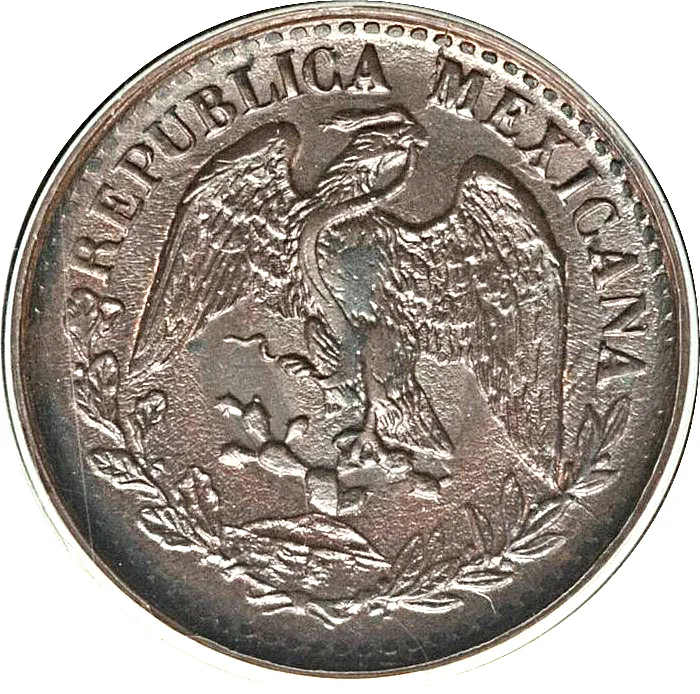
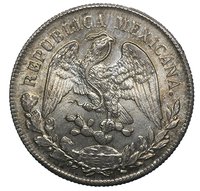
Obverse
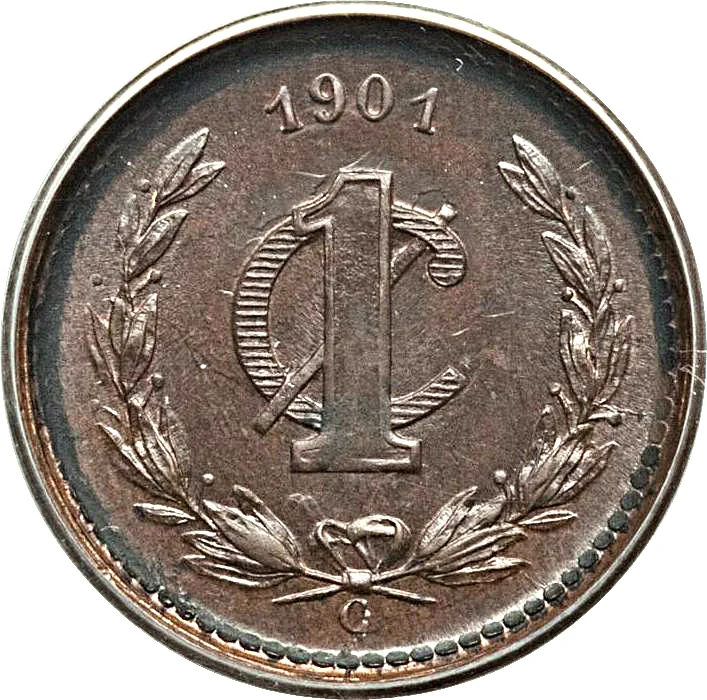
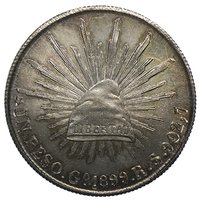
Reverse
Edge
Plain
Mintings
| Year | Mint Mark | Mintage | Quality | Collection |
|---|---|---|---|---|
| 1899 | M | 51,000 | ||
| 1900 | M | — | ||
| 1901 | C | 220,000 | ||
| 1901 | M | 1,494,000 | ||
| 1902 | C | 320,000 | ||
| 1902 | M | 2,090,000 | ||
| 1903 | C | 536,000 | ||
| 1903 | M | 8,400,000 | ||
| 1904 | C | 148,000 | ||
| 1904 | M | 10,250,000 | ||
| 1905 | C | 110,000 | ||
| 1905 | M | 3,643,000 |
Historical background
In 1899, Mexico's currency system was in a state of transition and consolidation under the prolonged authoritarian rule of President Porfirio Díaz. The period, known as the Porfiriato (1876-1911), was characterized by a drive for modernization and foreign investment, which necessitated a stable and reliable monetary system. The official currency was the silver peso, often called the "Mexican dollar," which was internationally recognized and widely traded, particularly in Asia. However, the government had been actively working to move the nation toward a gold standard to align with major global economies like the United States and Great Britain, aiming to attract further foreign capital for railroads and industry.
The monetary landscape was complex, with both silver and gold coins in circulation. A key piece of legislation, the Monetary Law of 1905, was still six years away, so in 1899 the system operated under earlier reforms. The gold peso existed but its use was not yet exclusive; much of the everyday economy still ran on silver. This created vulnerability to international fluctuations in the price of silver, which had been in decline since the 1870s. Consequently, the silver peso's value against gold-based currencies was unstable, causing periodic economic uncertainty despite the era's overall growth. The Banco de México, as a central bank, did not yet exist, with note issuance handled by several private banks of issue under government concession.
Thus, the currency situation in 1899 was one of managed duality, reflecting the contradictions of the Porfirian era itself: surface-level stability and progress underpinned by underlying metallic vulnerability and social strain. The government's push for gold was a fiscal priority to cement Mexico's place in the global financial order, but the full realization of a uniform, gold-backed currency remained a work in progress. This economic environment, favoring foreign interests and a growing domestic elite, would contribute to the financial grievances that fueled the coming Mexican Revolution in 1910.
The monetary landscape was complex, with both silver and gold coins in circulation. A key piece of legislation, the Monetary Law of 1905, was still six years away, so in 1899 the system operated under earlier reforms. The gold peso existed but its use was not yet exclusive; much of the everyday economy still ran on silver. This created vulnerability to international fluctuations in the price of silver, which had been in decline since the 1870s. Consequently, the silver peso's value against gold-based currencies was unstable, causing periodic economic uncertainty despite the era's overall growth. The Banco de México, as a central bank, did not yet exist, with note issuance handled by several private banks of issue under government concession.
Thus, the currency situation in 1899 was one of managed duality, reflecting the contradictions of the Porfirian era itself: surface-level stability and progress underpinned by underlying metallic vulnerability and social strain. The government's push for gold was a fiscal priority to cement Mexico's place in the global financial order, but the full realization of a uniform, gold-backed currency remained a work in progress. This economic environment, favoring foreign interests and a growing domestic elite, would contribute to the financial grievances that fueled the coming Mexican Revolution in 1910.
🌱 Common