

20 Paisa – Nepal
Circulating commemorative coins
Commemoration: F.A.O.
Nepal
Context
Year: 1978
Vikram Samvat Year: 2035
Issuer: Nepal 
Ruler: Birendra Bir Bikram Shah
Currency:
(since 1932)
Total mintage: 234,079
Material
References
KM: #Click to copy to clipboard813
Numista: #9691
Value
Exchange value: 0.20 NPR
Obverse
Description:
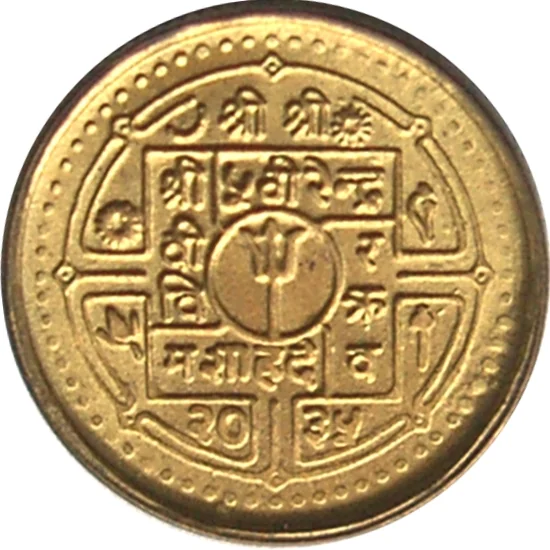
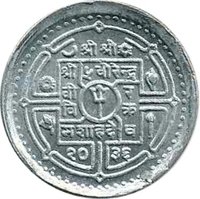
Central circle: Trident. Square interior: King Birendra's name. Exterior: Hindu symbols—Chakra, Shank, Gadha, Padma—clockwise from top left. Top: Crescent, Sri symbol, Sun. Bottom: Year.
Inscription:
श्री श्री
श्री ५ वीरेन्द्र
वी र
वि क्र
म शाहदे व
२०३५
श्री ५ वीरेन्द्र
वी र
वि क्र
म शाहदे व
२०३५
Translation:
Shri Shri
Shri 5 Virendra
Ve Ra
Vi Kra
Ma Shahadeva
2035
Shri 5 Virendra
Ve Ra
Vi Kra
Ma Shahadeva
2035
Reverse
Description:
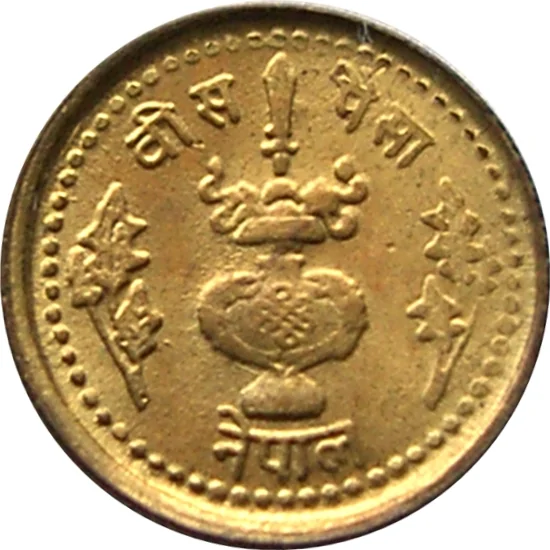
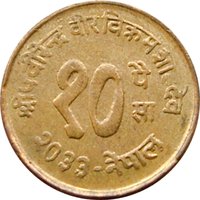
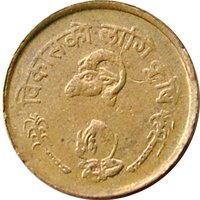
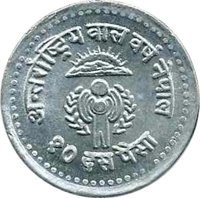
Akshaya Patra Dagger, 20 Paisa Nepal
Inscription:
वीस पैसा
नेपाल
नेपाल
Translation:
Twenty-five paisa
Nepal
Nepal
Language: Nepali
Edge
Reeded
Categories
| Organization> FAO |
Mintings
| Year | Mint Mark | Mintage | Quality | Collection |
|---|---|---|---|---|
| 1978 | — | 234,079 |
Historical background
In 1978, Nepal's currency situation was characterized by its fixed exchange rate system and close monetary ties to India, a relationship formalized in 1960. The Nepalese rupee (NPR) was pegged to the Indian rupee (INR) at a rate of 1:1.25, with 1.6 NPR equaling 1 INR. This peg facilitated extensive cross-border trade, as India was Nepal's dominant economic partner, but it also meant Nepal's monetary policy was largely dictated by India's economic conditions and decisions made by the Reserve Bank of India. This linkage provided stability but limited Nepal's independent control over its money supply and inflation.
The decade leading up to 1978 saw significant institutional development. The Nepal Rastra Bank (NRB), established in 1956, was gaining experience as the central bank. A key milestone was the issuance of the "Nepal Rastra Bank Act, 1974," which strengthened the NRB's regulatory authority. Furthermore, the "Foreign Exchange Regulation Act of 1978" was enacted, marking a step toward managing foreign currency reserves and transactions more systematically, though the economy remained heavily influenced by India and dependent on agriculture and remittances.
Economically, the period was one of relative stability but within a framework of a tightly controlled and underdeveloped financial system. The fixed peg simplified trade but also exposed Nepal to imported inflation from India. The currency itself was not freely convertible on international markets, and foreign exchange reserves were managed cautiously. Thus, in 1978, Nepal's currency regime was stable yet dependent, operating within a structured but constrained system that balanced the benefits of economic integration with India against the need for gradual moves toward greater monetary autonomy.
The decade leading up to 1978 saw significant institutional development. The Nepal Rastra Bank (NRB), established in 1956, was gaining experience as the central bank. A key milestone was the issuance of the "Nepal Rastra Bank Act, 1974," which strengthened the NRB's regulatory authority. Furthermore, the "Foreign Exchange Regulation Act of 1978" was enacted, marking a step toward managing foreign currency reserves and transactions more systematically, though the economy remained heavily influenced by India and dependent on agriculture and remittances.
Economically, the period was one of relative stability but within a framework of a tightly controlled and underdeveloped financial system. The fixed peg simplified trade but also exposed Nepal to imported inflation from India. The currency itself was not freely convertible on international markets, and foreign exchange reserves were managed cautiously. Thus, in 1978, Nepal's currency regime was stable yet dependent, operating within a structured but constrained system that balanced the benefits of economic integration with India against the need for gradual moves toward greater monetary autonomy.
🌱 Common